
Grant Gardner and Matthew Dixon write in Southern Ag Today: Large-scale climate patterns can shift the odds toward wetter, drier, warmer, or cooler conditions over several months. For winter 2026‑27, all eyes are on El Niño, a phase of the El Niño-Southern Oscillation (ENSO) pattern in the equatorial Pacific that influences weather around the world. NOAA’s Climate Prediction Center has an El Niño Advisory in place, with better than an 83 percent chance that a strong to very strong event holds through March and a similarly high chance that October through December will exceed the intensity of any El Niño since 1950 (NOAA-CPC, 2026). This article investigates what past strong El Niño winters have meant for the crop that followed.
There have been nine strong El Niño winters since 1950 (NOAA-CPC, n.d.). This article analyzes eight of them, removing the 1982‑83 El Niño because the 1983 drought that followed was a significant outlier event. In each instance, the following year’s crop yield is compared with a normal trend-line expected yield to estimate a potential yield impact. Figures 1 through 4 represent those average impacts as a percentage above or below normal (USDA-NASS, 2026). Blue states yielded better than normal, red states yielded worse. The outlined states are those where the difference is larger than the state’s normal year-to-year swing would explain, the standard for calling a result statistically significant.
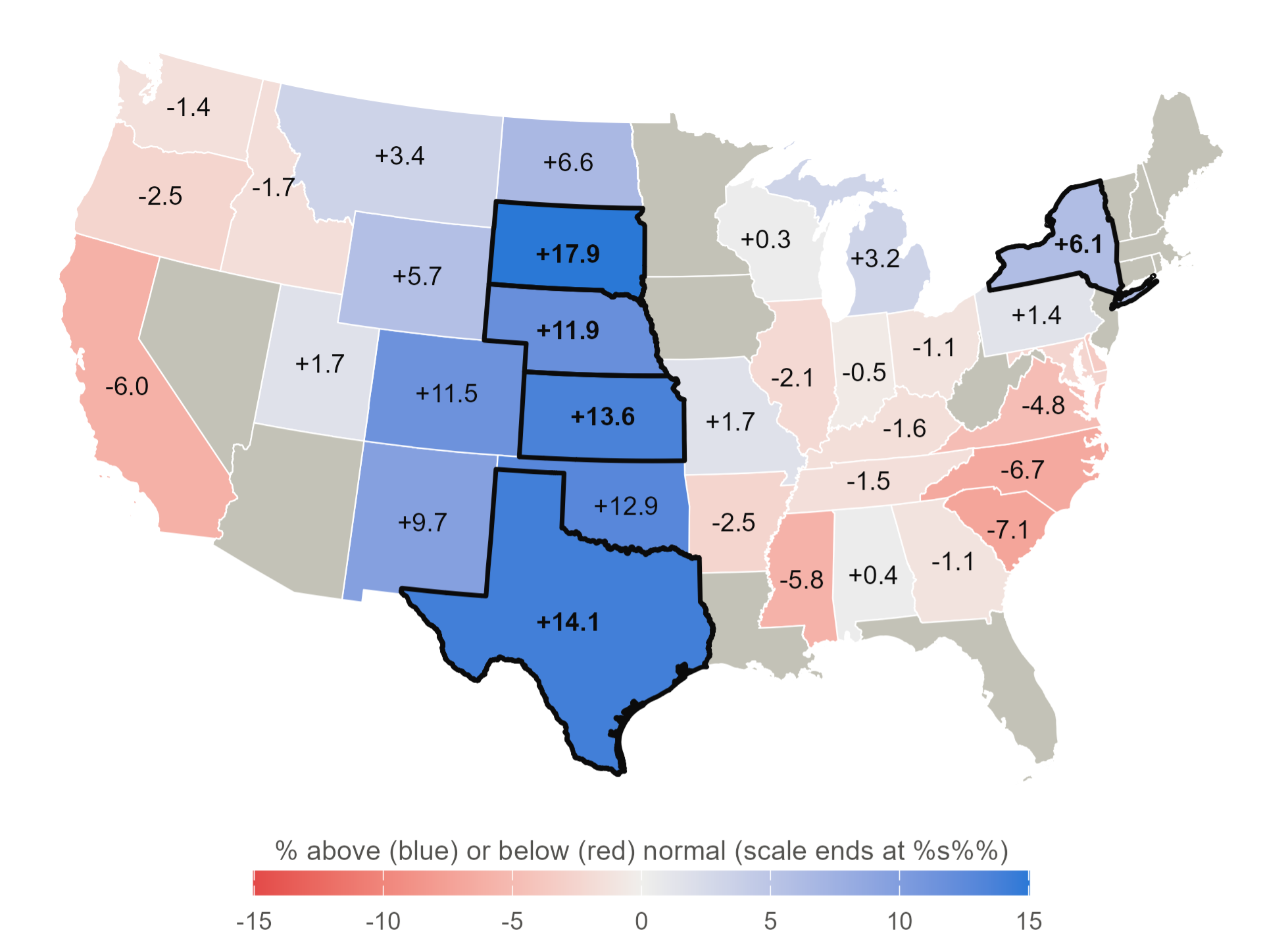
The strongest impact shows up in winter wheat in the Plains (Figure 1). In the years after strong El Niño winters, wheat averaged about 18 percent above normal in South Dakota, 14 percent in Texas, 14 percent in Kansas, 13 percent in Oklahoma, 12 percent in Nebraska, and 12 percent in Colorado. South Dakota, Nebraska, and Texas were above normal in seven of the eight years. That fits expectations, since El Niño winters tend to bring above normal rain to the southern Plains and milder conditions to the north (Welch, 2025). NOAA’s winter outlook for 2026‑27 shows the same pattern, with wetter than average odds across the southern tier and warmer than average odds across the north (NOAA, 2026). The 2024 crop was the last example, with winter wheat condition ratings well above average coming out of that El Niño winter (Welch, 2024). Outside those states, the gain is negligible. Wheat is flat through the Corn Belt and slightly negative in the Southeast, about 2 percent under normal in Kentucky and 7 percent under in the Carolinas.
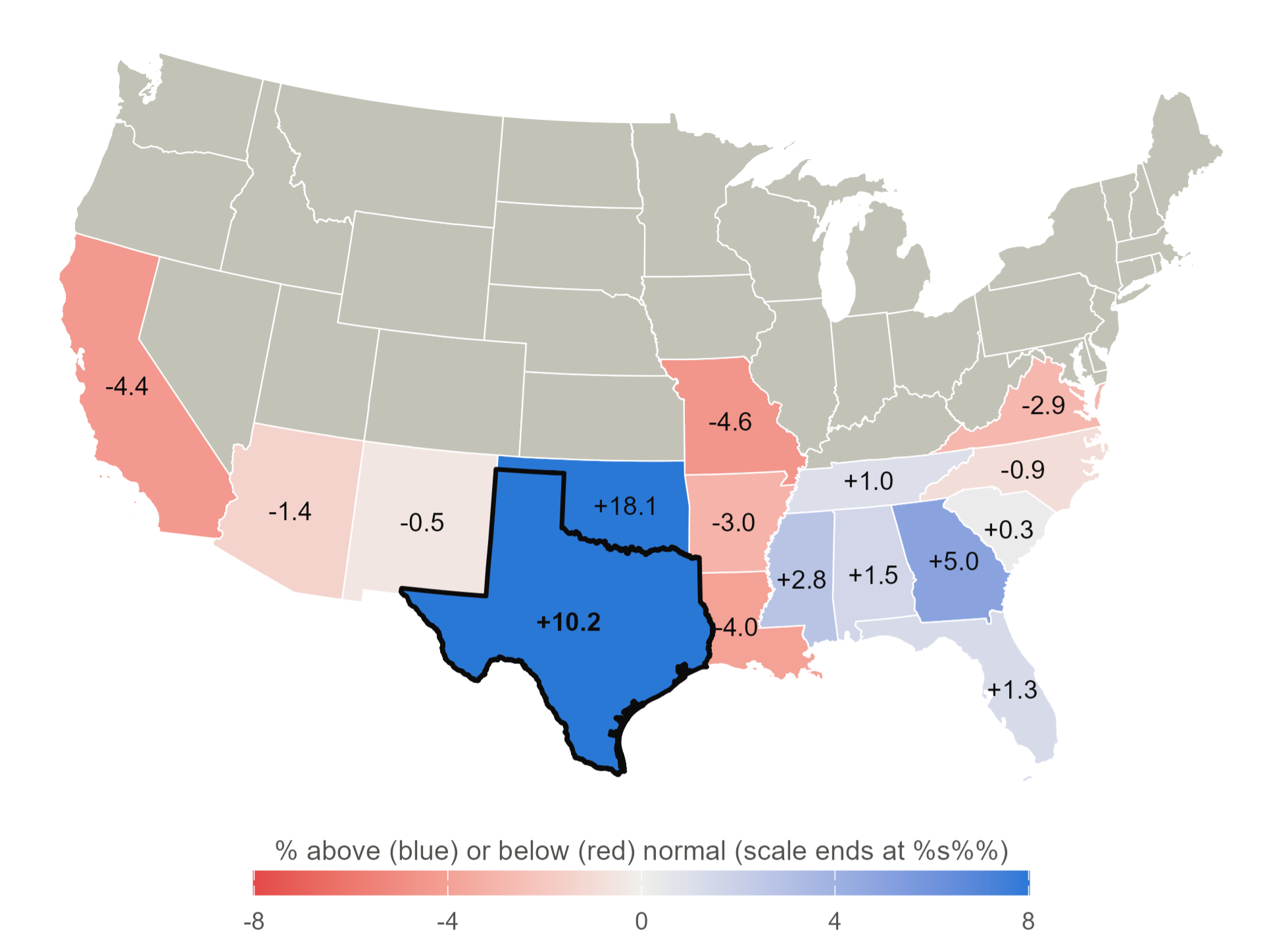
Cotton shows a similar impact in the same region (Figure 2). Texas averaged about 10 percent above normal in the years after these winters, above normal in six of the eight and steady across them, and it is the only cotton state where the gain is larger than normal variation would explain. Oklahoma averaged more, 18 percent, but three years carry it, 1958, 1973, and 2016, and without them the average is about 1 percent. Georgia averaged 5 percent above normal and Mississippi 3, both inside the normal swing, while California, Missouri, Louisiana, and Arkansas averaged 3 to 5 percent under. Texas grows 37 percent of the U.S. crop, much of it dryland on the High Plains, where a wet winter recharges the soil profile before planting.
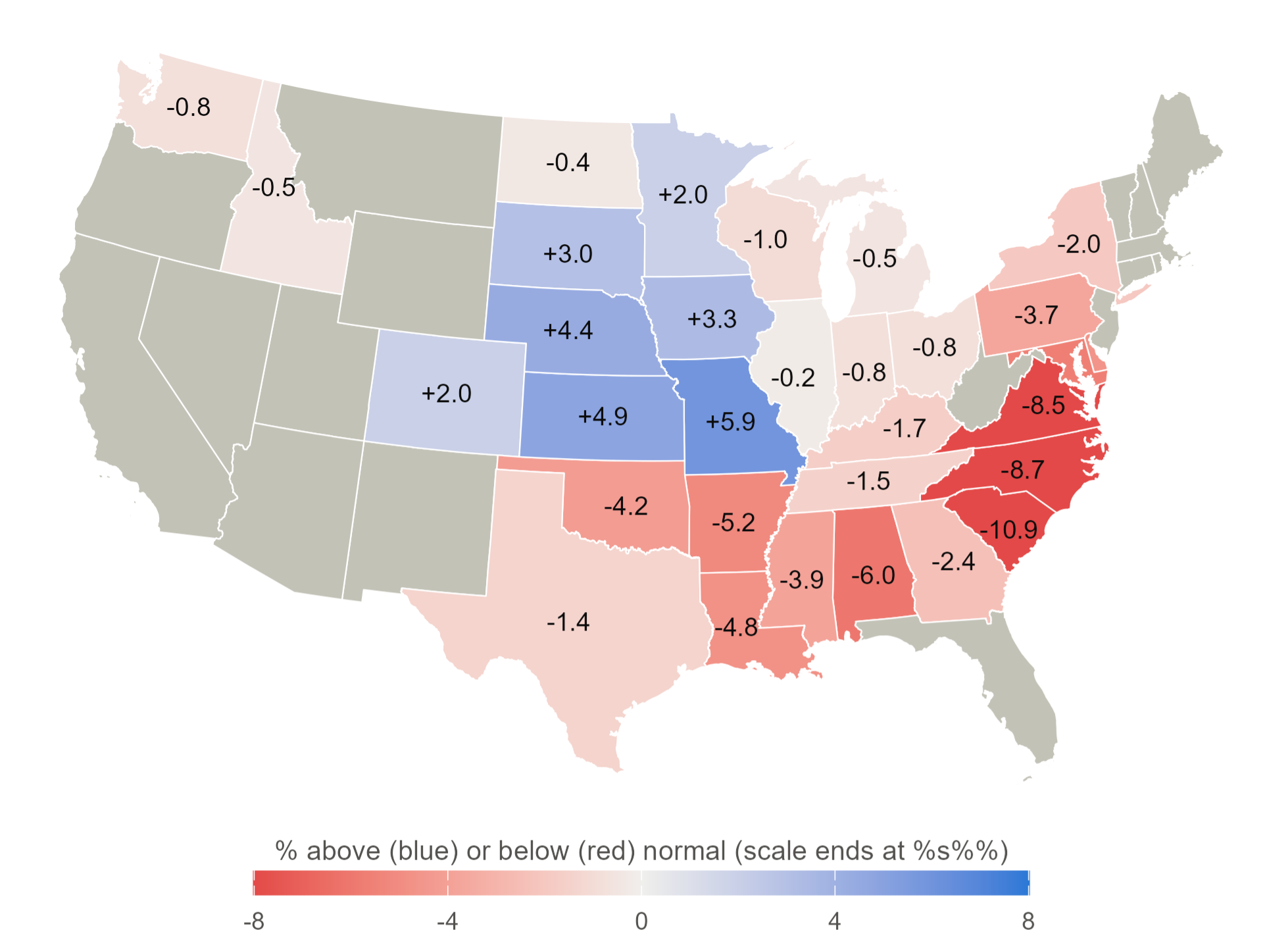
Corn is another story (Figure 3). No state stands out, but the map splits west from east. Missouri, Kansas, and Nebraska averaged 6 percent, 5 percent, and 4 percent above normal, while Illinois, Indiana, Ohio, and Kentucky came in within about 2 percent of normal and the Atlantic states ran 9 to 11 percent under. The South in general sees lower corn yields after strong El Niño winters, and the results are progressively worse moving east, but no state moves more than its normal year-to-year swing, making it a tilt in the odds rather than a number to plan around.
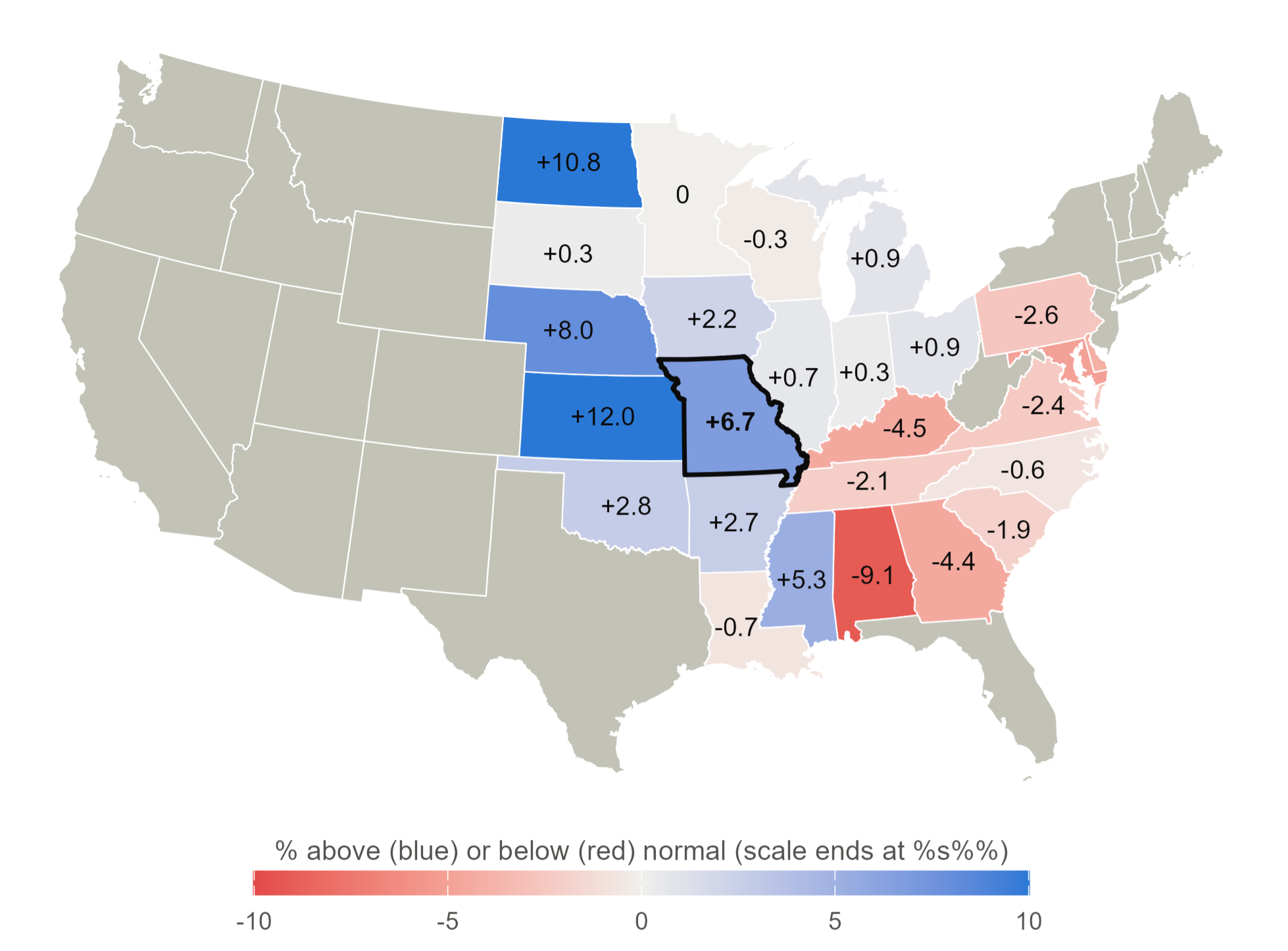
Soybean impacts are mixed (Figure 4). Kansas averaged 12 percent above normal, North Dakota 11, Nebraska 8, and Missouri 7, though only Missouri’s gain is larger than that state’s normal year-to-year variation. Kentucky, Tennessee, and Alabama averaged 2 to 9 percent under normal, again inside the usual swing. For corn and soybeans, a strong El Niño winter is not a reason to move acres or budget a different yield in 2027.
What has mattered for corn and soybeans shows up later. The El Niño pattern was gone by the following summer every time, and in three of the nine years (1973, 1998, and 2010) La Niña had taken hold by June, July, or August (NOAA-CPC, n.d.). Those summers hurt: U.S. corn averaged about 4 percent under normal, Kentucky corn 8 percent under, and Kentucky soybeans 8 percent under. That makes next spring’s outlook worth watching, while insurance and input decisions are still open.
While this El Niño is stronger than anything on record, the numbers above represent a direction, not a specific yield to budget. USDA will hold trend yields until the August surveys regardless of what the winter does (Gardner, 2026). The same winter that favors wheat and cotton in Texas and the southern Plains tends to work against corn in the Southeast, something to weigh on diversified southern acres. For now, southern Plains wheat and cotton growers may plan accordingly, with top-dress nitrogen, fungicide plans, and harvest and storage capacity set up for a better than normal crop, while corn and soybean growers have little reason to act before spring.
Figure 1. Winter wheat in the year after a strong El Niño winter, the crop that grew through the winter. Percent above (blue) or below (red) a normal year for that state, averaged over eight El Niño winters. Outlined states stand out from normal variation; gray states grow little or no wheat.
Source: USDA NASS; NOAA Climate Prediction Center.
Figure 2. Cotton in the year after a strong El Niño winter, planted the following spring. Percent above (blue) or below (red) a normal year for that state, averaged over eight El Niño winters. Outlined states stand out from normal variation; gray states grow little or no cotton.
Source: USDA NASS; NOAA Climate Prediction Center.
Figure 3. Corn in the year after a strong El Niño winter, planted the following spring. Percent above (blue) or below (red) a normal year for that state, averaged over eight El Niño winters. Outlined states stand out from normal variation; gray states grow little or no corn.
Source: USDA NASS; NOAA Climate Prediction Center.
Figure 4. Soybeans in the year after a strong El Niño winter, planted the following spring. Percent above (blue) or below (red) a normal year for that state, averaged over eight El Niño winters. Outlined states stand out from normal variation; gray states grow little or no soybeans.
Source: USDA NASS; NOAA Climate Prediction Center.
References
Gardner, Grant. “July 2026 WASDE: Acreage Moves in July, Yields Move in August.” Southern Ag Today, July 15, 2026. https://southernagtoday.org/2026/07/15/july-2026-wasde-acreage-moves-in-july-yields-move-in-august/
National Oceanic and Atmospheric Administration (NOAA). “El Nino Looms Large Over U.S. Winter Outlook.” October 15, 2026. https://www.noaa.gov/news-release/el-nino-looms-large-over-us-winter-outlook
National Oceanic and Atmospheric Administration, Climate Prediction Center (NOAA-CPC). “ENSO Diagnostic Discussion.” October 8, 2026. https://www.cpc.ncep.noaa.gov/products/analysis_monitoring/enso_advisory/ensodisc.shtml
National Oceanic and Atmospheric Administration, Climate Prediction Center (NOAA-CPC). “Oceanic Niño Index (ONI).” Accessed September 11, 2026. https://www.cpc.ncep.noaa.gov/data/indices/oni.ascii.txt
U.S. Department of Agriculture, National Agricultural Statistics Service (USDA-NASS). “Quick Stats.” Accessed September 11, 2026. https://quickstats.nass.usda.gov/
Welch, J. Mark. “2026 Wheat Outlook.” Southern Ag Today, December 17, 2025. https://southernagtoday.org/2025/12/17/2026-wheat-outlook/
Welch, J. Mark. “An Early Look at 2024 Production Expectations for U.S. Wheat and Sorghum.” Southern Ag Today, April 22, 2024. https://southernagtoday.org/2024/04/22/an-early-look-at-2024-production-expectations-for-u-s-wheat-and-sorghum/
Gardner, Grant, and Matthew Dixon. “What Does a Strong El Niño Winter Mean for Next Year’s Crop Yields?” Southern Ag Today