
members from throughout the nation gathered in Palm Springs, Calif., Wednesday for the organization’s annual Strategic Planning Conference. The meeting attracted a record number of participants as USMEF celebrated its 50th anniversary.
USMEF Chair Jay Theiler, executive vice president of Idaho-based Agri Beef Co., welcomed the group by paying tribute to those who founded the organization a half-century ago.
“We all owe a debt of gratitude to the past leaders of USMEF for their vision of foresight, which made possible these 50 years of growth and success,” Theiler said. “But to properly honor their legacy, we need to keep our eye on the future and continue to build on USMEF’s strengths. One of our greatest strengths is our diverse membership, bringing many sectors of U.S. agriculture together to work toward a common goal.”
USMEF President and CEO Dan Halstrom, who began his career as an exporter more than 40 years ago, echoed this theme, noting the enormous obstacles the U.S. meat industry faced decades ago, when access to global markets was severely limited and exports accounted for just a small fraction of total production and sales.
Halstrom highlighted Latin America as a shining example of how market access gains achieved through free trade agreements can pave the way for tremendous pork and beef export growth. He cited Central America, Colombia and the Dominican Republic as markets that were once extremely price-driven, but now consumers crave the quality, consistency and versatility of higher-value red meat cuts.
“Look at the growth of U.S. pork exports into these markets in the last 15 years – it’s just amazing,” he said. “Pork to Colombia this year is on track to be over $400 million, and Central America could seriously touch $700 million. That’s the fastest growing area in the world for pork. And when we look at beef, there was a time in the Dominican Republic when beef pricing made it tough to sell anything. But now there’s a growing middle class with more spending power and a greater appreciation for quality.”
Halstrom also addressed the importance of developing new products – including protein snacks – that appeal to consumers whose top priority is convenience. He specifically cited recent success for U.S. pork in Mexico’s convenience store sector.
“Just a few years ago we had nothing going on in these stores,” Halstrom explained. “But now there are eight different U.S. pork items at 22,000 Oxxo stores in Mexico and about 8,000 7-Elevens. This is exactly the sort of thing we need more of – value-added products that appeal to young consumers.”
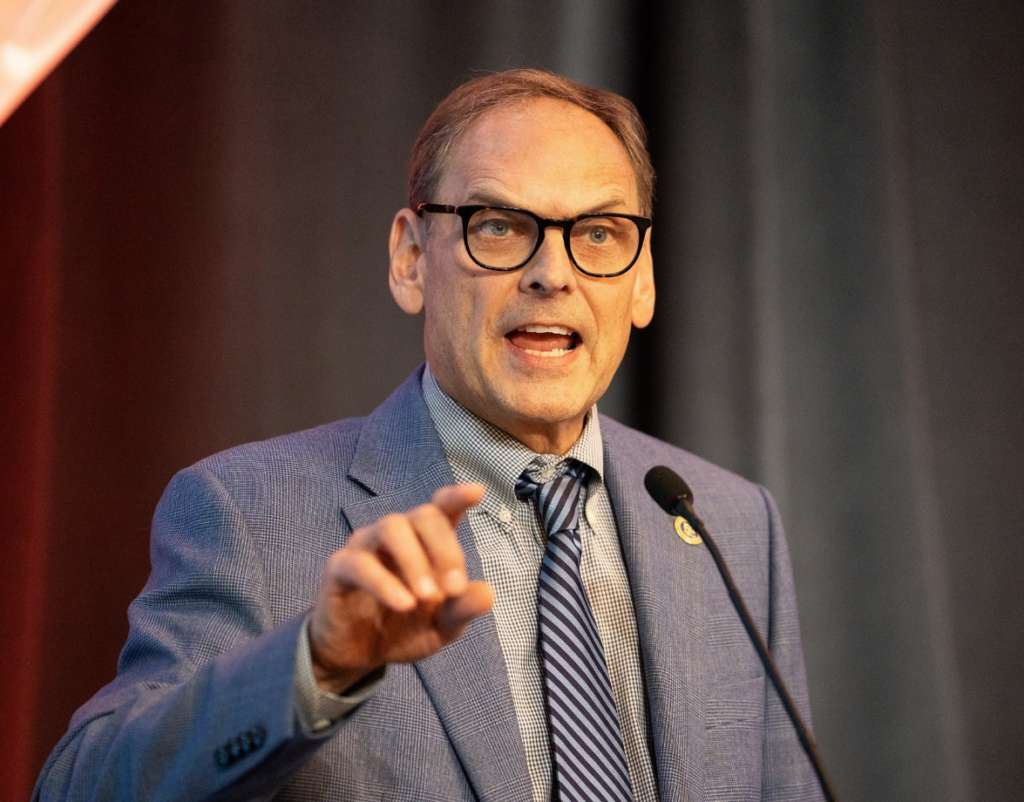
USMEF members then heard from the event’s keynote speaker, geopolitical strategist and author Peter Zeihan, who discussed global trade, energy security and the economic implications of lower birth rates and aging populations around the world.
While noting that beef and pork exports have achieved tremendous success in north Asia, Zeihan explained that demographic trends in the region underscore the importance of market diversification for the U.S. meat industry.
“In Japan, Korea and China, they now have three times as many people in their 50s as they have children,” Zeihan said. “This is a market that is going to shrink – it has to shrink. Taiwan’s the best of the batch, and it doesn’t exactly look great.”
Zeihan cited Southeast Asia as a promising region for long-term growth, specifically highlighting Indonesia and Vietnam. He noted that U.S. trade officials are pursuing market access improvements in this region that could eliminate trade barriers for U.S. red meat, but warned that more resources may be needed for these efforts to be successful.
“Here’s a complication: the way the United States is now pursuing trade deals, framework agreements, sectorial agreements, things that don’t have to go through Congress – they don’t have to be ratified,” Zeihan explained. “So why would [trading partners] abide by them? Any U.S. deal that is a framework or a sectoral deal has to be enforced every single day. The Office of the U.S. Trade Representative, at its height in post-war world, only had 300 staff. Now it’s closer to 200. You know how many Australia has? Six thousand.”
The conference continues Thursday with a panel discussion featuring CattleFax CEO Randy Blach, National Pork Board CEO Dr. David Newman, Iowa Corn Promotion Board CEO Craig Floss, Interra International founder and CEO Steve Isaf and Jihae Yang, who oversees USMEF’s operations in the Asia Pacific. The meeting will conclude on Friday with the election of a new USMEF officer team.