

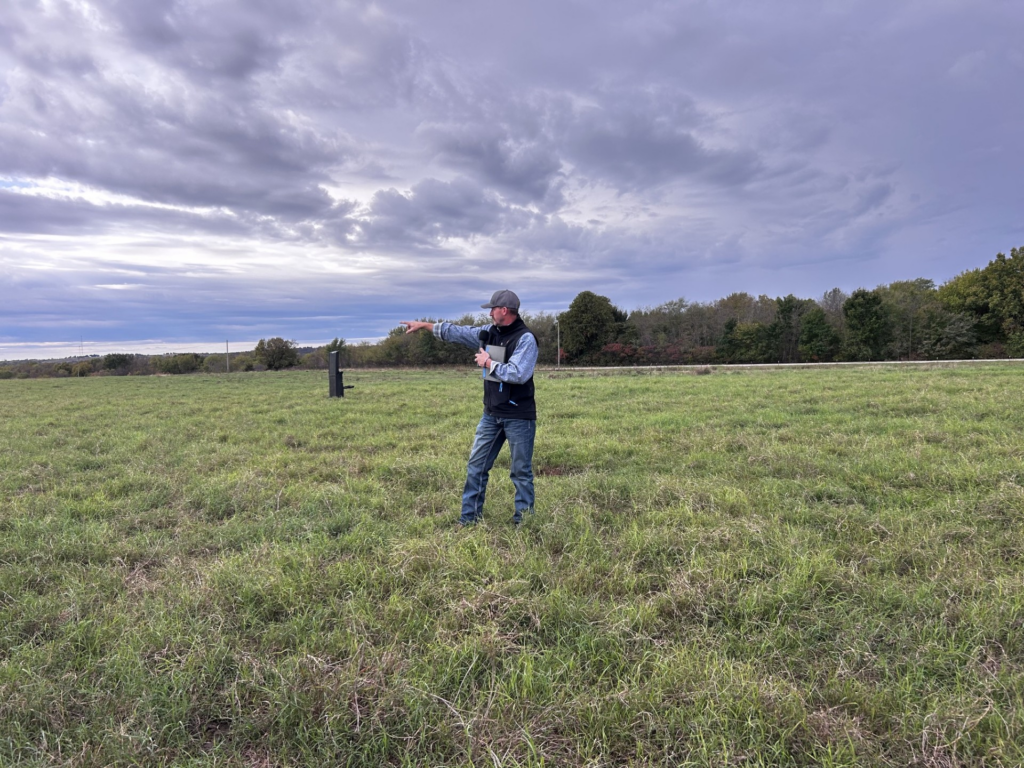
Stockpiled Bermuda grass can help Oklahoma cattle producers reduce winter hay and supplementation costs while making better use of the forage already growing on their operations. During the Oklahoma State University Livestock Range and Field Day, OSU Extension Forage Specialist Brian Pugh spoke with Associate Farm Reporter Carli Davenport about how producers can prepare Bermuda grass for fall and winter grazing.
Pugh said one of the biggest advantages of stockpiling Bermuda grass is its potential to shorten the amount of time cattle producers need to feed hay and supplements during the winter. “I think probably the number one most important thing about stockpiled Bermuda grass is its ability to reduce the hay and supplementation season of our cow herds,” Pugh said.
He explained that with input costs continuing to change, producers are looking for ways to make their operations more efficient. “With all the changes we’re seeing in input costs, fuel, labor, machinery, that’s the name of the game is making the cow do more of the work,” Pugh said.
Preparing Bermuda Grass for Fall and Winter Grazing
For producers interested in stockpiling Bermuda grass, Pugh recommended starting with some of the better-quality ground on their operations.
He said soil testing can help producers identify fields that are more likely to respond well to fall stockpiling. “I would recommend they look at some of their better quality ground and base that on a soil test,” Pugh said. “Typically, we see better response in fall stockpiling on that better quality soil.”
Pugh also emphasized the importance of preparing the pasture before applying fertilizer. Producers should have their fields grazed short or mow hay meadows down before the end of August so they are ready for fertilization.
Having the pasture prepared allows producers to get started on the stockpiling process ahead of the fall and winter grazing season.
Stockpiled Bermuda Grass Can Improve the Bottom Line
Beyond reducing the amount of hay producers need to put up or purchase, Pugh said stockpiling Bermuda grass can provide meaningful savings on a per-cow basis. “We typically say for every day that we’re going to be grazing a cow on stockpiled fertilized and stockpiled Bermuda grass, we’re going to save about $1 per cow per day over your typical hay and supplement costs,” Pugh said.
He described that savings as a significant opportunity for producers who are willing to let cattle harvest their own forage rather than relying as heavily on harvested hay and supplemental feed. “It’s a huge change to their bottom line if they look at, again, making that cow go out and harvest her own forage,” Pugh said.
How Long Will Stockpiled Bermuda Grass Last?
The length of time producers can graze stockpiled Bermuda grass depends heavily on fall weather conditions, forage production and stocking rates.
Under fairly average fall rainfall conditions, Pugh said producers stocking at approximately one acre per cow can expect around 45 to 60 days of grazing.
That estimate is based on applying 50 pounds of nitrogen per acre, which Pugh said can produce approximately one ton of forage per acre during the fall.
However, rainfall patterns can change how long that forage remains usable. “If we have wet falls, that forage quality goes down a little faster,” Pugh said. “We need to use it a little quicker. We need to move through it quicker.”
On the other hand, dry fall conditions and early winter weather can allow producers to stretch their stockpiled forage further. “If we have very dry falls and early winters, we may be able to last all the way into the end of January before we need to move to another forage resource or to hay and supplement,” Pugh said.
Pugh Encourages Producers to Start Small
For producers who have not tried stockpiling Bermuda grass, Pugh recommended starting with a smaller field rather than immediately making a large investment across their entire operation.
He acknowledged that fertilizer costs can make the practice a difficult decision for producers, especially when the expense comes out of pocket during the fall.
However, he said producers can test the practice on a smaller scale before incorporating it into their overall grazing system. “What I would recommend that a producer does is don’t start at one acre per cow. Maybe just take one small field, fertilize it in the fall, and prove to yourself first that it works,” Pugh said.
Pugh noted that OSU has 30 years of research data demonstrating the benefits of stockpiled Bermuda grass. He has also worked with large-scale operations that have incorporated the practice into their annual grazing plans. “I’ve worked with producers all the way up to 1,200-cow herds that use stockpile Bermuda every year because it saves them so much money,” Pugh said.
Ultimately, he encouraged producers to gain experience with the practice on a smaller scale before expanding. “I think the proof is always in the pudding for most producers,” Pugh said. “So start small, prove to yourself that it works, and then go ahead and incorporate that into your grazing system at about an acre per cow.”