
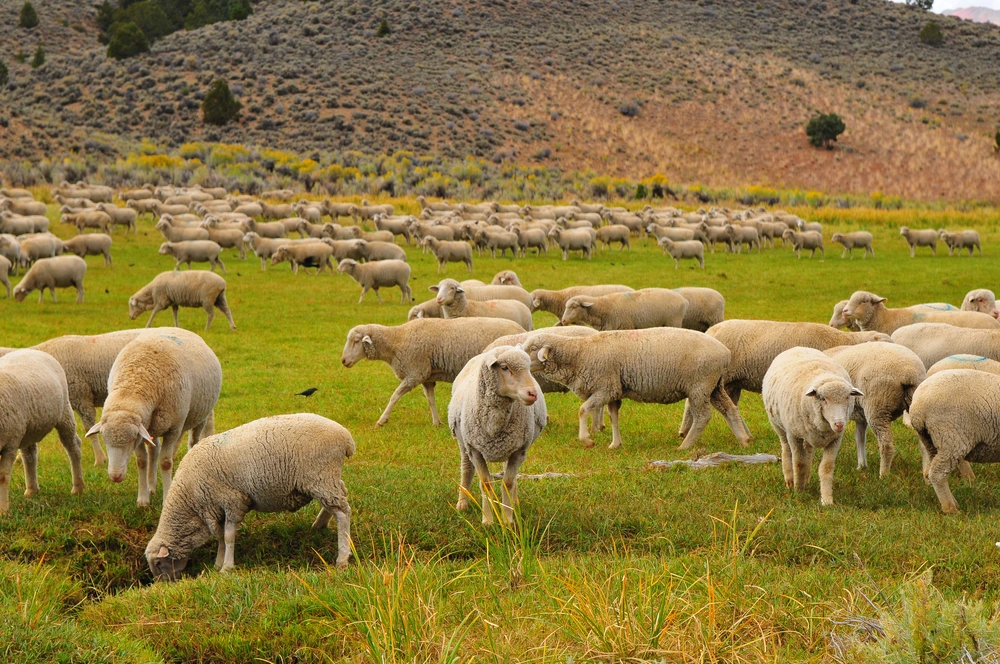
R-CALF USA today welcomed the advancement of the lamb meat global safeguard investigation to the remedy phase following the U.S. International Trade Commission’s equally divided determination on injury. Under the safeguard process, a tie vote allows the case to proceed to the remedy phase, keeping open the opportunity for relief for America’s sheep producers.
“This is an important step forward for the sheep producers who have watched imports take over their market while family operations disappear,” said R-CALF USA CEO Bill Bullard. “Today’s decision opens the door to relief that can give American producers an opportunity to rebuild.”
R-CALF USA began this effort on August 3, 2023, when Protect American Lamb, then a project under its Sheep Committee, petitioned the Office of the U.S. Trade Representative for relief from injurious lamb and mutton imports and requested a global safeguard investigation. Producer endorsements, county resolutions and bipartisan congressional support followed. The Commission formally initiated the current lamb-meat investigation on July 13, 2026, at USTR’s request.
The American Sheep Industry Association, Protect American Lamb (PAL), Cowboy Meat Company and R-CALF USA worked together to represent the domestic sheep industry. R-CALF USA also recognized attorney Charles Benoit of the Law Office of Charles Benoit, counsel for PAL and Cowboy Meat Company, for assisting R-CALF USA throughout the hearing process.
R-CALF USA and its domestic partners defended American sheep producers in an investigation whose parties included nine foreign governments and the European Union. Australia, New Zealand and the United Kingdom challenged the case for safeguard relief, while Chile and Spain sought exclusions for their exports or products. The domestic industry also faced formidable opposition from foreign producer and meat-industry organizations, including Meat & Livestock Australia, Sheep Producers Australia, Beef + Lamb New Zealand and the Meat Industry Association of New Zealand.
A global safeguard investigation under the Trade Act of 1974 examines whether increased imports are seriously injuring, or threatening serious injury to, a domestic industry. Commonly called a Section 201 investigation, it covers imports from all sources and can lead to temporary relief to help the industry adjust to import competition. It does not require proof of dumping, foreign subsidies or another unfair trade practice.
The statutory test is whether increased imports are a substantial cause of serious injury, or the threat of serious injury, to the domestic industry. Serious injury means significant overall impairment of the industry. Imports must be an important cause, no less important than any other individual cause. R-CALF USA’s case addressed drought, production costs and other pressures while documenting the separate harm caused by imports.
R-CALF USA’s October 8 prehearing brief traced how lost sales of American lamb meat reduce processors’ purchases of domestic lambs and feeders’ purchases from ranchers. Its October 23 posthearing brief reinforced that evidence, answered the Commission’s questions and challenged arguments that imports merely filled a domestic supply shortage. Both briefs urged the Commission to include sheep growers and lamb feeders when evaluating injury to the domestic industry.
The posthearing brief cited Commission data showing that U.S. lamb consumption increased 17.3 percent from 2021 through 2025 while reported shipments made from domestic lamb fell 10.5 percent. Imports undersold domestic lamb in 144 of 154 quarterly product-price comparisons.
At the October 16 injury hearing, Carson Jorgensen, a Utah sheep rancher and chair of PAL, described processors asking him to lower his price to match imports. Michael Bardsley, representing John Espil Sheep Company and testifying for R-CALF USA, described losing established buyers and selling only half his lamb crop in fall 2022, receiving less than half the previous year’s price per pound on those sales.
“The import price is the ceiling, and everything I can pay a rancher sits underneath it,” testified Charlie Hollenbeck, president and CEO of Cowboy Meat Company in Forsyth, Montana.
The Commission’s remedy hearing is scheduled for December 1, 2026. Its report and remedy recommendations are due to the President by January 11, 2027. After receiving that report, the President will make the final decision on whether to provide relief and, if so, its form and duration. Today’s equally divided determination does not itself impose tariffs or quotas.
“We view this action as vitally important because the sheep industry is the canary in the coal mine for America’s cattle industry,” Bullard said. “Our cattle producers are suffering similar harm from imports, but their industry is not yet as far along the path of decimation as the sheep industry.”
“If we can reverse the course of the domestic sheep industry, our chances of securing the reforms needed for the cattle industry are greatly enhanced,” Bullard continued. “Restoring opportunities for American sheep producers can help show the way toward rebuilding both industries.”
Editor’s note: R-CALF USA will update this release as additional details become available from the USITC.