


Dennis Brothers writes in Southern Ag Today: As Thanksgiving approaches, many families are beginning to plan their holiday meals and wondering what this year’s turkey prices will mean for their grocery budgets. While food prices remain elevated compared to pre-pandemic levels, current data suggest that turkey supplies are adequate and price increases for most consumers should remain modest.
One of the best indicators of Thanksgiving turkey availability is the amount of turkey currently held in cold storage. September 2026 cold storage inventories were slightly lower than the same month in 2025, although inventories were somewhat higher earlier in the summer. This pattern may simply indicate that turkey products began moving into retail channels earlier this year.
While current inventories remain below the average levels observed during the previous four years, supplies appear sufficient to meet holiday demand. Barring unexpected disruptions, consumers should not encounter turkey shortages this Thanksgiving.
Production Continues at Normal Levels
U.S. turkey production has remained relatively stable throughout 2026. Aside from a temporary decline during spring 2025, production levels have tracked closely with historical patterns and remain consistent with the past five years.
Stable production has helped maintain adequate supplies despite ongoing concerns about Highly Pathogenic Avian Influenza (HPAI). Commercial turkey operations experienced lower HPAI-related losses in 2025 than in 2024 and impacts during 2026 have been even smaller thus far.
However, producers remain watchful as the fall migration season progresses. Wild bird migrations have historically been associated with increased HPAI risk, and additional outbreaks could affect fresh turkey availability, as outbreaks tend to effect market age birds. That could place upward pressure on available frozen turkey prices.
Figure 1. Monthly U.S. Turkey Production, 2021-2026
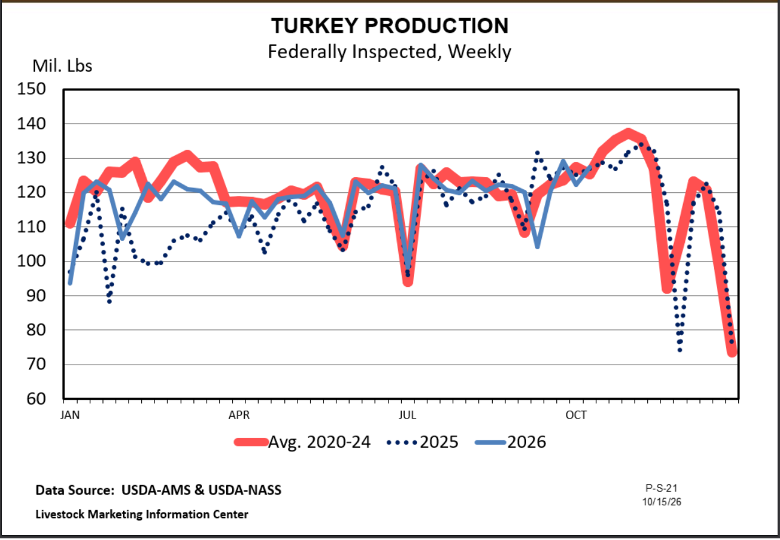
Cutline: Turkey production has remained remarkably stable during 2026 and is comparable to production levels observed during the previous five years, suggesting ample supplies for the holiday season.
What Can Consumers Expect to Pay?
Wholesale market signals provide a mixed picture. Turkey breast prices have fallen sharply, down approximately 58% from the same period last year and near long-term average levels. This indicates that wholesale breast prices have largely returned to normal following unusually high pricing in 2025.
Conversely, wholesale prices for whole birds remain roughly 40% above historical averages. Retail price data suggest consumers may see mild increases compared with last year, but the changes are unlikely to significantly affect holiday budgets.
Retail Turkey Price Comparison
USDA Agricultural Marketing Service weekly advertised retail price survey, October 2026.
| Product | Oct. 2025 | Oct. 2026 | % Change | $ Change |
| Frozen whole turkey (16 lb.) | $1.08/lb ($17.28) | $1.23/lb($19.68) | +13.9% | +$2.40 |
| Frozen whole bone-in turkey breast (7 lb.) | $1.26/lb($8.82) | $1.36/lb($9.52) | +7.9% | +$0.70 |
Cutline: USDA retail survey data show moderate increases in advertised turkey prices compared with last year. A typical 16-pound frozen turkey costs about $2.40 more than in October 2025, while a 7-pound frozen turkey breast costs approximately $0.70 more.
Bottom Line
Current production, storage, and HPAI impacts indicate that turkey supplies should be sufficient for Thanksgiving 2026. Although retail prices are slightly higher than last year, the increases are relatively modest, amounting to less than $3 per turkey in most cases. In addition, many grocery retailers routinely feature turkey as a holiday promotional item, which could further reduce consumer costs. For most families, turkey availability and affordability should not be a major concern this Thanksgiving season.
Brothers, Dennis. “Thanksgiving Turkey Outlook: Supply Strong, Prices Stable Heading into the Holiday Season.” Southern Ag Today