

Speaking with Oklahoma Farm Reports’ Maci Carter at Washington Watch, Spencer Chase of the Corn Refiners Association (CRA) broke down the findings of the newly released “Feeding the Economy” report, highlighting just how deeply food and agriculture shape the U.S. economy.
At the corner of industry data and national policy discussion, Chase said the report is designed to help people see agriculture beyond individual sectors.
Feeding the Economy: A “Farm to Fork” View of Agriculture
Chase explained that the annual report takes a broad look at the entire food system—from production agriculture to retail and transportation.
“The feeding the economy report is something that CRA is one of 35 organizations that sponsored their report this year,” Chase said. “And really what it does is it offers us an opportunity to look at food and agriculture as a comprehensive unit.”
He emphasized that many people only see fragments of the industry. “A lot of folks are very familiar with their specific silo of food and agriculture,” he said. “They might be very familiar with the beef industry, the corn industry, the wheat industry, but really, when you zoom out, it takes a lot to get from farm to fork.”
That broader view, he added, helps both industry leaders and consumers understand scale and pressure points.
A $10.4 Trillion Economic Engine
One of the most striking findings in the report is the size of the U.S. food and agriculture system.
“When you look at it, a $10.4 trillion economic output American food and agriculture, that’s about 20% of the overall American economy,” Chase said. “Something that I think I certainly didn’t realize it was even quite that big. And I’ve worked in agriculture my entire career.”
The report also highlights employment across the entire supply chain, from farms to food service.
“Nearly 49 million jobs in that entire system… about 24 million direct jobs in food and agriculture,” Chase said.
He noted that this includes everything from production agriculture to logistics, processing, and retail.
“Folks that are working the trucking in between… food retail, food service, folks that are working and the trucking in between, for example,” he said.
Oklahoma’s Role and Localized Impact
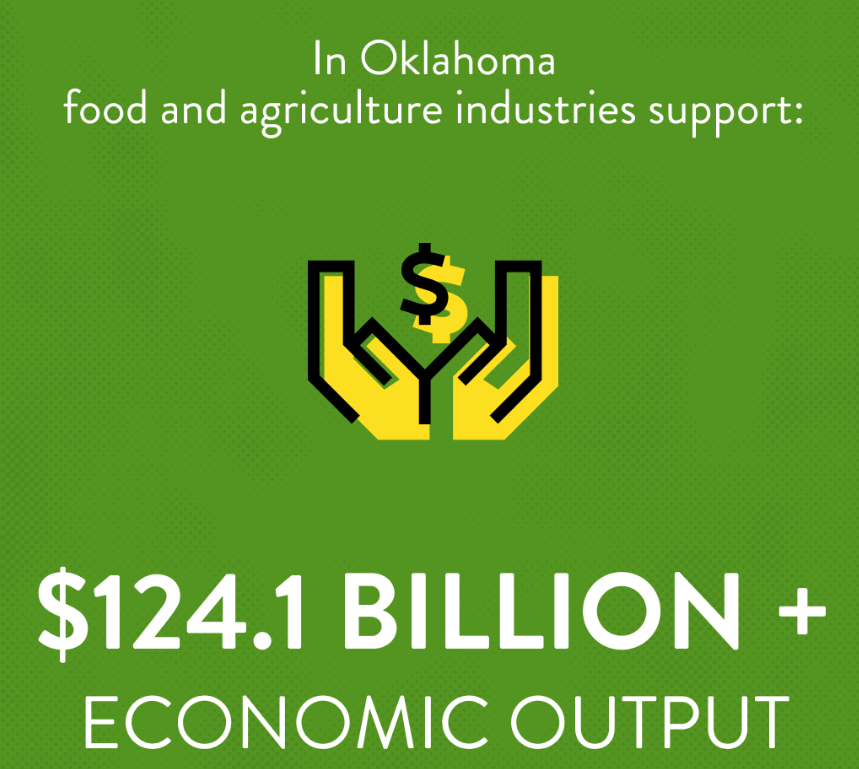
The report also breaks down data by state and congressional district, showing agriculture’s reach even in urban areas. “Looking just at the state of Oklahoma, it had an economic output of $124.1 billion,” Chase said.
He added that the interactive tools available through the report help visualize agriculture’s footprint nationwide. “Folks can go to feedingtheeconomy.com and play with an interactive map that shows us numbers across the country,” he said, noting that nearly every congressional district is impacted in some way.
That includes roles outside traditional farming. “Ag manufacturing… taking and processing those raw commodities into a consumer-ready product… that’s about 2.3 million people in this country,” Chase said.
Why the Data Matters Going Forward
Chase said the value of the report goes beyond numbers—it’s about shaping how policymakers and consumers view agriculture.
“I think it’s an opportunity for you know, I mentioned the congressional district by congressional district level data,” he said. “A lot of folks might think, well, food and agriculture is great, but I live in an urban center, well, it’s beyond that.”
He emphasized that agriculture’s influence extends into transportation, storage, and retail systems nationwide. “Folks are actively involved in food and agriculture, whether they know it or not,” Chase said. “And so having these localized figures… really gives us an opportunity to tell that story.”
Bioeconomy and Trade Driving the Future of Corn
Looking ahead, Chase said demand growth—especially through the bioeconomy—is critical for agriculture and corn refining. “The most important thing that we see right now is that agriculture needs markets,” he said. “Whether that’s domestic markets… or international markets.”
He pointed to the bioeconomy as a major opportunity. “The bio economy… has about 4 million people employed within the United States, about a $489 billion economic impact,” Chase said. “There is so much more that we can be doing with agricultural input, specifically corn in this case.”
He also stressed the importance of global trade stability. “We are firm believers in science-based, rules-based trade,” he said. “Making sure that those rules are being followed… are hugely important for us in corn refining and for American agriculture more broadly.”
Final Takeaway on Corn Refining
Chase closed with a message about the role of corn refining in modern agriculture.
“The corn refining industry is an industry of chemical engineering, and it is incredibly important in the United States,” he said. “Nobody is more productive. Nobody is more sustainable than the American corn farmer, and we are proud to partner with them every day at America’s Corn Refiners.”







