

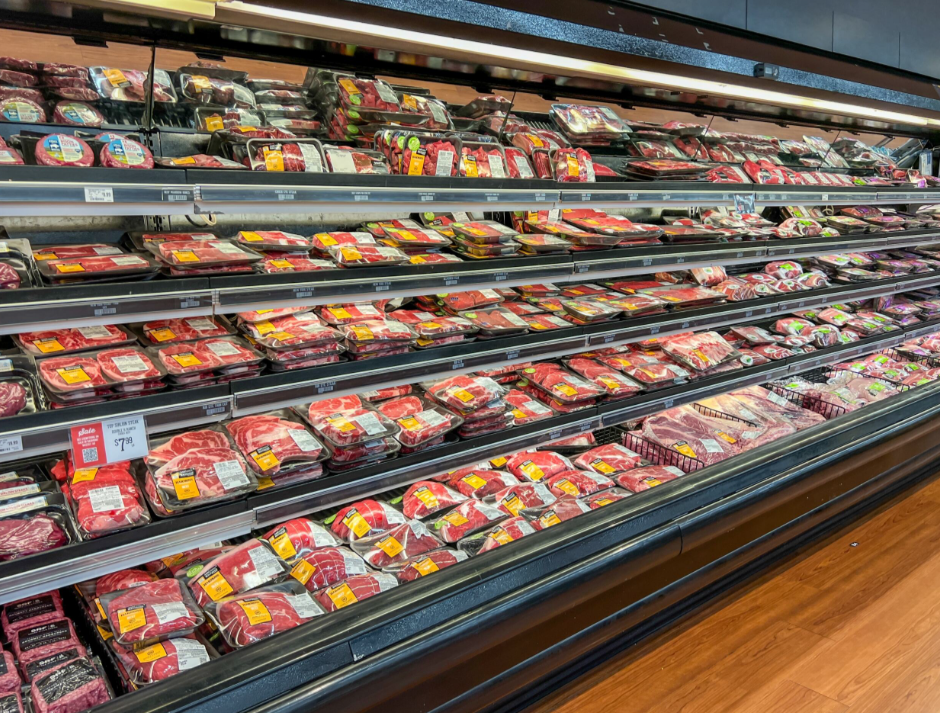
If we’re to address retail beef prices, which are the prices consumers pay for beef, then we need to start at the retail beef market and work our way upstream into the beef supply chain.
We know that retail beef prices have been increasing for more than a decade, so let’s determine how much of that increased beef price is attributable to higher input costs versus the concentrated retail sector’s leverage over beef pricing. Of course, the main input cost borne by retailers is the cost of the wholesale beef product purchased from the beef packer. This is a readily measurable cost as the U.S. Department of Agriculture publishes monthly wholesale and retail beef prices.
To begin, we need to determine how the retail sector’s margins have changed over the past decade. The retail sector’s margin is the difference between what the retailer pays for wholesale beef and the price the retailer charges to consumers.
For the first four years of the past decade, from 2016 through 2019, the retail sector’s margins remained relatively constant and averaged about $1,345 per head of cattle. Now this calculation is made by using the USDA’s rule of thumb that it takes about 2.4 pounds of a standard animal to produce 1 pound of retail beef. So, a 1,200 lb. live steer would be expected to produce 500 lbs. of retail beef, and the per head calculations I am making are based on 500 lbs. of retail beef equaling one animal. Keeping this factor constant will ensure that we can make a relatively accurate determination regarding the change in the retail sector’s margins over time.
So, at the beginning of the decade, the retail sector’s monthly margin averaged about $1,345 per head. In 2020, the year of the COVID pandemic, the retail sector’s average margin increased to $1,440 per head, nearly a $100 increase over the first four years of the decade.
2020 was a pivotal year as the retail sector’s margins increased significantly post 2020. For the next four years of the decade, from 2021 through 2024, the retail sector’s margins increased to an average of $1,703 per head, a $358 increase from the first four years of the decade.
Then, in 2025, the retail sector’s margins exploded to a monthly average of $1,963 per head, an increase of $618 per head above the decade’s monthly average over the first four years.
And, this year, January 2026 through March, the retail sector’s average monthly margin jumped to $2,035 per head. This represents a $595 increase since the COVID year and a $690 per head increase over the first four years of the decade, 2016-2019.
Why did this happen? How is it that the retail sector has substantially increased its margins during the past decade?
Was it because cattle prices started clawing their way upward after 2020? Well, no. That couldn’t be because the retail sector does not buy cattle. What we’re measuring is the difference between wholesale beef prices and the prices retailers charge consumers. Therefore, the cost of the retailer’s main input cost is not the price of cattle, it’s the price of wholesale beef.
What this tells us is that over the past decade, the retail sector has been progressively increasing its markup price above the wholesale beef price, which has significantly increased the retail sector’s revenues.
Now, whether this progressive and substantial markup was due to increases in the retail sector’s other input costs, such as increased labor, interest, transportation, promotion and advertising costs, is unknown.
But this progressive markup, which is roughly a 50% markup over the past decade, warrants an investigation to determine if it is justified by inflationary factors, or if all or part of the markup was achieved through the retail sector’s improper exercise of market power.
We know that in today’s market structure, cattle producers do not possess market power and do not have the opportunity to move the market; this is because they are widely dispersed and decentralized participants in the beef supply chain and are considered price takers.
But on the other hand, downstream beef packers and retailers are highly concentrated and do possess market power, which gives them the opportunity to move prices.
Before policies are implemented to lower cattle prices in the hope that lower cattle prices translate into lower consumer beef prices, regulators and antitrust enforcers should first determine what percentage of increased retail beef prices is attributable to competitive market forces versus what is attributable to anticompetitive buying and selling practices of the concentrated beef packers and retailers.
We know, for example, that if the retailer margin was the same in March 2026 as it was in March 2016, Choice retail beef prices would be $1.40 per pound less than what they are today.







