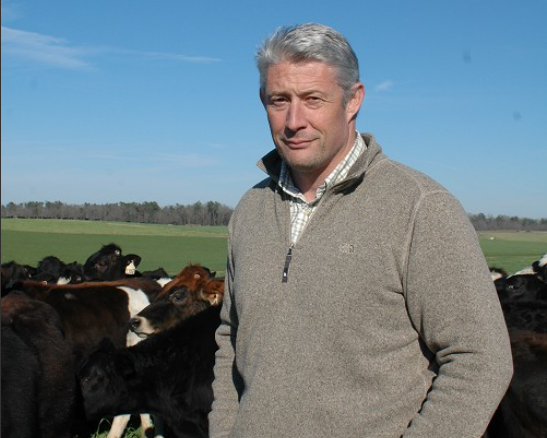
In today’s Beef Buzz, senior farm and ranch broadcaster Ron Hays speaks with Dr. Richard Watson, Senior Soil Health and Grazing Specialist with American Farmland Trust, about a new $42 million initiative designed to help beef producers improve profitability through sustainable grazing management. The bulk of the program is being funded by a $30 million grant from the NRCS of the USDA.
The program, known as the Beef Producer Economic Resilience Initiative, is funded through USDA’s Natural Resources Conservation Service and will focus on helping cattle producers adopt grazing practices that can improve both environmental and economic outcomes. “It’s a large pool of money from the Advancing Markets for Producers fund out of the USDA, administered by the NRCS, primarily focused on advancing markets for producers,” Watson said. “Creating opportunities for producers through different practice adoption, to create marketing groups, to create opportunities in the marketplace to either get price premiums or access different markets.”
Watson said AFT was honored to receive the grant and is eager to work directly with cattle producers across participating states. “We were fortunate to be the recipient of a relatively large $30 million grant from the USDA NRCS that is focusing specifically on grazing management,” he said.
Unlocking the Potential of Grazing Lands
According to Watson, grazing lands represent one of the largest opportunities for improving agricultural sustainability in the United States. “Grazing pasturelands and rangelands are the single biggest land use in the United States, making up 30% of the total land mass,” Watson said. “So it’s a massive opportunity when we’re talking about sustainability and resilience and improving things like soil health and biodiversity of rangeland and pastureland.”
He believes overlooking those acres would mean missing a tremendous opportunity to improve both natural resources and ranch profitability. “If we’re ignoring this massive land base and the opportunity to work with the farmers on it to try and improve these things, it’s a tremendously large missed opportunity,” Watson said.
AFT’s previous work with producers and NRCS programs helped position the organization to lead the effort. “We have this history in working directly with farmers and working with the NRCS specifically on practice adoption at the local level, at the state level, and at the regional level,” he said.
Focused on Profitability and Family Farm Success
While the initiative includes goals related to soil health and biodiversity, Watson emphasized that producer profitability remains a central objective. “We’re trying to drive practice adoption that will achieve some of the major outcomes of this project, which is more resilient farming systems, better soil health, better biodiversity, better productivity, better forage quality, better animal output, and ultimately better price and marketing,” Watson said.
He added that long-term farm success depends on helping operations remain financially viable. “We want succession in our farming families,” Watson said. “Well, we don’t get succession without success, so we need to try to help farmers become more successful in their operations so they can stay on the farm and produce for the next generation.”
Oklahoma Producers Encouraged to Participate
Watson said the network is open to beef producers of all sizes and production systems. While the project has a regional focus, Oklahoma is among the states included in the effort. “Beef cattle producers in those areas are welcome to participate,” Watson said.
The targeted states include Pennsylvania, Maryland, Virginia, Georgia, Alabama, Mississippi, Texas and Oklahoma. “It doesn’t matter if you have one cow or 1,000 cows or more,” Watson said. “We’re not restricting on size.”
The initiative will emphasize peer-to-peer learning among producers. “We’re looking to build a farmer peer-to-peer network where farmers are learning off farmers,” Watson said. “We want a broad swath of participants of all different shapes and sizes and production types.”
That includes operations ranging from traditional cow-calf ranches to stocker enterprises and direct-to-consumer beef businesses. “We believe that grazing management is something that can be applied across all beef cattle operations,” Watson said.
Meeting Producers Where They Are
Watson stressed that the program is designed for producers at every stage of grazing management adoption. “We want to meet farmers where they’re at,” he said. “It doesn’t matter whether you’re at the very basic level and doing continuous grazing or you already do some sort of adaptive grazing management.”
The goal is to develop educational opportunities and practical resources that fit a wide range of cattle operations. “We want to develop programs, produce programs, and ultimately deliver programs that cater to all types of farming operations and beef cattle operations,” Watson said.
American Farmland Trust hopes to identify as many as 700 producers to participate in the Beef Producer Economic Resilience Initiative as it builds what organizers believe will become a valuable grazing management network for cattle producers across the region.
The Beef Buzz is a regular feature heard on radio stations around the region on the Radio Oklahoma Ag Network and is a regular audio feature found on this website as well. Click on the LISTEN BAR above for today’s show and check out our archives for older Beef Buzz shows covering the gamut of the beef cattle industry today.