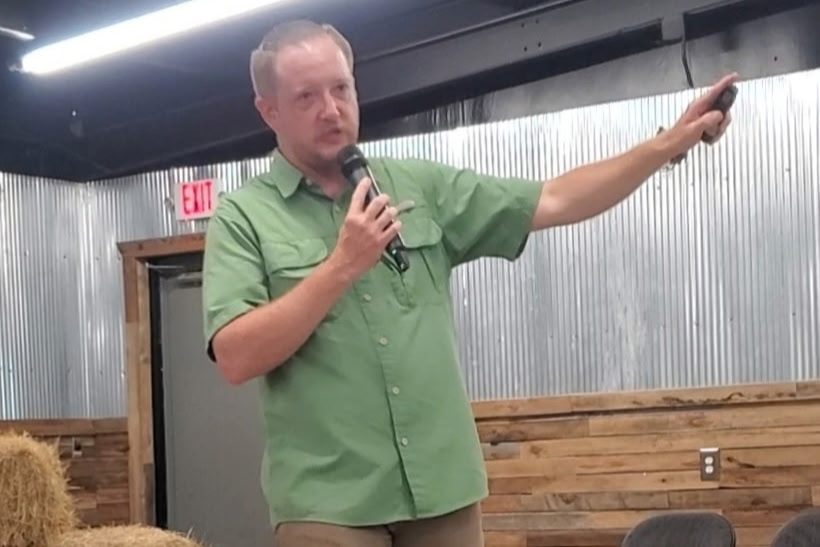
Oklahoma Farm Report intern Haden Snelson recently spoke with Creek County farmer Darren Blanchard about his concerns surrounding data center development and the additional energy infrastructure needed to support the projects.
Blanchard, a Mounds native and Oklahoma State University graduate, said his involvement began after his family was approached about a high-voltage transmission line crossing their property.
“So, I’m originally from Mounds, Oklahoma,” Blanchard said. “I’m a graduate of Oklahoma State University, so I’ve never left this state. I love this state. I believe in this idea of the Oklahoma Standard, if you will.”
Before returning home, Blanchard worked in government as an auditor and compliance officer. He moved back shortly before the COVID-19 pandemic to care for his grandparents and pursue plans for a small produce farm.
“I didn’t want to see them go into a nursing home,” Blanchard said. “They had a good spot of land here in Mounds, Creek County, and I always had this idea, this dream, this motive to start a small produce farm.”
In 2023, a land agent approached the family about a transmission line that would cross part of the property. Blanchard said the easement language raised questions about what other infrastructure could eventually be placed on or near rural land.
“As you start to read the easement, which is titled a transmission line easement, you see that there is language that allows the developer to add wind turbines, solar panel facilities and computer data systems,” Blanchard said. “That’s pretty alarming.”
Blanchard said his efforts to protect his grandparents’ property eventually led him to assist other landowners questioning large solar, transmission and data center projects.
“Me standing up for my grandparents’ property at the time to defend against a transmission line that I felt was overreach and unnecessary turned into me helping landowners simply raise their hands and ask good questions,” Blanchard said.
When residents hear that a proposed data center will occupy approximately 300-acres, Blanchard said they should also consider the solar facilities, battery storage systems, substations and transmission lines that may be connected to it.
“So, it’s not just a 300-acre data center,” Blanchard said. “It is huge swaths of land that are looking to be industrialized.”
Blanchard believes converting rural land to industrial use could affect agricultural production, housing availability and the ability of communities to accommodate future growth.
“When you put in all of this infrastructure that quite literally is going to take thousands of acres of land, you are handicapping those communities’ future growth,” Blanchard said.
He said agricultural land loss could also have consequences for food production and prices.
“The one thing that I think is the most effective talking point in all of this is that, at some point, this affects the cost of food, and it affects the food supply chain,” Blanchard said.
Blanchard also raised concerns about the electricity required to operate data centers and the possibility of some facilities relying on diesel-powered backup generators.
“If you have multiple data centers that are running on diesel fuel nonstop, what does that do to the cost of diesel?” Blanchard said. “What does that do to the farmer in Wichita? What does that do to the average American, regardless of where you live, when you go buy a loaf of bread?”
Supporters of data center development commonly point to construction jobs, tax revenue and economic growth. Blanchard acknowledged that construction projects can provide employment for several years, but he questioned the number of permanent local positions created once a facility becomes operational.
“Once that data center is up and running, you’re looking at very few on-site employees,” Blanchard said. “A lot of the jobs are remote.”
Blanchard also questioned what could happen if demand for artificial intelligence infrastructure changes or if new technology makes some large developments unnecessary. He said communities should require financial protections to prevent local taxpayers from being responsible for unfinished or abandoned facilities.
“When these proposals are not attached to a surety bond, the communities where they’re installed are going to be left to pick up the bill,” Blanchard said. “That’s really concerning.”
Water and electricity were among Blanchard’s primary concerns. Project Mustang in Claremore has been described as using closed-loop, air-cooled technology with limited direct water use. Blanchard said his greater concern is the cumulative effect of multiple projects across the state.
“The overall effect is the biggest concern because, again, I’m not against these developments,” Blanchard said. “One or two here and there, sure. That’s probably needed because AI is a national security concern. But it’s that cumulative effect.”
He said closed-loop cooling systems may reduce direct water consumption but require additional electricity. Blanchard also questioned whether development agreements contain strong enough language to ensure the cooling method cannot be changed later.
“For example, it says the developer intends to use a closed-loop system,” Blanchard said. “Well, there’s a difference between ‘intend’ and ‘shall’ when you’re looking at contracts or agreements.”
Blanchard said smaller communities may not always have the experience or expertise needed to negotiate highly technical development agreements.
“That’s the concern,” Blanchard said. “A lot of times in these smaller communities, the city council and city managers are not equipped with the necessary experience or expertise to decipher these contracts and put proper protections in place for their constituents.”
He also expressed concern about placing additional demand on Oklahoma’s electric grid during periods of extreme heat and high residential usage.
“We’re not against growth. We’re not against progress. We’re not against technology, but we are against irresponsible growth,” Blanchard said. “We just want this to be done in a way that’s not going to have negative consequences for the public.”
Through open-records requests, Blanchard said he has reviewed planning information and communications related to proposed developments. He believes some major decisions are made before residents become aware that a project is being considered.
“The real concern is that these decisions regarding a data center and all of the externalities that are going to come with it are being made before the public ever enters the room,” Blanchard said.
Blanchard said nondisclosure agreements can further limit public participation, particularly when developments could affect water, electricity, land use and utility rates beyond the city where the facility is located.
“It’s just not a good look when you are committing quite literally millions of gallons of water per day to one customer and you’re not making the public aware of it,” Blanchard said. “The demand on public resources and this commitment of public resources need to be made transparently and with public notice.”
He encouraged farmers and rural landowners to monitor zoning applications, annexation notices and requests for transmission line easements. Blanchard said those actions can provide early indications that a large industrial development may be planned nearby.
“If there is a notice for annexation, that has to be posted,” Blanchard said. “To use Sand Springs as an example, 827-acres were annexed into the city limits of Sand Springs.”
Blanchard also encouraged residents to attend public meetings, review government records and connect with others who are tracking developments in their communities.
“Get with them,” Blanchard said. “See what can be done in terms of fundraising, attending meetings and bringing others into the debate, because a lot of times these are in very small, unincorporated parts of the county, and we need more voices to be heard at city council meetings.”
While Blanchard acknowledged the national security importance of artificial intelligence and digital infrastructure, he said policymakers must also consider food security, affordable housing and the long-term availability of agricultural land.
“Yes, it is very much a national security concern,” Blanchard said. “But what’s forgotten is food security and available, affordable housing.”
To hear the full conversation, listen to the complete audio interview with Darren Blanchard attached to this story.