

Andrew Muhammad writes in Southern Ag Today: Prior to the reopening of the Chinese market in 2017, China was a negligible destination for U.S. beef exports; however, imports subsequently expanded rapidly, reaching a peak of approximately $2.1 billion in 2022 and establishing China as the third-largest market for U.S. beef exports, behind Japan and South Korea (U.S. Department of Agriculture, 2026a). All of this changed in 2025. Rising trade tensions between the United States and China led to higher tariffs and the lapse of export establishment registrations for many U.S. beef suppliers (Muhammad, 2025). As a result, U.S. beef exports to China fell sharply, reversing much of the progress made in recent years.
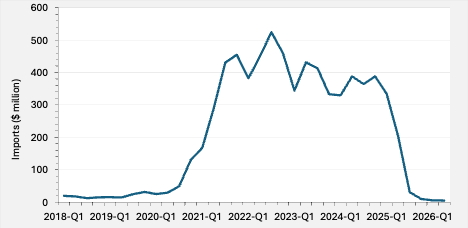
Figure 1 shows the rapid growth and subsequent collapse of Chinese imports of U.S. beef and beef products between 2018 and the first half of 2026. Imports expanded from less than $20 million per quarter in 2018 to more than $500 million in the third quarter of 2022, reflecting China’s emergence as a major destination for U.S. beef exports. Although imports moderated during 2023 and 2024, quarterly values remained historically high before declining sharply in 2025. The downturn coincided with rising trade tensions, retaliatory tariffs, and disruptions to export establishment registrations, causing imports to fall from over $330 million in the first quarter of 2025 to less than $10 million by the fourth quarter. By the first half of 2026, imports had fallen to their lowest levels (less than $5 million by the second quarter) since the reopening of the Chinese market to U.S. beef in 2017.
Looking ahead to the second half of 2026 and 2027, the outlook for U.S. beef exports to China remains challenging despite China’s continued need for imported beef. Following a recent safeguard investigation on the impacts of beef imports on domestic producers, China implemented a country-specific tariff-rate quota (TRQ) system on January 1, 2026, concluding that rising imports had caused serious injury to the domestic cattle industry. Under a TRQ system, a specified quantity of imports may enter at the normal tariff rate, while imports exceeding the quota face substantially higher duties. In China’s case, imports above each country’s quota allocation are subject to an additional 55% tariff, greatly increasing the cost of accessing the market once quota limits are reached. The U.S. quota was set at 164,000 metric tons in 2026 and rises only modestly to 168,000 metric tons in 2027, limiting the scope for export growth even if demand for U.S. beef recovers (Dokken, 2026). For context, China’s imports of U.S. beef averaged approximately 169,500 metric tons per year between 2022 and 2024 (Trade Data Monitor, 2026). In effect, the policy places a ceiling on the volume of U.S. beef that can enter China under more favorable tariff conditions while discouraging additional shipments through significantly higher import costs
Additional challenges extend beyond the quota itself. Most U.S. beef products continue to face a 10 percent reciprocal tariff in addition to normal import duties, while exporters and importers remain concerned about establishment eligibility, customs clearance risks, and residue testing requirements. At the same time, U.S. beef continues to face a price disadvantage relative to major South American suppliers, particularly Brazil (U.S. Department of Agriculture, 2026b). As a result, any recovery in U.S. beef exports is likely to be gradual and constrained by both policy barriers and market conditions. Consequently, the extraordinary growth achieved in the Chinese market between 2018 and 2024 may prove difficult to replicate in the coming years, leaving the future of U.S. beef exports to China highly uncertain.
Muhammad, Andrew. “Trade Tensions and the Uncertain Future of U.S. Beef Exports to China.”