
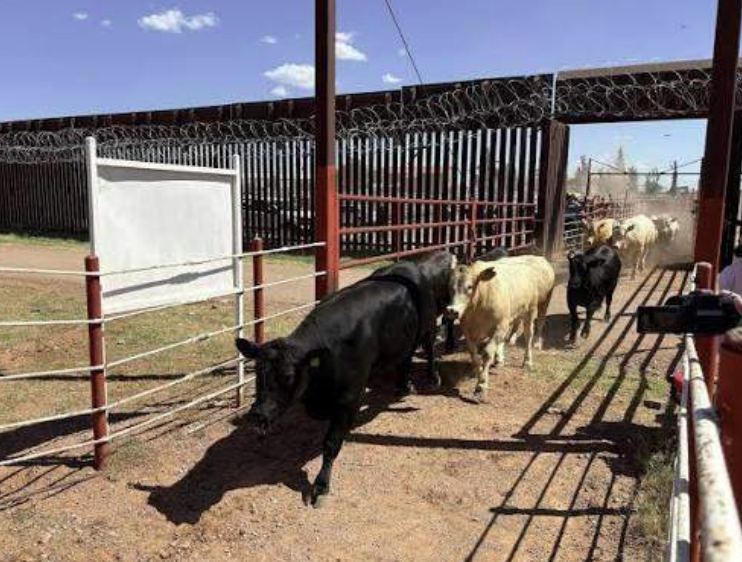
In today’s Beef Buzz, senior farm and ranch broadcaster Ron Hays speaks with Oklahoma State University Extension livestock market economist Dr. Derrell Peel about the movement of Mexican cattle into the United States as additional border ports prepare to reopen. With the Douglas, Arizona, crossing now operating, Peel says heavier cattle have been among the first animals moving north, while a larger flow of lighter-weight cattle is expected later.
Heavier Cattle Moving Through Arizona
Peel says there are some heavier cattle in Mexico right now, and producers there had time to prepare for the reopening of the border. “Yeah, there’s some heavy cattle down there,” Peel said. “You know, they had a month to anticipate the border opening from the time the announcement was made.”
That month gave some Mexican producers an opportunity to hold cattle that otherwise may have entered the domestic market while waiting for the chance to ship them into the United States. “I think it’s an open question going forward. Does it mean that there’s a lot of cattle backed up in Mexico? I’m not sure,” Peel said. “I don’t think it probably does, and so I suspect these initial phases were just taking advantage of the fact that market’s open and the value’s good, so they’re trying to move some of these heavier cattle.”
Peel says the number of cattle moving through the border remains relatively limited, and the traditional fall calf crop will also be looking for access to U.S. markets. “So we’re going to have fall cattle coming out of Mexico that would be their normal calf crop that they’ll want to get across as well,” he said.
Douglas Moving 800 to 900 Head a Day
The Douglas, Arizona, port has been moving roughly 800 to 900 head of cattle per day as officials and industry work through the process of reopening cattle trade. “They’ve been running through Douglas eight to 900 head a day,” Peel said. “it was about this last week, it was only a four-day week last week. I think they got about 3,400 head or something like that across last week.”
Equipment problems briefly slowed the operation, but Peel says the port appears to be getting back up and running. “I think we’re working into it. It’s going pretty much as I expected,” Peel said. “Again, we’re in that eight, 900 head a day.”
He said equipment breakdowns the week before Labor Day limited the movement to roughly 100 head for the entire week. “But we’ll keep building, and those will build slightly over time as they get some of the wrinkles out of it and get some of the protocols or the procedures ironed out a little bit,” Peel said.
Santa Teresa Set to Reopen Next
The next major port expected to reopen is Santa Teresa, New Mexico, which Peel says is the largest of the cattle crossings. “Santa Teresa, New Mexico, is the largest of the ports,” Peel said. “And that is, as I understand it, that’s the one they’re planning to open next.”
Even though the facility has greater capacity, Peel expects the initial flow to be limited as officials work through the reopening process. “I think it’s going to open relatively slowly as well,” he said. “I did see something that indicated they would probably limit it to seven or 800 head a day, even though at full capacity that port has the ability to cross more cattle than that.”
Peel says officials will need time to get accustomed to the procedures and protocols involved with reopening the facility. “But they won’t start there. It’s going to take some time,” Peel said. “There’s again, there’s some new protocols and procedures, and then of course they just haven’t done it for a while, so they got to get back into the swing of things a little bit.”
Heavier Cattle Could Reach Feedlots Sooner
The heavier cattle now moving through the border could enter the U.S. feeding system more quickly than the lighter cattle that have traditionally come north from Mexico. “To the extent that we bring in some of these heavier cattle, they’ll go straight into the feedlot for sure,” Peel said.
Depending on their weight, some of those cattle could reach slaughter weight relatively quickly. “They may finish here, you know, close to the end of the year or in the very early part of next year,” Peel said. “So we’ll start to see a few as we go forward.”
However, Peel expects the larger flow eventually to consist of lighter-weight cattle. “Again, I think the bigger numbers as we go forward will probably be more the traditional lighter weight cattle,” he said. “But we’ll have a few of these bigger cattle that’ll get into the system a little bit quicker.”
Mexican Cattle Could Help Southern Plains Feedlots
As more Mexican cattle are allowed into the United States, Peel says the additional supply should eventually help feedlots in the Southern Plains. “It certainly will over time,” Peel said. “I think it’s going to be several months before we see appreciable numbers come across.”
Still, even knowing that additional cattle are expected to become available provides some opportunities for businesses that depend on those cattle. “Yes, it certainly will help over time relieve some of the regional pressure on cattle availability for feedlots in the Southern Plains,” Peel said. “And, just knowing that it’s coming, that at least it’s on tap right now, I think will provide opportunities for some of those feedlots and businesses that rely on those cattle to sort of get themselves ready for it and be ready for it when the opportunity comes.”
Secretary Rollins to Inspect Santa Teresa
After Ron Hays’ conversation with Peel on Wednesday, additional information came regarding the expected reopening of Santa Teresa.
Hays says U.S. Secretary of Agriculture Brooke Rollins is scheduled to travel to Santa Teresa today to inspect the port alongside New Mexico Agriculture Secretary Jeff Witte. Witte has indicated the inspection is part of the process of preparing the facility to resume cattle crossings.
According to Hays, if everything lines up during the inspection, the target remains September 24 for reopening the port.
The Santa Teresa facility is installing cattle identification technology and working with the Cattlemen’s Union of Chihuahua, which has operations on both sides of the border, along with USDA officials to prepare for the reopening.
The initial flow is expected to be approximately 750 head per day as the port gets back into operation. Santa Teresa has been closed to cattle since May 11, 2025, when USDA shut the crossing over concerns about the spread of New World screwworm.
The Beef Buzz is a regular feature heard on radio stations around the region on the Radio Oklahoma Ag Network and is a regular audio feature found on this website as well. Click on the LISTEN BAR above for today’s show and check out our archives for older Beef Buzz shows covering the gamut of the beef cattle industry today.