
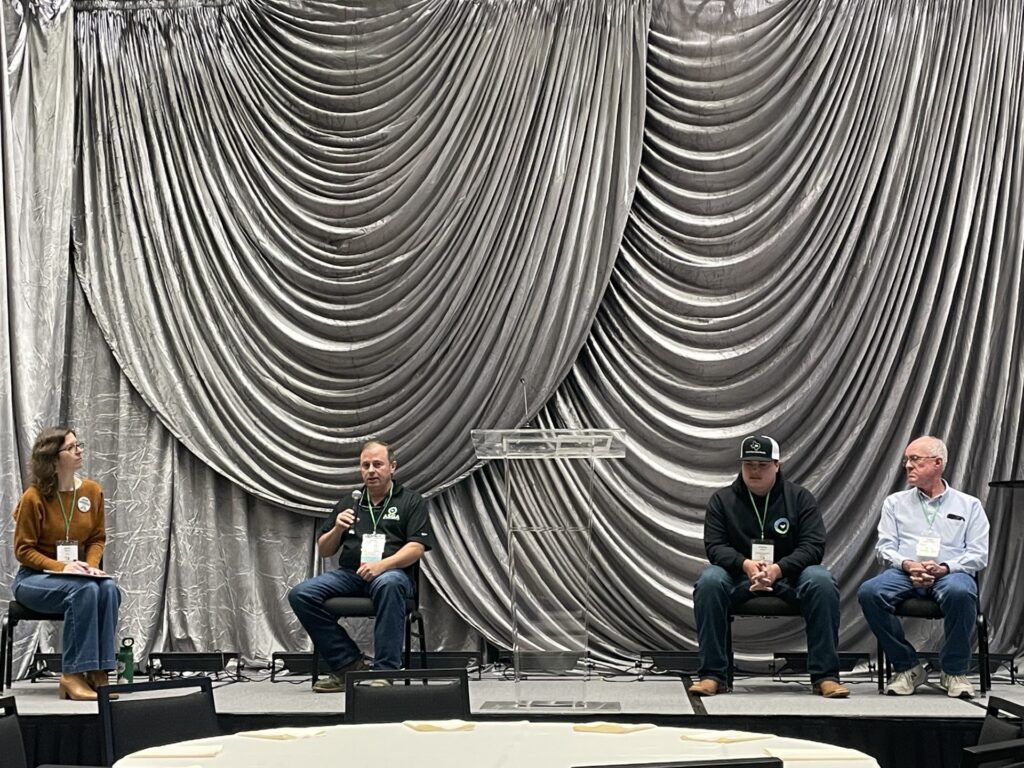
As solar energy development continues to expand, farmers and ranchers are finding new ways to keep agricultural land productive. Oklahoma Farm Report intern Haden Snelson spoke with American Solar Grazing Association (ASGA) President Chad Raines at the Oklahoma Solar Summit in Stillwater about how livestock grazing and solar energy production can work together.
Raines explained that ASGA is a nationwide nonprofit organization founded by farmers to educate producers and solar developers about the benefits and practices of solar grazing.
“We’re an organization, you know, created by the farmers, for the farmers,” Raines said.
The association works with producers and solar companies to establish management practices and expectations for grazing livestock on solar facilities. Raines said the organization also participates in policy discussions and provides educational resources for those interested in getting involved.
According to Raines, sheep have become the most common livestock used for solar grazing because of their size, temperament and ability to manage vegetation around solar panels.
“Basically, my sheep are four-legged lawnmowers,” Raines said. “They keep the grass down.”
He explained that solar grazing operations typically use rotational grazing methods, moving sheep between smaller sections of a solar facility to control vegetation growth. Electric fencing is often used to divide larger areas into manageable grazing paddocks.
Rather than transporting livestock between different locations, Raines said sheep generally remain within a solar facility and rotate between sections as needed.
Sheep also offer advantages over larger livestock when working around sensitive solar equipment.
“They’re fairly docile animals,” Raines said, explaining that sheep are less likely to damage wiring or panels.
He added that sheep tend to favor weeds, which can become a problem for solar operators when taller vegetation begins shading panels and interfering with energy production.
Beyond vegetation management, Raines believes solar grazing can provide agricultural benefits for both livestock and pastureland.
He said the partial shade provided by solar panels can help grasses retain moisture and remain green longer while also giving sheep relief from summer heat.
For Raines, one of the biggest misconceptions surrounding solar development is that agricultural production must end when solar panels are installed.
“You drive by, you may see the big solar arrays out off the interstate and think that, you know, we’re losing farmland to solar. It’s not the case,” Raines said. “We’re able to integrate both.”
He believes the industry has only begun exploring the possibilities of combining solar energy development with traditional agricultural practices.
“We’ve just now scratched the surface of what can be done on solar,” Raines said.
As more solar facilities are developed, Raines hopes producers and landowners recognize that renewable energy infrastructure does not necessarily mean the end of agricultural activity.
“So, when you drive by and you see the solar array out there, just think that agriculture is still going on,” Raines said.