
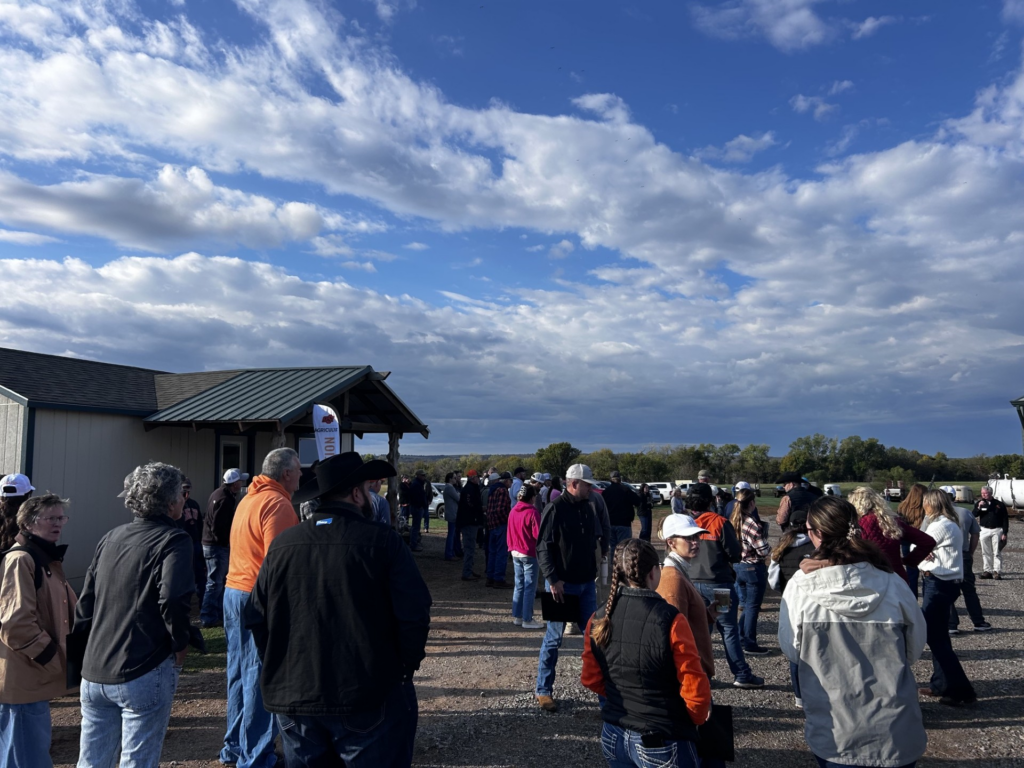
Free-choice cattle supplements may be more efficiently utilized when cattle consume smaller amounts multiple times throughout the day, according to research presented at Oklahoma State University’s Livestock Range and Field Day. Caitlin Kleffner, an OSU graduate research assistant, studied cattle supplementation behavior to better understand how often animals visit self-fed liquid supplement feeders and how those visits could affect supplement utilization.
Kleffner said in a conversation with associate farm reporter Carli Davenport that the research began with questions about how cattle were using the free-choice liquid supplementation system already being used to provide protein to mature cows and some heifers. “We were currently utilizing a free-choice liquid supplementation using a four-wheel lick tank to provide protein supplementation for our cows, our mature animals, and some of our heifers,” Kleffner said. “And so we were just curious at looking at the general behavior of how the cattle were utilizing the supplement.”
The research focused on whether cattle consumed large amounts of supplement in one visit or returned to the feeder multiple times throughout the day. “Overall objective was just to kind of characterize some of that supplementation visiting behavior, supplement seeking behavior,” she said.
Cattle Averaged Seven Supplement Visits Per Day
One of the encouraging findings was that cattle consistently returned to the supplement feeder multiple times throughout the day.
Kleffner said the animals averaged seven visits per day, although individual cattle varied in their visiting frequency. “Our animals were averaging seven visits per day, with an individual range of three visits all the way to nine visits,” she said.
She added that every animal in the study visited the feeder multiple times rather than relying on a single daily visit. “So although the animals did vary, all of them visited multiple times,” Kleffner said.
That behavior was particularly important because the study involved a urea-based liquid protein supplement.
Urea is rapidly converted into ammonia once it enters the rumen, where rumen microbes utilize it. Because that process happens quickly, smaller, more frequent supplement meals may help provide a more consistent supply for rumen microbes.
Kleffner explained that researchers wanted to see cattle returning to the feeder throughout the day rather than consuming one large amount at once. “You would hope to see a more continuous conversion of that urea, of that ammonia in the rumen,” she said. “We’re very happy to see that and that they were efficiently kind of utilizing that supplement the way we had hoped.”
What the Research Means for Cattle Producers
For cattle producers using self-fed supplements, the findings offer insight into how animals naturally approach supplemental nutrition.
Kleffner said free-choice supplementation can reduce the labor involved in providing cattle with supplemental feed while allowing animals to regulate their own supplement-seeking behavior.
“With self-fed supplements there’s less labor included, and the cows can kind of have the ability or have the behavioral characteristics to regulate themselves on their supplement-seeking behavior,” she said.
However, Kleffner emphasized an important limitation of the research: Researchers measured feeder visits, not the actual amount of supplement each animal consumed. “With this study, I can’t directly say that the behaviors that we saw directly indicated differences in intake,” she said. “We would like to assume that, but we can’t definitively say that just because we didn’t measure intake.”
Even without measuring individual intake, Kleffner said the visiting patterns were encouraging because they matched the behavior researchers hoped to see.
For producers investing in self-fed supplements, understanding how cattle interact with those feeders could help provide a better picture of supplement utilization. “It’s nice to know that those behaviors match what we would hope to see that could possibly reflect intake,” Kleffner said.
She added that multiple smaller visits throughout the day could help cattle make more efficient use of self-fed supplements and potentially improve the value producers receive from their supplementation investment. “Just knowing for producers that multiple smaller visits made by the animals can increase the efficiency utilization of those self-fed supplements for those cattle and have better utilization of the money they’re putting into that supplement,” Kleffner said.