
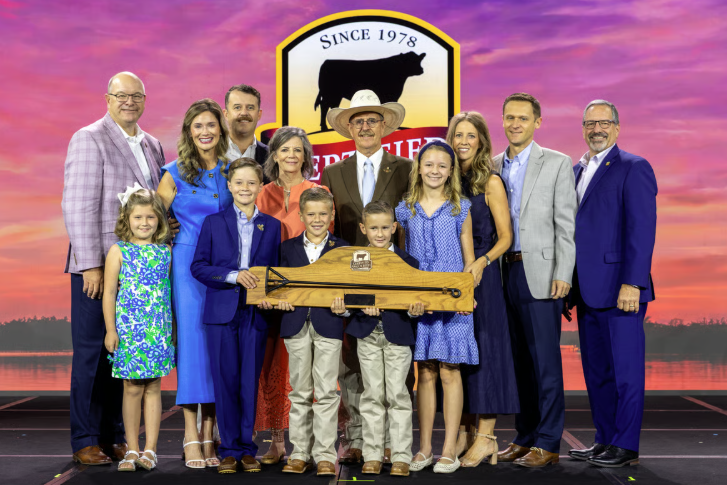
In today’s Beef Buzz, senior farm and ranch broadcaster Ron Hays speaks with Alan Jett, owner and operator of Jett Ranch near Slapout, Oklahoma, about his family’s efforts to increase carcass quality through Angus genetics. Earlier this year, Jett Ranch received the Certified Angus Beef Commercial Commitment to Excellence Award, recognizing the ranch’s focus on producing high-quality beef. With recent cattle achieving 81% and 87% Prime on their kill sheets, Jett shares how a long-term breeding strategy has helped move his herd toward higher premiums.
Jett Ranch Sees High Prime Results Through Angus Genetics
Jett said the ranch’s most recent cattle demonstrated just how far its genetics program has come. “Last two kill sheets have been 81 and 87 percent Prime,” Jett said.
The results came after years of gradually improving the herd. Jett originally operated a different cow herd but decided to begin investing in Angus bulls with stronger carcass genetics. Over time, the ranch continued to see improvements in quality grade while maintaining the functionality and fertility of its cows. “We just continued, kept getting more choice and more choice, and finally we hit 100% Choice,” Jett said. “I still had a very functional, very viable, very fertile cow herd. You know, probably my cow herd was easy flesh and just as fertile as what I started with.”
As the percentage of Choice cattle increased, Jett began seeing more Prime carcasses and the additional premiums they could bring. “You had cattle bringing $15, $20 a hundred more for a Prime than a Choice, and it’s kind of like, I want more of those,” Jett said.
Genetics Provide a Longer Marketing Window
Jett said his approach to increasing Prime percentages centers on genetics rather than relying primarily on additional corn or feed. “My philosophy is, let’s do it with genetics,” Jett said. “One of those reasons, if we do it with genetics as opposed to corn, it gives us a bigger marketing window.”
His long-term goal is to reach 100% Prime while maintaining a 60- to 75-day marketing window. While he recognizes that is an ambitious target, he believes continued genetic improvement can help get the ranch there.
The ranch’s latest group of cattle reached 87% Prime after spending close to 200 days on feed. Jett said the decision to feed them longer was intentional, allowing the operation to better understand the cattle’s potential and identify the right marketing window.
Finding the Sweet Spot for Days on Feed
Based on the latest results, Jett believes the ranch can adjust its feeding program to improve efficiency while still capturing strong carcass premiums. “I’m thinking that 170 days is the sweet spot,” Jett said.
He explained that not every animal needs the same amount of time on feed. Some cattle can be identified and marketed earlier, while others may need additional days to reach their genetic potential.
Jett also noted that the latest group included more heifers, which contributed to a higher number of Yield Grade 4 carcasses. Moving those heifers through the feeding program sooner is one adjustment he plans to make moving forward.
Prime Premiums Deliver Added Value Above Cash Market
The financial results have reinforced Jett’s decision to continue pursuing higher Prime percentages.
He said the group that graded 87% Prime brought $349 per head above the Kansas cash market for that week. The previous group, which graded 81% Prime, brought $425 per head above cash. “The last set of cattle that I keep talking about, those cattle killed $349 over cash,” Jett said. “The set before that with 81% Prime, those cattle killed $425 over cash. So yeah, there’s some money in it.”
Those premiums demonstrate the potential value of producing cattle that meet higher quality specifications, particularly when backed by a consistent breeding and feeding strategy.
Jett Encourages Producers to Develop a Breeding Plan
For cattle producers interested in increasing Prime percentages in their own herds, Jett said success requires a long-term commitment to genetic selection and feeding management. “You got to be dedicated. You got to select bulls that will do it,” Jett said.
He added that artificial insemination can be an effective way to access the genetics needed to improve carcass quality without necessarily taking on the same costs associated with purchasing additional breeding bulls. “Main thing, you gotta get a breeding plan. You gotta be dedicated to it,” Jett said. “And first off, you gotta be willing to feed cattle, you know, and you gotta be willing to feed them year after year after year. You can’t just do it hit and miss.”
Jett continues to use Angus genetics to move his herd toward higher Prime percentages, with the ultimate goal of producing more premium beef while maintaining a productive and fertile cow herd.
The Beef Buzz is a regular feature heard on radio stations around the region on the Radio Oklahoma Ag Network and is a regular audio feature found on this website as well. Click on the LISTEN BAR above for today’s show and check out our archives for older Beef Buzz shows covering the gamut of the beef cattle industry today.