

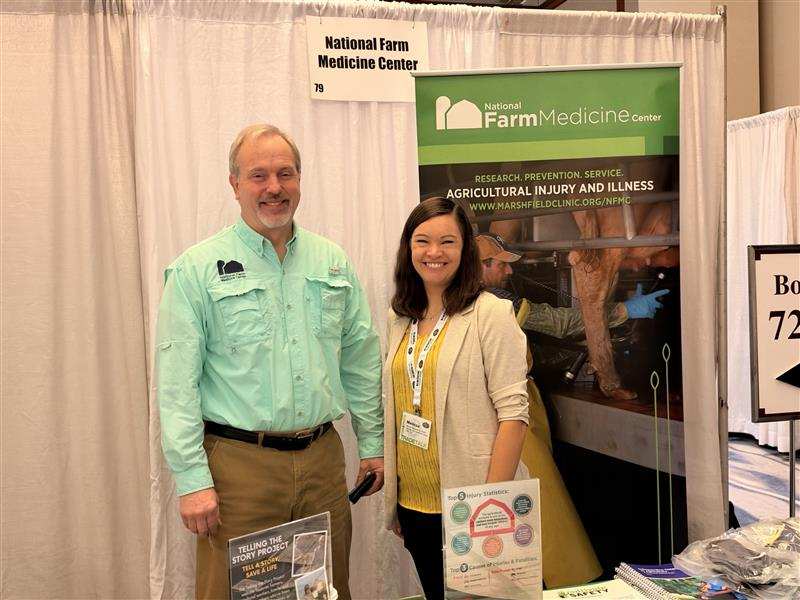
Alpha-Gal syndrome is becoming a growing concern for farmers and ranchers as tick bites lead to more diagnoses across the United States. Melissa Ploeckelman, Research Education Outreach Specialist with the Marshfield Clinic, recently discussed the condition with Farm Director KC Sheperd, highlighting how the allergy can affect not only a person’s diet but also their ability to work around livestock.
“There was a great study done in Nebraska about the number of people that are being diagnosed with Alpha Gal from tick bites, and nearly half a million Americans are now diagnosed with alpha-gal,” Ploeckelman said. “Which means they can’t eat meat sometimes.”
However, the effects can reach beyond food restrictions. Ploeckelman said people with Alpha-Gal syndrome can also experience reactions to animal dander, potentially making it difficult for them to work with livestock. “The other thing is their lifestyle; they can’t work with their livestock because the dander can affect them,” she said. “And we need to start talking about this and figuring it out because we love our farmers and we want them to be able to do what they do best, and that’s work with their livestock.”
Alpha-Gal Can Be Difficult to Diagnose
One of the biggest concerns Ploeckelman highlighted is how difficult it can be for patients to receive an accurate diagnosis.
She explained that symptoms can initially resemble common digestive problems, leading patients and physicians to overlook the possibility of Alpha-Gal syndrome. “A lot of times somebody goes in, they have a stomach ache, or maybe they have diarrhea, so they think okay, well, you might just maybe you ate something wrong,” Ploeckelman said.
She noted that patients may be sent home without a diagnosis and have to make multiple trips to the doctor before the condition is identified. “It takes like three visits to a doctor to figure out what it is,” she said. “And farmers do not have time, and they don’t go to the doctor.”
Ploeckelman said increased awareness among physicians could help shorten that process and make it easier for patients to recognize what is happening.
She also pointed to another finding that surprised her: symptoms tend to be more severe in females. “We do see that actually females have stronger symptoms and more severe symptoms,” Ploeckelman said.
For farmers who suspect they may have Alpha-Gal syndrome, she recommended telling their physician about any known tick bites and specifically asking about testing for the condition. “If a farmer knows that they’ve been bit by a tick, then yes, mention that,” she said. “Bring it up to your physician and say, ‘Can you please check for alpha gal? See if that’s the, see if that’s what it is.'”
Keeping track of meals and symptoms can also help physicians identify a possible connection. “I recommend farmers actually have a notebook and write down what you ate and when did you feel sick?” Ploeckelman said. “Because that can help a doctor diagnose you.”
Lone Star Ticks Linked to Alpha-Gal Syndrome
Ploeckelman explained that the Lone Star tick is the primary tick associated with Alpha-Gal syndrome, making tick identification an important part of understanding potential exposure.
Through the Marshall Clinic Research Institute, she said researchers have a citizen-science study that allows people to mail in ticks for identification.
While participants will not receive results showing whether a tick carried a particular disease, researchers can provide information about the tick’s age, gender and type. “That’s the other important thing is the type because it’s the Lone Star tick that can give you this alpha gal,” Ploeckelman said.
She added that keeping a tick after removal and taking it to a physician can be helpful. She also discussed the importance of removing ticks properly rather than attempting to burn them off. “A lot of farmers try to burn their ticks out,” Ploeckelman said. “Oh, that is a bad idea. Please do not do that.”
Instead, she recommended using tweezers to grasp the tick near its head and pull it out.
“When people try to burn it out with a match or a lighter, it does back itself out,” she explained. “But before it backs out, it throws up everything in its system,” Ploeckelman said that process can expose a person to illnesses or diseases the tick may be carrying.
Tick Prevention Important for Agricultural Workers
Farmers and ranchers can be particularly vulnerable to tick bites because of the amount of time they spend working outdoors in areas where ticks live.
Ploeckelman recommended several prevention practices, including wearing long pants and long sleeves, tucking pants into socks, and treating clothing with permethrin.
She also encouraged landowners to mow down long grasses in areas that are not being used for pasture or fields.
Another important step is checking for ticks every evening after spending time outdoors. “Just every night when you get in, do a tick check and make sure that you look at the most vulnerable places,” she said. Those areas include around the waistband, armpits, ankles and hair.
Ploeckelman also noted that Lone Star ticks are becoming more prevalent in additional areas of the country.
She said milder winters may be contributing to their spread because ticks are less likely to die off during cold weather. “Now we have more mild winters, so we’re not freezing off the ticks. They’re not dying, so yeah, they can migrate further and they can spread faster because they can just reproduce and continue living,” she said.
Symptoms Can Become More Severe Over Time
While digestive problems after eating red meat may be one of the more recognizable signs of Alpha-Gal syndrome, Ploeckelman emphasized that symptoms can vary significantly.
People may experience anything from mild nausea after eating to severe allergic reactions.
The condition can also affect individuals through exposure to animal dander, creating additional challenges for those who work closely with livestock.
Ploeckelman cautioned that allergic reactions can become more severe with repeated exposure. “If you notice that you’re getting sick when you’re eating proteins, the red meats, the venison, the beef, the pork, then you want to stop because it’s just going to get worse the more you do it,” she said.
Currently, there is no known cure for Alpha-Gal syndrome, although the condition can be diagnosed. Ploeckelman said researchers are continuing to learn more about the condition as diagnoses become more common. “We can diagnose it, but we do not have a cure yet,” she said.
She added that Alpha-Gal syndrome is not necessarily a lifelong condition for everyone, but more research is needed to understand why some people recover and others continue experiencing symptoms.
Where to Learn More About Alpha-Gal Syndrome
Ploeckelman encouraged farmers and ranchers to learn more about Alpha-Gal syndrome and the risks associated with tick exposure.
The research article she discussed is available through the Journal of Agromedicine as an open-access publication. The study was led by Sean Cross of Nebraska.
Ploeckelman said increasing awareness among agricultural producers and medical professionals is an important step toward better recognition, diagnosis and understanding of Alpha-Gal syndrome.







