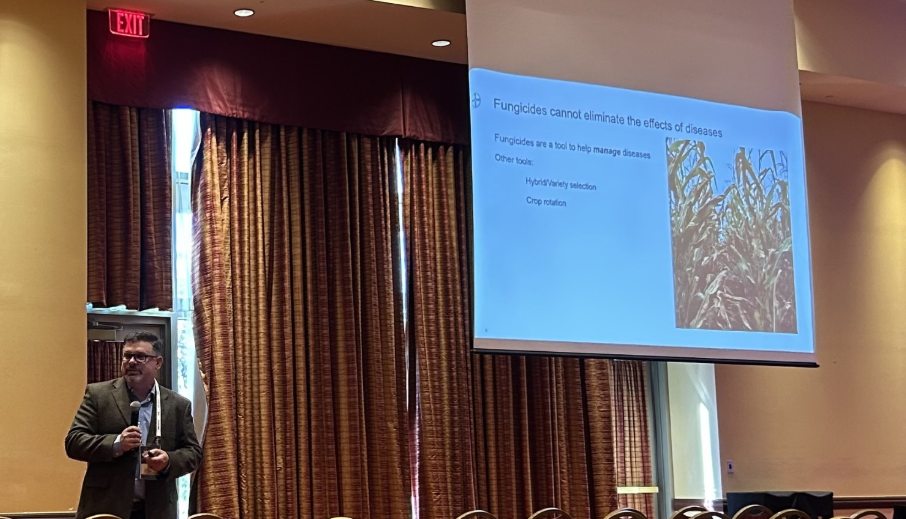
Associate Farm reporter Carli Davenport spoke with Jeff Ball of Bayer CropScience, who opened the conversation by emphasizing that fungicides cannot undo damage that has already occurred, explaining that “it’s basically timing.” He said, “If you’re a little late to the game, you can’t correct what’s already happened.” He pointed out that symptoms such as rust appearing on leaves mean the infection started weeks earlier. That’s why, he stressed, “It’s always best to be on the early side,” with fungicide applications planned and budgeted in advance to get the most benefit.
When it comes to early applications, Ball said applying fungicide around the V5 growth stage in corn can pay dividends. “An early season in corn is going to really help us with standability,” he explained, noting that soilborne pathogens can weaken stalks. At this stage, “the plant’s deciding a lot about reproduction,” and protecting it from disease allows it “to be on the aggressive side towards yield,” producing a healthier and more productive ear of corn.
Discussing disease challenges across Oklahoma, Ball said wheat growers often plant “a naked seed out there without a seed treatment,” which can lead to crown rot and Fusarium infections. “Our biggest competition is the untreated acre,” noting that black heads seen later in the season often trace back to infections at planting. For corn, this year’s “wet, cool spring” led to more stalk rots than usual, while “southern rust blew through late,” though yield impacts were minimal. In soybeans, he’s seeing frog-eye leaf spot move westward in wetter years and reminded that diseases like Asian soybean rust are manageable with timely fungicide use.
On droplet size and fungicide coverage, Ball said achieving proper coverage is key because “we need to cover the plant.” Most fungicides “move in the plant to the leaf tip, through the xylem,” so placement matters. He explained that droplet size must balance between being too fine—where it “lifts or moves with the wind”—and too dense, which causes it to “roll off the leaf to the ground.” Ball said applicators should follow label guidance for nozzle type and pressure to “get that best opportunity for coverage.”
Addressing common mistakes and misconceptions, Ball said many growers assume all fungicides are the same, when in fact “triazoles have very strong curative aspects,” while other classes like SDHIs and strobilurins are more protective. He clarified, “You’re never going to go back and reverse damage that’s already been done,” but a curative can “eliminate that disease that’s present.” However, triazoles are short-lived, so he recommends tank mixes for broader and longer protection.
Ball concluded by warning against the belief that a single fungicide application offers season-long control. “The misconception is, I ran a fungicide—I should be protected all the way through,” he said. Over time, “you just don’t have that active in the plant anymore for that long of a growing season.” His message to producers was clear: timing, product selection, and understanding how fungicides actually work are crucial to keeping crops healthy and productive.