
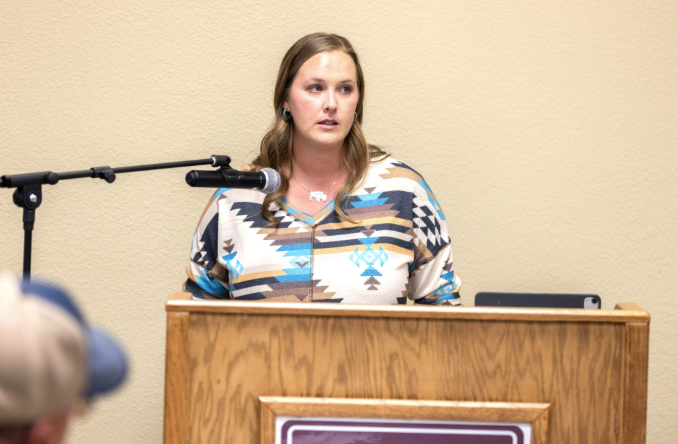
Senior farm and ranch broadcaster Ron Hays spoke with Megan Langley, who—along with her husband Kyle—operate Egg Drop Farm in far northeastern Oklahoma. Langley joined other Oklahoma and Arkansas poultry growers at a meeting earlier this week in Bentonville to discuss the latest in the battle over chicken litter in the Illinois River Watershed. Langley explains that they run breeder houses and produce hatching eggs. “We built them for Tyson 10 years ago, and then about four years ago, we switched to Simmons,” she says, noting they now contract with Simmons and carry the full financial responsibility for their facilities.
Langley outlines the economic structure growers face when entering the poultry business. Producers must secure a contract first, then take on all borrowing and building costs. As she explains, “The financial responsibility is solely on us… We own our houses. We own the land. They basically just pay us to take care of their birds.” That reality makes the current legal tensions in the Illinois River watershed especially daunting for growers like her.
Her family has been connected to the watershed litigation for decades, dating back to the start of the century. “My father-in-law was actually the first person subpoenaed, because he was cleaning out chicken houses and he was a litter applicator,” she says. The core dispute continues to revolve around phosphorus levels from poultry litter, even though, as Langley emphasizes, “Most of this chicken litter is already being shipped out of the watershed.”
Langley notes that strict state rules already govern litter application, including nutrient management plans and mandatory testing. While many now export their litter, her family still uses some on their land and sells limited amounts to neighbors. “Without the chicken litter, you wouldn’t grow anything but sage grass and rocks out here,” she says, calling it an essential fertilizer that benefits local soils.
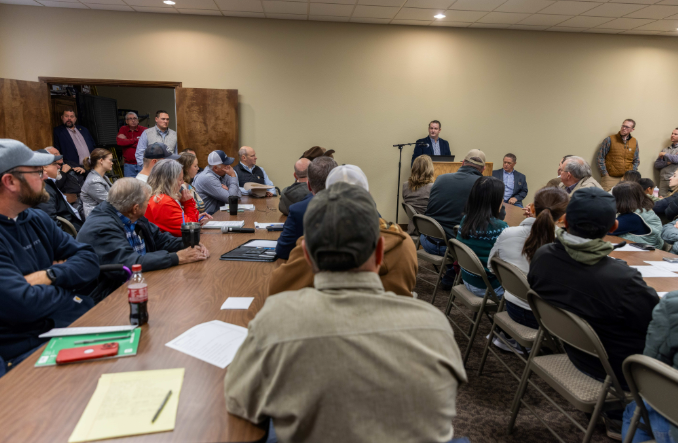
As the long-dormant lawsuit resurfaced and Attorney General Gentner Drummond pushed forward, anxiety among growers escalated. Langley says the fear stems from unpredictability: “Now it’s the unknown that we’re scared of… depending on his ruling, it could really affect a lot of people.” She was especially alarmed by communications in which Drummond appeared to dismiss growers’ concerns, noting, “My concern… Simmons can’t just pick up 52 contracts from Tyson. That’s not realistic.”
Tension grew further when Tyson notified all broiler growers in the watershed that contracts would not be renewed. Langley reiterates the magnitude: “Starting next year, 14 families, 14 farms will lose their contracts… and ultimately it will be 57 contracts.” She attended a recent meeting in Fayetteville where she witnessed “a lot of worry… a lot of people who could potentially lose everything they have.”
According to the Northwest Arkansas Democrat Gazette, Tyson is serious about backing out of their closest to home watershed- “Tyson’s growers have called portions of the Illinois River Watershed home for over 80 years,” the company’s statement from Wednesday says. “We are heavily invested in this community and want to see it thrive. The last thing we want is to curtail contract growing in our own backyard.”
“In making this difficult decision, we have determined we will continue to honor all existing grower contracts through their remaining terms, some of which last for more than a decade,” the statement says. But Tyson cannot offer any new contracts in the Illinois River watershed “because it is no longer a hospitable place to do business,” the statement says.
Even though her farm currently contracts with Simmons, Langley says the company is also named in the lawsuit. If fines are imposed, “How many blows can Simmons take… before they say it’s not worth it?” She stresses that it is family growers—not corporations—who stand to lose the most. “These are owned by real people… Tyson’s not going to take the hit. We are.”
Langley believes the path forward requires Attorney General Drummond to acknowledge improvements and listen to farmers. “The phosphorus levels have gone down… the water quality is better, and he’s not listening to that,” she argues. She also warns that banning litter would force producers toward less-regulated commercial fertilizers, raising new environmental concerns. As both a poultry farmer and a rural water board member, she notes that their drinking supply comes directly from the watershed—and remains clean. “It takes very little to clean that water… so I want more than anybody to have clean water, because we drink it every day.”