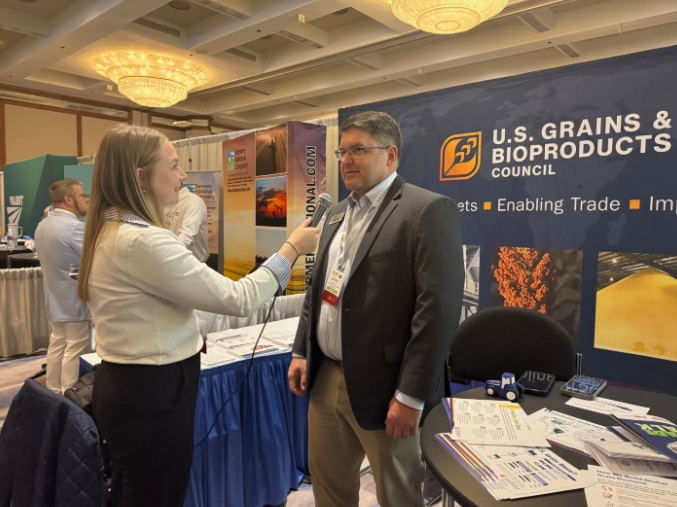
Global trade pressures and shifting political dynamics are reshaping how U.S. grains and bio products move into key international markets. Our Own Maci Carter caught up with Andrew Brandt, Director of Trade Policy for U.S. Grains & BioProducts Council, who says current U.S. trade policy is being shaped most heavily by North American relationships, pointing to the U.S.-Mexico-Canada Agreement as the single most important framework for grain and biofuel exports. He calls USMCA “the cornerstone of trade policy,” noting that Mexico is “our number one corn market” while Canada stands as “our number one ethanol market.” Brandt explains that the agreement is now under its six-year review process, which will culminate next July with a report from the Trump administration that could determine whether the deal continues unchanged or is modified.
Global political shifts, particularly involving China, have had immediate and painful impacts on U.S. producers, according to Brandt. He says tensions with China led the country to “basically quit buying sorghum altogether” over the summer, a move that was “pretty devastating to some of our soybean sorghum farmers.” In some regions, he notes, growers “couldn’t even get bids for their crops,” a situation Brandt describes as something many corn and soybean farmers have “never had to contemplate.”
Beyond geopolitics, Brandt emphasizes that global customer expectations are evolving, especially around sustainability and environmental transparency. He says buyers increasingly want to know “how corn is grown, how sorghum has grown, what the environmental impact of that is, or the footprint.” In response, the council has developed tools like the Corn Sustainability Assurance Protocol, adding that similar efforts for sorghum are now being rolled out to meet private-sector demand worldwide.
Looking ahead, Brandt identifies Southeast Asia as one of the most promising growth regions for U.S. grains and bio products. He points to recent trade activity following President Trump’s visit to the region, where new deals were announced with Vietnam, Cambodia, and others. Brandt says the long-discussed rise of the Southeast Asian middle class is becoming more actionable, while access to India could be “especially valuable for sorghum.”
Africa also looms large as a future market, Brandt explains, citing rapid population growth. He notes that the continent is expected to add “40 million people per year for the foreseeable future,” creating long-term demand for feedstocks and protein production. Before that, he says South Asia, including India and Bangladesh, remains a key stepping stone for expanded U.S. grain exports.
When it comes to risks, Brandt says China remains the biggest uncertainty because it can act “like an on-off switch.” He also warns producers not to underestimate competition from South America, describing Brazil and Argentina as “a very formidable force” capable of producing grain “at very, very competitive rates.” Lowering tariffs alone, he cautions, “may not necessarily guarantee we get that sale,” as U.S. farmers must still compete on price and performance.
Brandt outlines how the U.S. Grains and Bio Products Council works to defend and grow market share through boots-on-the-ground engagement. With 10 offices worldwide, he says the council focuses on demand-building, technical education, and trade servicing, from teaching poultry nutrition in Africa to resolving port and documentation issues. He stresses that relationship-building matters in a market where “some countries are just going to buy based on price,” while others value long-term trust.
In closing, Brandt says he wishes more producers and lawmakers understood the global impact of the council’s work. Drawing on his farm background in Missouri, he says many farmers may never see the council’s overseas offices, but checkoff dollars are being “leveraged with MAP and FMD funds” to deliver results. He describes the council’s mission as creating “a win-win situation,” exporting U.S. surplus while helping trading partners solve their own food and protein challenges.