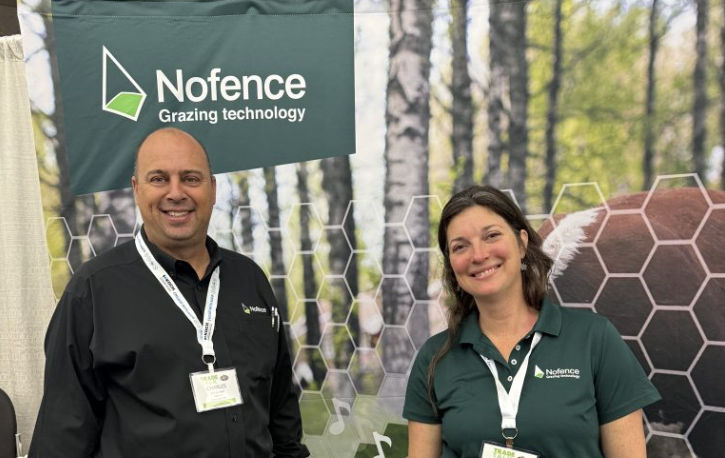
Meghan Filbert introduces her role as the community and partnerships manager for NoFence to intern Karleigh Erramouspe and explains how the company’s virtual fencing technology works. Filbert describes the system as GPS-enabled collars for cattle, sheep, and goats that connect to a phone app to set and adjust boundaries. As she puts it, the collars guide animals using “a scale of tones,” followed by a mild electrical pulse if the animal continues forward.” Filbert emphasizes that livestock learn the system quickly, saying animals are “trained in about seven days,” which then opens up extensive new grazing opportunities.
Filbert explains that virtual fencing has become a practical way for producers to expand or streamline rotational grazing. Many farmers, she says, use the collars “as a substitute for internal cross fencing,” which means they can create and alter paddocks instantly without the labor of installing physical fences. Because the animals “essentially move themselves,” producers can increase their rotational frequency without additional time or workload. This flexibility makes intensively managed grazing far more accessible.
The technology also benefits livestock performance. Filbert notes that users are seeing “better utilization of the biomass of the forage on the farm,” which leads to healthier animals, improved weight gain, and potentially stronger reproductive outcomes. She highlights that the system is “animal friendly” and helps align livestock movement with forage availability more efficiently than traditional infrastructure allows.
Finally, Filbert discusses the broader environmental and operational advantages. Early adopters, she says, are grazing acres previously “unable to be grazed because they weren’t fenced or the fence was in disrepair,” including steep or brushy terrain. The technology has also supported targeted grazing—for example, goats managing invasive species—and has seen rapid adoption in California for “wildfire prevention.” Her advice to hesitant producers is to consider the new opportunities virtual fencing can unlock and to check with local NRCS offices, as “more and more states have approved virtual fencing as a cost share practice.”