
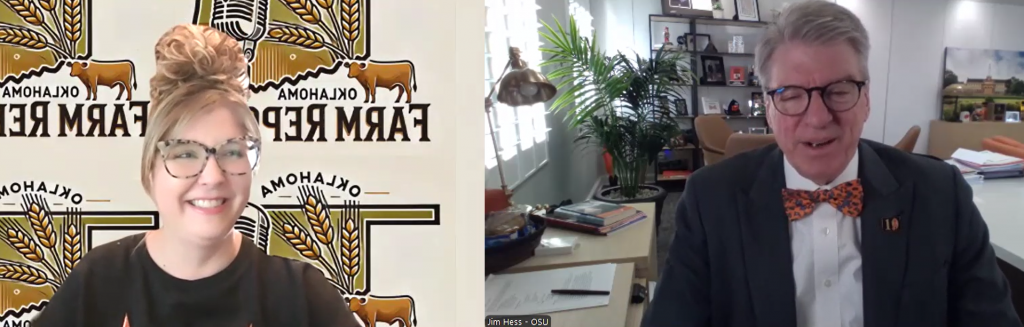
“The Hess Address” is a new quarterly feature on the Radio Oklahoma Ag Network designed to keep producers directly connected to Oklahoma State University leadership. In this series, Farm Director KC Sheperd sits down with OSU President Dr. Jim Hess to go beyond the headlines and discuss the real-world impact of higher education on rural Oklahoma. In this episode, President Hess opens up about the challenges of managing a snow-covered campus, unveils the ambitious “Code Calls” fundraising campaign, and explains why upgrading OSU’s agronomy research facilities is a critical legislative priority for the state’s wheat growers.
President Hess outlined a bold vision for the university’s future, highlighting critical legislative priorities, a major new fundraising campaign, and the evolving role of technology in agriculture.
Amid lighthearted banter about the recent snowstorm that dumped nearly 42 miles of sidewalk-clearing work on OSU’s landscape crews, Dr. Hess quickly pivoted to the university’s serious ambitions. Reflecting on his return to Stillwater last February, he emphasized his primary goal: restoring the College of Agriculture to its “premier status.”
Legislative Priorities and Agricultural Research
A centerpiece of this effort is a significant investment in infrastructure. Dr. Hess highlighted securing $250 million—eventually growing to $329 million—to rebuild the animal teaching hospital. He stressed the vital link between veterinary medicine and the agricultural economy, particularly given the shortage of rural veterinarians.
“That connection between veterinary medicine and our agricultural economy is absolutely critical,” Hess stated. “I really wanted to make that our first legislative priority. We got that done.”
Looking ahead to the upcoming legislative session, Dr. Hess identified the university’s agronomy research program as the next top priority. He underscored the urgency of upgrading aging facilities, noting that 70% of Oklahoma’s wheat production—and 13% globally—uses OSU wheat varieties.
“It’s time for our agronomy program to receive the attention that it deserves,” Hess said. “When you don’t have a controlled environment to be able to work on wheat genetics, you’re subject to the whims of the weather and temperature variations, and you can lose a decade’s worth of research on a season that we’re experiencing in the last few days.”
He specifically praised Dr. Brett Carver, OSU’s renowned wheat expert, calling him a “national treasure” who deserves the best facilities to continue his vital work. “It is absolutely critical for our wheat-producing economy in this state,” Hess added.
The “Code Calls” Campaign
To support these ambitions and ensure accessibility for rural students, Dr. Hess detailed the university’s comprehensive fundraising campaign, “The Code Calls.” The campaign aims to raise $2 billion, with half of that amount—$1 billion—dedicated solely to scholarships.
“For a student who wants to live and work and produce in a rural area, that scholarship can make the difference between whether they can actually come or not,” Hess explained.
The initiative goes beyond financial aid. Dr. Hess outlined a holistic support system for incoming students, including:
- Academic Advisors: Providing educational guidance.
- Career Coaches: Helping develop professional and life skills long before senior year.
- Alumni Mentors: Connecting students with one of the 265,000 active OSU alumni for a four-year mentorship.
“We want to recruit folks from rural Oklahoma, provide them the highest quality education at the best possible price, and then prepare them to go back and produce and be productive agricultural economic participants in rural Oklahoma,” Hess said.
Embracing Technology while Honoring Tradition
Addressing the future of agriculture, Dr. Hess discussed the role of Artificial Intelligence (AI). While acknowledging some resistance to new technologies, he framed AI not as a replacement for tradition, but as a “knowledge industry” tool that can enhance production and soil protection.
“We want to use artificial intelligence… in a way that is helpful and stays within the values boundaries and within our code,” Hess affirmed.
Supporting Extension
Dr. Hess also reaffirmed his commitment to OSU Extension, describing it as the “front door to the university” for many Oklahomans. He acknowledged the challenge of funding the network across 77 counties and expressed a desire to improve compensation for Extension agents, whom he described as “24/7, 365 employees.”
“It’s really important that we do everything we can to keep them compensated at a level where they can continue to provide the services that are vital to our rural areas,” he said.
Get Involved
For those looking to support OSU’s mission, Dr. Hess encouraged people to connect with the OSU Foundation or the Alumni Association. Whether through donations to specific interests such as the Beef Center of Excellence or through volunteering time as a student mentor, he emphasized that all contributions are valuable.
“Money is sure important… But time is also a treasure,” Hess concluded. “If they would love to be a mentor for a student… we can make that happen for them.