

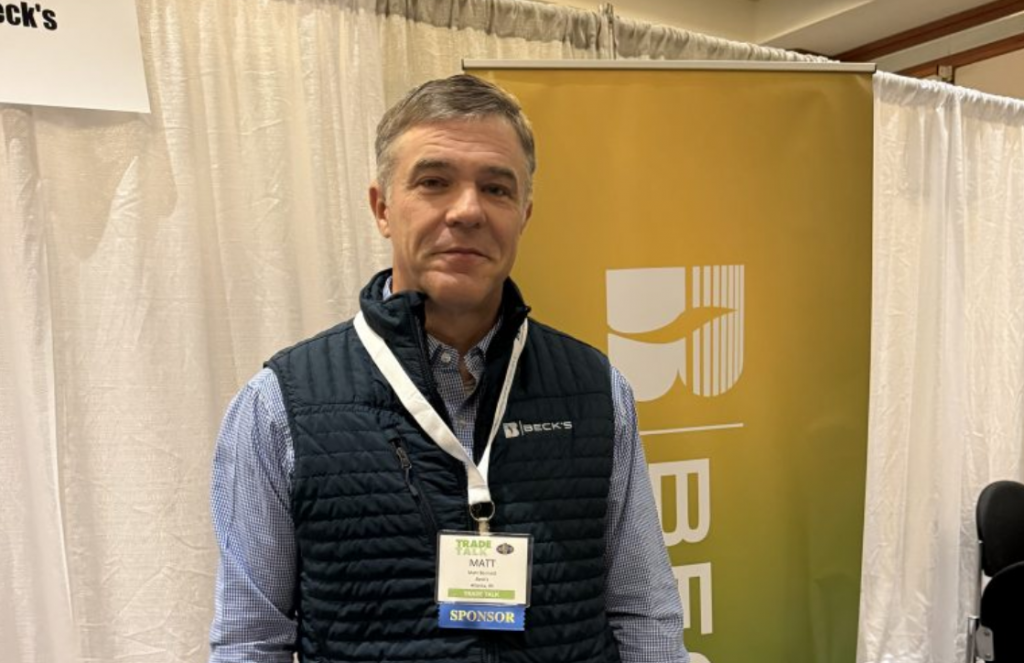
Matt Bennett, Grain Marketing Consultant at Beck’s Hybrids, spoke with Intern Karleigh Erramouspe about the challenges facing grain producers, emphasizing the need for flexible marketing strategies and a close eye on unpredictable global weather patterns.
The Dynamics Behind Corn and Soybean Prices
Bennett acknowledged the difficulties farmers have faced recently due to ample supply, which has kept prices depressed.
“Clearly the last couple years have been a real struggle for people. We’ve had what you would call ample supply in the U.S. and so what that’s done is it’s given the market very little reason to rally,” Bennett explained.
He noted that improved genetics have helped maintain this ample supply, as “some of these new genetics have performed quite well,” allowing crops to withstand drought-like conditions and keeping supply stable. However, he also highlighted a recent positive trend: “at least things are looking up,” pointing out that the soybean markets have been trading at 15-month highs recently.
Marketing Strategies for Risk Mitigation
When discussing how farmers can manage market risk in the current environment, Bennett advised moving beyond simple strategies like selling across the scale or holding grain in the bin.
He stressed the importance of flexible hedging to protect against downside risk while maintaining the ability to participate in market rallies.
“I want to be very flexible in my marketing plan,” Bennett asserted. He advises producers to adopt strategies that are not “going to hurt me so to speak,” meaning selling today while still having the ability to “participate in that upward market.”
Bennett uses his platforms—a marketing newsletter and a weekly live podcast on the Beck’s Hybrid YouTube channel—to help growers understand these complex, limited-risk strategies.
Global Weather Trumps Trade Deals
Bennett noted that while trade policy, such as the U.S.-China deal, receives heavy attention, global weather remains the dominant market driver. China’s promise to purchase U.S. soybeans is being offset by their simultaneous buying of cheaper Brazilian beans, but Bennett believes the buying target will ultimately be met because of the bigger picture.
“The U.S. is the largest consumer of goods in the world. We’re gluttons. I mean, that’s all there is to it. And so China wants our business,” he said.
China is willing to pay slightly more for U.S. soybeans in the short-term because the long-term trade deal involves dropping tariffs, allowing their goods to “freely flow… into the country.”
However, the most critical factor for prices moving forward is the weather below the equator.
“I think the more overriding factor is what’s going to happen with weather in South America,” Bennett stated, emphasizing that Brazil is now the largest soybean grower in the world.
He pointed to Argentina, a dominant player in the soybean meal market, which is currently “very dry.”
“If they stay dry, it’s a very strong likelihood that the soybean meal market will rally, which should drag along that soybean market as well. If the soybean market rallies, there’s a really good chance the corn market will rally too. So, what’s going on in weather south of the equator for the next three to four months is going to be much more important than what weather’s going on in the U.S.“
Addressing U.S. Drought for Spring Planting
Closer to home, Bennett is concerned about low moisture content across the Corn Belt heading into winter, cautioning that snow doesn’t deliver the same moisture benefits as rain.
“A big chunk of the Corn Belt’s dry right now and it’s very concerning… We don’t like to go into a freeze with really low moisture content because let’s say we get a big snow year, that’s not going to give us the moisture that good rain gives us,” he noted.
Ultimately, Bennett sees the role of Beck’s Hybrids, and his marketing consultancy, as helping growers survive these challenging times. “We’re both trying to do the same thing. We’re both trying to help growers.”







