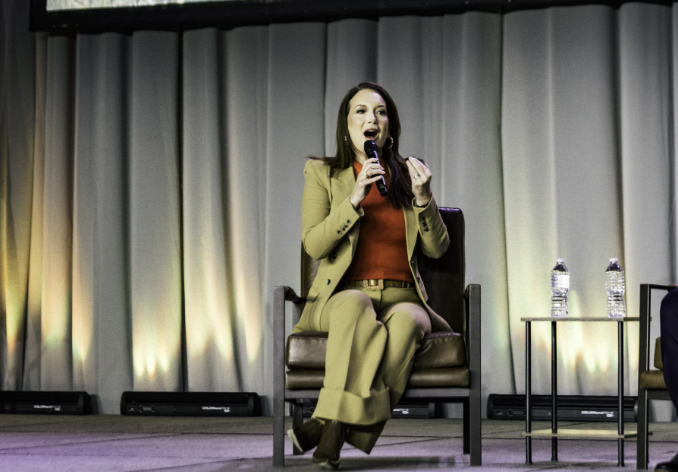
In today’s Beef Buzz, Senior Farm and Ranch Broadcaster Ron Hays features comments with U.S. Secretary of Agriculture Brooke Rollins, who is signaling a possible shift toward reopening the U.S.–Mexico border to feeder cattle imports while continuing aggressive efforts to contain New World screwworm. The Secretary spoke with the media following her Saturday address to cattle producers attending the Texas and Southwestern Cattle Raisers.
A Possible Path to Reopening the Border
Rollins made it clear that while the border has remained closed up to this point, conversations are intensifying about a limited reopening strategy. “Up to this weekend, we’ve had no plan to reopen the U.S.-Mexico border to allow Mexican feeder cattle to come back into the United States.”
Now, that stance is evolving as USDA evaluates risk and geography. “We’re currently evaluating a potential phased-in strategy.” “We obviously will not be opening all four ports anytime soon.”
She pointed to the westernmost port as the most likely candidate for an initial reopening due to its distance from current screwworm activity. “There is a realistic conversation that’s currently happening that’s looking at that port that’s about 800 miles from the closest case.”
That westernmost port of entry is at Agua Prieta, Sonora which crosses into Douglas, Arizona. It was one of two ports that were open from February to May of 2025 under the multi step protocols designed to keep New World Screwworm out of the United States. No Mexican cattle have been allowed since then into the US.
Secretary Rollins says Producers won’t have to wait long for clarity. “More to come on that, I expect an announcement either way on that perhaps within the next two to four weeks.”
Screwworm Pressure Building, But Containment Holding
Rollins acknowledged that the New World screwworm continues to push north, but emphasized that containment efforts have exceeded expectations. “Against all odds, I mean every model showed the New World screwworm being in Texas last summer.” “So against all odds, we have been able to keep it, with a few exceptions, right around 200 miles south of the Texas border.”
However, she didn’t downplay the ongoing risk. “There’s no question, when you look at the heat maps, that it is in large proportion moving up.”
USDA is responding in real time with constant monitoring and adjustments. “We have the new dispersal facility… moving around and adjusting as day to day as we get new data coming in.” “So we’re looking at it every single day.”
She also highlighted how distance varies by region. “The closest the screwworm has gotten to the Arizona border is about 800 miles.” That being the reason, the USDA is considering opening that port.
Border Closure Driving Stronger Cooperation with Mexico
Rollins credited the border closure with strengthening accountability and cooperation between the U.S. and Mexico. “I think they would have been good partners… whether we closed the ports or not.” “But I know for sure they have been much better partners because those ports have been closed.”
She said that pressure has translated into measurable expectations. “They have to meet a certain number of metrics and goals. We’re holding them to that and accountability.”
The U.S. has also stepped in with direct support to bolster the response. “We’re obviously deploying USDA resources. They don’t have the resources we do.” “It became very clear that to protect Texas, we were going to have to use our own resources in Mexico.”
“Our staffing, our tools in Mexico… our traps, etc.”
Even with that support, she emphasized the partnership has been productive. “So they have been good partners.”
Billion-Dollar Investment in Sterile Fly Facility
A major part of the long-term strategy is a new sterile fly production facility in South Texas, and Secretary Rollins says USDA is ready for an official groundbreaking ceremony. “We are actually looking for a date right now. We expect it to be mid-April.”
“Obviously, it’s not slowing the work down. The contract has been signed. We are ready to go.”
She stressed that the investment is significant, especially in the current political climate. “This groundbreaking is pretty unprecedented at a time when our administration… is working to cut costs, cut taxes, shrink government.” “We’re investing a billion dollars in that particular effort in South Texas.”
The goal is to eliminate reliance on foreign infrastructure. “So we’re no longer or ever again reliant on a facility in Panama that clearly isn’t producing nearly enough flies.”
Staying Visible and Prepared at the Border
Rollins says her repeated visits to the southern border are intentional and necessary to maintain focus on the issue. “That will be maybe my fourth trip to the border, which is more than I think I’ve been anywhere.” “That McAllen trip for me is really important.”
She said those visits help keep producers informed and engaged. “It helps us bring attention to the story every time that I am there.” “It helps us get the message out to our producers, our ranchers… on what we’re working to achieve.”
Ultimately, the goal remains containment—but with readiness for any scenario. “Our goal… we feel fairly confident, at least to this point, we’ve been able to contain, keeping it out of America, keeping it out of Texas.” “But if it ends up in Texas, we’re ready for that as well.”
Oklahoma Farm Report shared Secretary Rollins’ comments in Ft Worth with Texas Cattle Feeders President & CEO Ben Weinheimer, who offered this reaction: “TCFA continues to be supportive and appreciative of the comprehensive approach that Secretary Rollins and the team of animal health experts at USDA-APHIS have worked intently to implement in response to NWS in Mexico.
“TCFA’s position has been aligned with Secretary Rollins, inclusive of new sterile fly production and dispersal facilities; close coordination with federal and state agencies for research, response protocols and treatment options; importation of feeder cattle from Mexico subject to strict inspection and treatment; and science-based domestic zoning and regionalization.”
“It is encouraging to hear Secretary Rollins report on the progress being made to fight NWS in Mexico and mention the possibility of revisiting a staged reopening of the border ports in the coming weeks. While cattle markets and freight largely determine the final destination of Mexican feeder cattle in the U.S, in the past it has been common for cattle to originate from any of the ports along the border and ultimately be fed in TCFA member feedyards.”
The Beef Buzz is a regular feature heard on radio stations around the region on the Radio Oklahoma Ag Network and is a regular audio feature found on this website as well. Click on the LISTEN BAR above for today’s show and check out our archives for older Beef Buzz shows covering the gamut of the beef cattle industry today.