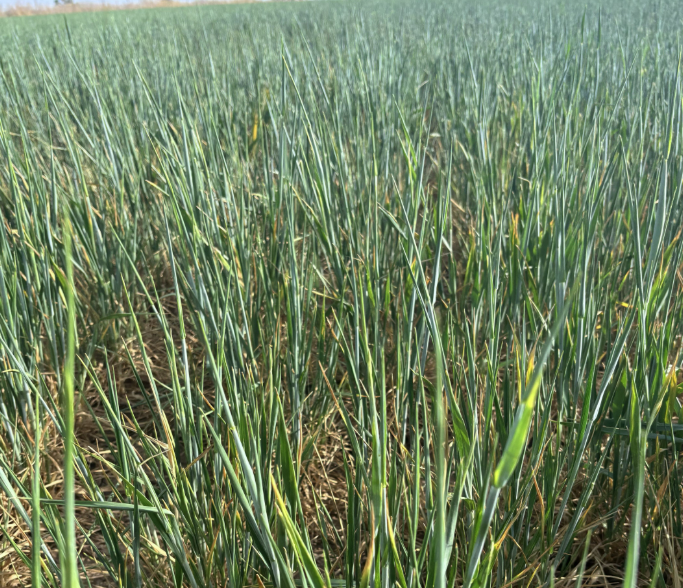
Oklahoma wheat producers are facing one of the toughest seasons in recent memory as drought, freeze damage and pests continue to drag down the 2026 hard red winter wheat crop across the Southern Plains.
Schulte: “I’ve Never Seen It This Bad”
Speaking with senior farm and ranch broadcaster Ron Hays, Executive Director of the Oklahoma Wheat Commission. Mike Schulte said conditions across Oklahoma — and much of Kansas and Texas — are among the worst he has seen during his time with the commission.
“It’s just really not,” Schulte said when asked if this is a favorable crop year. “Unfortunately, it’s really probably not going to be a favorable crop for the southern plains of the United States.”
He added, “I myself, in my tenure at the commission, have never seen it this bad.” Schulte said the combination of prolonged dryness since November and multiple cold snaps hit an already stressed crop hard.
“Just because of the lack of moisture from November up until this point, it really created hardship for the crop,” he said. “So it was so stressed when we got a couple of those cold snaps. Certainly we do see freeze damage in the field.”
He said producers are also seeing lost tillers and poor recovery in grazed wheat fields. “This is a year where it just did not recover very well from the grazing situation,” Schulte said.
Poor Ratings, Pest Pressure and Insurance Claims
According to Schulte, USDA recently rated Oklahoma’s crop just 10% good to excellent, while 48% fell into the poor-to-very poor category. “It’s really just been a role reversal of where we have been the last two years,” he said, noting much stronger ratings at this same point in both 2024 and 2025.
Beyond weather stress, Schulte said insects and mites are adding more pressure statewide. Central Oklahoma producers are dealing with greenbugs and bird cherry oat aphids, southwest Oklahoma has seen brown wheat mites, while western counties and the Panhandle are battling wheat curl mite issues.
“In many instances, producers have been trying to weigh the options of even if they need to treat for those issues because the crop’s looking so poor,” Schulte said.
He added that many farmers have already turned fields over to insurance adjusters, especially in southwest and central Oklahoma. “There are many regions where probably half of the crop has already been turned in to be disastered out,” he said.
Tough Economics and Looking Ahead
With rising input costs and very low yield expectations, Schulte said many growers had little choice but to abandon some acres. “They really didn’t have a decision,” he said. “There wasn’t really any reason for them with the high input costs that we’re dealing with right now.”
Some early reports suggest yields as low as three to four bushels per acre. “When they say the break-even point’s eight to 10 bushels, it would be really hard to do that right now and make it make sense,” Schulte said.
Even so, Schulte said producers are hoping late-April moisture can help areas of central and north central Oklahoma still hanging on. “As we move forward, we’re just hoping to get this one behind us, and hoping to look forward to a better year ahead next year,” he said.
Wheat Plot Tours Begin April 20
Schulte also reminded producers that Oklahoma State University wheat variety plot tours begin April 20 in Walters and continue through May 22 in Miami.
Individuals can find the full schedule through the Oklahoma Wheat Commission website at OKWheat.org.