

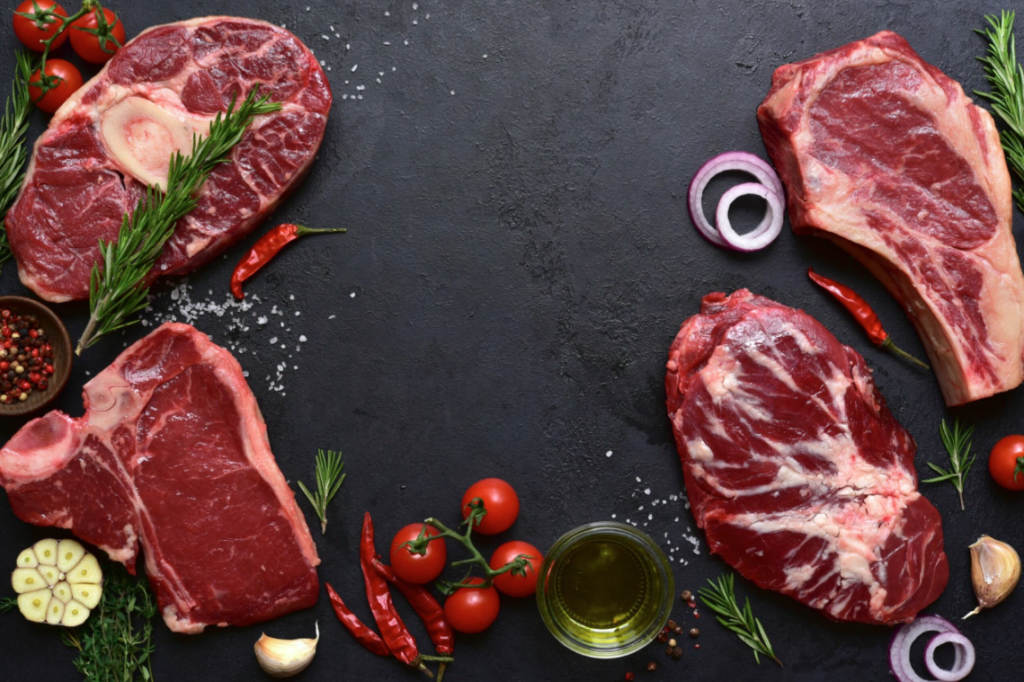
In today’s Beef Buzz, senior farm and ranch broadcaster Ron Hays features comments with Dr. Glynn Tonsor about the latest consumer demand trends from the monthly Meat Demand Monitor and why beef continues to outperform other proteins. Tonsor, a livestock market economist at Kansas State University, works with both the beef and pork checkoff programs to monitor consumer meat demand. He said the newest April data shows beef demand remains surprisingly resilient.
“So you asked about willingness to pay retail — grocery store demand for meat in April was up in six of the eight categories we track,” Tonsor said. “Specifically to beef, ribeye steak and ground beef, the willingness to pay numbers were higher than they were in March, which is great.”
While retail demand strengthened, Tonsor said restaurant demand softened slightly compared to the previous month. “When we look over to food service, it’s actually the opposite, so we’ve had some pullback,” Tonsor explained. “I want to pause there, though, because March had some very strong food service numbers.”
Tonsor believes beef demand remains strong despite broader economic uncertainty. “I would put a bow on this and say the beef side of demand remains pretty good, surprisingly good, given lots of the other kind of challenges and uncertainties outside of the industry,” Tonsor said.
Beef Continues to Outperform Other Proteins
According to Tonsor, longer-term trends continue to favor beef over competing proteins like pork and poultry.
“If you back up and do kind of a broader year-over-year, what’s the two, three, five-year trend in demand here, and not just with Meat Demand Monitor but multiple data points, I’m always watching,” Tonsor said. “The beef demand strength is definitely outpacing what’s going on in pork and chicken.”
The Meat Demand Monitor also tracks the factors driving consumers’ purchasing decisions. Tonsor said taste consistently remains the top reason consumers choose beef. “So it’s a list of 12 things, and it’s a forced rank,” Tonsor explained. “We regularly find taste and freshness lead the decision. They are most frequently the top decision factor for folks.”
Price and food safety typically follow behind taste and freshness, although price has become increasingly important over the past few years. “There was a time when safety outpaced price,” Tonsor said. “About halfway through this MDM project, three years ago or so, price replaced safety. So price has grown in importance.”
Meanwhile, factors such as environmental impact, traceability, animal welfare, and hormone or antibiotic use continue ranking much lower among most consumers.
“Taste is the key determinant factor,” Tonsor emphasized. “That’s not a new statement, but just because something isn’t new doesn’t mean it isn’t useful for us to remember it, and I think it’s critical to the beef demand success story we’ve witnessed the last few years.”
Consumer Finances Influence Beef Consumption
The monthly survey also tracks consumers’ attitudes toward their personal finances and how those attitudes affect meat purchases.
“So in April in the MDM, 17% told us their finances are better than April of 2025,” Tonsor said. “Contrast that with a full 38% — so over a third — say they’re worse.”
Those perceptions directly influence beef consumption levels.
“If you tell me your finances are better than a year ago, you consumed a little less than one meal — specifically .86 meals yesterday — that included beef,” Tonsor said. “Conversely, if you tell me, ‘No, my finances are worse,’ it’s more like .6.”
Tonsor said those differences may seem small individually, but they become significant when multiplied across the U.S. population.
“We’re a country of over 300 million people, so these small differentials times a big number, it adds up,” Tonsor said.
He added that consumers feeling financial pressure are especially likely to reduce restaurant spending.
“What market channel are we seeing these differentials show up in?” Tonsor asked. “It’s primarily if your finances are worse, you go to restaurants and spend money at restaurants less.”
The Beef Buzz is a regular feature heard on radio stations around the region on the Radio Oklahoma Ag Network and is a regular audio feature found on this website as well. Click on the LISTEN BAR above for today’s show and check out our archives for older Beef Buzz shows covering the gamut of the beef cattle industry today.







