

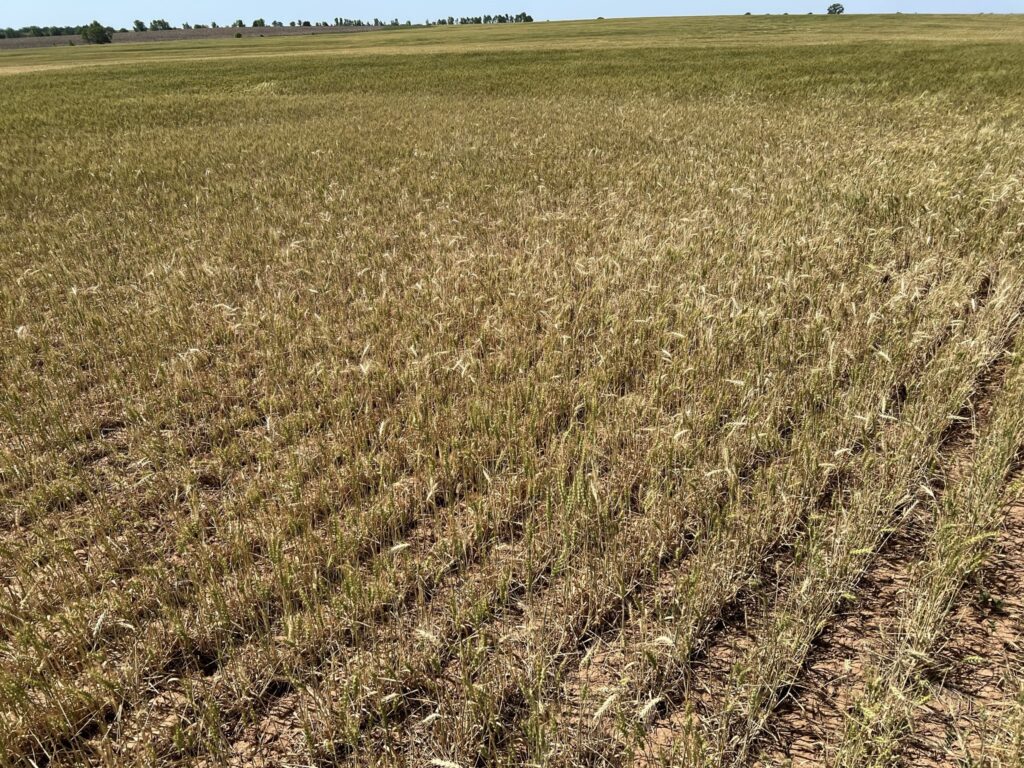
As the first leg of the 2026 Kansas Wheat Crop Tour drew to a close on Tuesday, participants emerged with a narrative of two crops: one flourishing in the eastern corridors and another struggling against the harsh realities of a dry, cold winter in the west. Senior Farm and Ranch Broadcaster Ron Hays caught up with Kremlin, Oklahoma wheat producer Dennis Schoenhals after a day of travel from Manhattan to Colby, Kansas.
Dennis Schoenhals, immediate past president of the Oklahoma Wheat Growers Association and a veteran of the tour, reported a day of stark contrasts. Traveling from Manhattan through Junction City and eventually out to Colby, the scouting teams witnessed a dramatic shift in crop health as they crossed US Highway 281- north of Russell, Kansas.
The “Tale of Two Crops”
The initial trek began with optimism. “We saw several really good fields of wheat there as we headed west towards Highway 81,” Schoenhals noted. However, the optimism faded as the teams pushed further into the western third of the state.
By the time the tour reached the Russell area, the agricultural landscape had shifted significantly. “We started seeing very short moisture,” Schoenhals said. “The grounds, the fields were cracked. The plants were about 10 to 12 inches shorter than the fields that were east of Highway 281.”
Environmental Toll: Freeze and Disease
Beyond the lack of rainfall, western Kansas wheat has endured a brutal temperature regime. Schoenhals highlighted significant freeze damage resulting from a stretch where temperatures plummeted below 24°F for three consecutive days during the critical “boot” stage of development.
The physical evidence of this stress was undeniable in the fields:
- Physical Damage: Yellowed plants, “white heads,” and heads that were kinked or struggling to emerge from the boot.
- Disease Pressure: Observations of Wheat Streak Mosaic, a persistent issue that also plagued the region in 2025.
- Yield Loss: Estimates suggested that in some fields, 15% to 20% of the crop had been significantly impacted by these combined factors.
Surprising Yield Indicators
Despite the visible damage, the day’s final numbers offered a surprising glimmer of resilience. While some western fields yielded measurements as low as 21 bushels per acre, others nearby hit the 50-bushel mark.
“It was very spotty,” Schoenhals explained, echoing a prediction from Justin Gilpin, Executive Director of the Kansas Wheat Commission. “You’re going to drive along and see a really good field… and 10 miles later down the road you’ll see a really poor field. That’s just how spotty the rain was or the snow was this last winter.”
The day’s 12-field car average ended at 43 bushels per acre, a figure that Ron Hays of the Oklahoma Farm Report noted was “not too awfully bad” given the environmental gauntlet the crop has run. Schoenhals agreed, stating the teams were “pleasantly surprised” that indicators were higher than anticipated.
A total of 17 cars drove various routes across the top of Kansas- and the at the report session in Colby- 187 stops were made by the scouts- and came up with an average yield of 38.3 bushels per acre. That compares to the 2025 which had 196 stops for day one with an average yield of 50.5 bushels per acre.
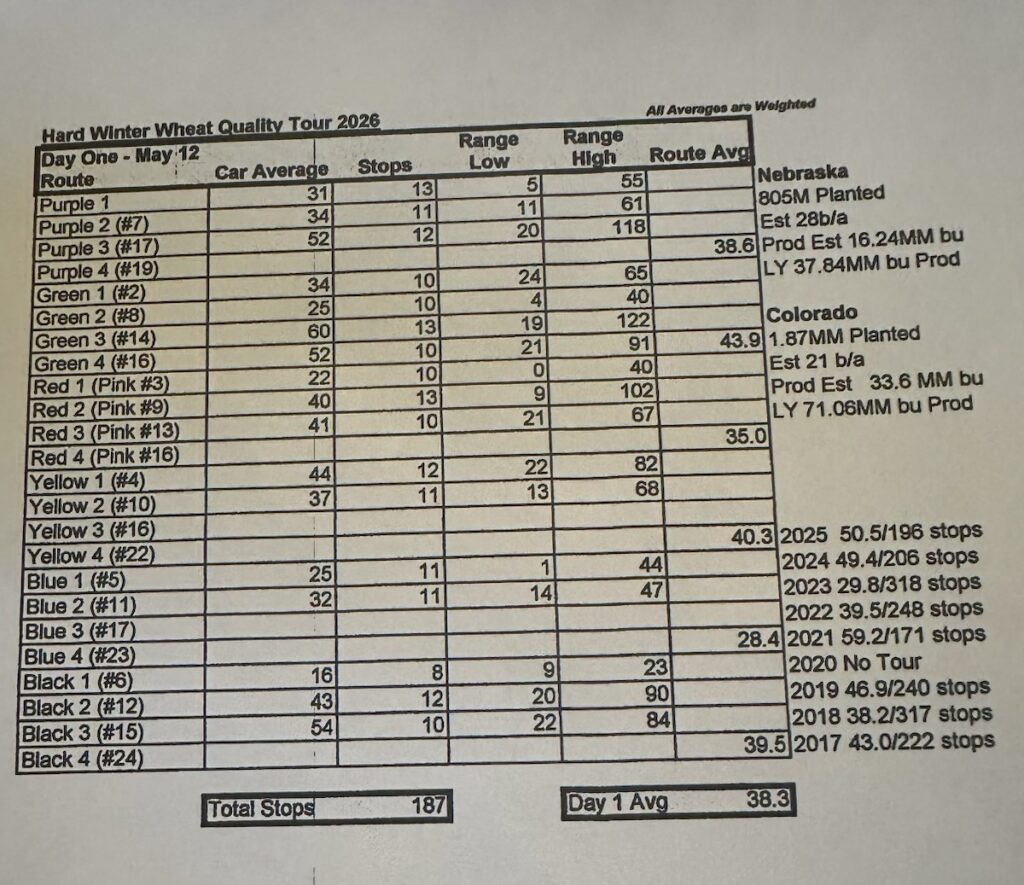
More than 60 are participating in this year’s event, said Sean Finnie, Wheat Quality Council interim executive director. Over the course of three tour days, the group will collectively travel thousands of miles across multiple routes in Kansas, along with one route in southern Nebraska and one in northern Oklahoma. Along the way, the scouts will stop in hundreds of wheat fields and estimate the crop’s overall yield potential, assessing its condition and quality and noting the presence and severity of insects and disease.
Looking Ahead: The Oklahoma Border
On Wednesday, the tour shifts its focus southward. Schoenhals and his team will drop down through Liberal, Kansas, crossing into the Oklahoma Panhandle near Forgan.
The transition into Oklahoma marks a shift from scouting to the brink of harvest. “I was telling my son Sunday afternoon I thought maybe we could be sampling on a week from yesterday,” Schoenhals said, noting that his custom cutters are already moving equipment into place. “Next Monday we might be… my cutter’s already got a combine down ready to go.”
The tour will conclude Thursday midday in Wichita, where final reports will be synthesized to provide a clearer picture of the 2026 winter wheat production outlook for the largest wheat producing state in the US. .
Key Tour Stats – Day 1 (Schoenhals Car):
- High Yield Measurement: 50 bu/acre
- Low Yield Measurement: 21 bu/acre
- Car Average: 43 bu/acre
- Primary Concerns: Freeze damage, drought stress, Wheat Streak Mosaic.







