

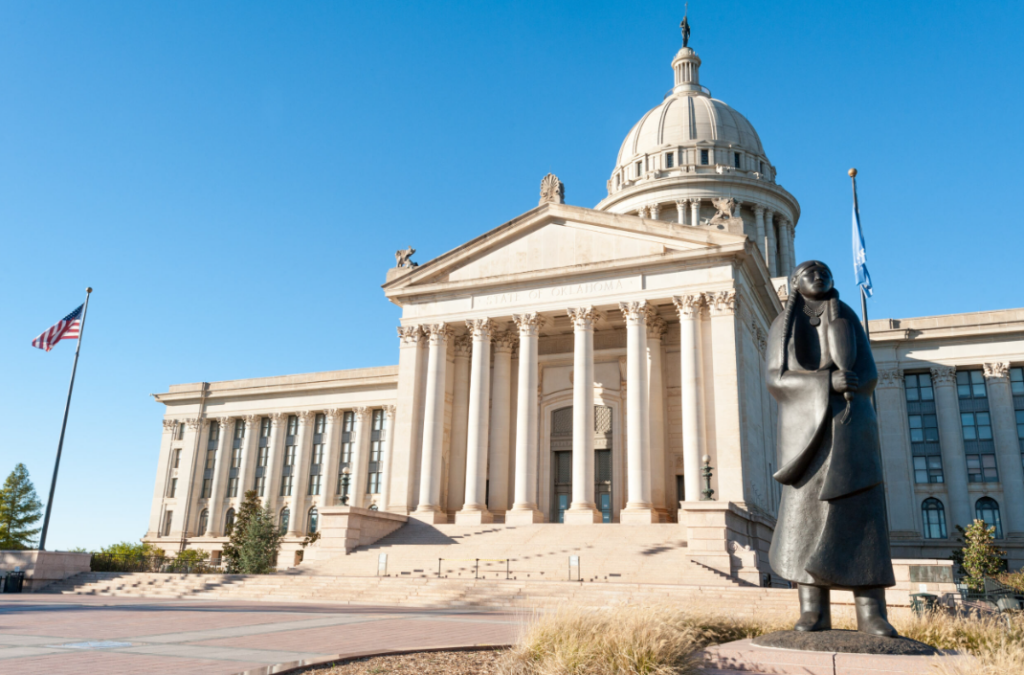
The second regular session of the 60th Oklahoma Legislature adjourned, sine die. The House was committed throughout session to advancing conservative priorities for Oklahomans and many significant policy wins will make Oklahoma better in the years to come.
The House, Senate and Governor came to an early agreement on the FY27 budget, the earliest in recent state history. The budget prioritized fiscal discipline while making strategic investments in critical areas of state government.
The budget makes significant strategic investments in education, including $27.3 million to fund health insurance increases for teachers, almost $80 million dedicated to reading and math initiatives, including support for the Strong Readers Act, and $100 million for teacher pay raises. These investments, along with others reinforce the Legislature’s commitment to improving student outcomes while strengthening Oklahoma’s education workforce. In total, the Legislature committed $232 million in new money to common education this year, triggering a 7-day increase in the school year to a minimum of 173 days in accordance with HB3151.
The budget also increases funding for the Department of Mental Health to support efforts with the ongoing consent decree, the Oklahoma Healthcare Authority for increased Medicaid utilization and the Department of Human Services for Advantage waiver, changes to the SNAP program and child care teacher recruitment and retention.
This budget also includes a cost of living adjustment for the Teachers Retirement System (TRS), Oklahoma Public Employees Retirement System (OPERS), Oklahoma Law Enforcement Retirement System (OLERS), Police and Firefighters Pension and Retirement System and Uniform Retirement System for Justices and Judges.
Once again, the Legislature made historic investments in education coupled with meaningful reform. Senate Bill 1778, authored by House Speaker Kyle Hilbert, R- Bristow, strengthens early literacy efforts through statewide reading screenings, targeted interventions grounded in the science of reading, additional support and training for teachers, stronger accountability measures and improved communication with parents about their child’s reading progress.
Under the new law, schools will identify reading deficiencies earlier and provide evidence-based interventions to help students improve before they fall behind. The legislation also expands teacher training opportunities, increases classroom support for educators and establishes new expectations for colleges of education preparing Oklahoma’s future teachers.
House Bill 2288 changes an existing 36-month waiting period to six months for teachers who retire before they can return to teaching in Oklahoma public schools, while also drawing on their earned retirement benefits. Currently, teachers are allowed to go into a job in the private sector or in a private school, but must wait 36 months before returning to a public school classroom.
House Bill 1276, or “Bell to Bell no Cell” by Rep. Chad Caldwell, R-Enid, requires school districts to permanently adopt a policy prohibiting students from using cell phones on campus during the school day.
The House also increased the annual cap on the Parental Choice Tax Credit, giving more parents the chance to choose the educational experience that best meets their child’s needs. Additionally, House Bill 3372, authored by Rep. Rob Hall, R-Tulsa, establishes a revolving loan fund program to provide lower-interest financing options for charter school capital projects, including construction, renovation and property acquisition. It also creates a bond credit enhancement program to help qualifying charter schools access more favorable financing terms.
Other legislation aimed at improving our student outcomes:
- House Bill 3151– increases the minimum number of instructional days from 166 to 173 for schools operating under an hours-based calendar, while maintaining the current minimum of 1,086 instructional hours
- Senate Bill 1177– creates the school security revolving fund and extends $50 million in annual school security funding for three years
- Senate Bill 1481– requires schools to provide students in grades pk-5 with 40 minutes of recess per day, which may be divided into two 20-minute periods
Since 2019, Majority Floor Leader Josh West, R-Grove, worked towards strong data privacy laws in Oklahoma. Senate Bill 546, authored by West, establishes new consumer rights regarding personal data and creates clear rules for businesses that collect and process information from Oklahoma residents. Under the new law, Oklahomans will be able to access, correct, delete and obtain copies of their personal data, as well as opt out of the sale of their personal data and certain targeted advertising practices.
House Bill 1168, authored by Rep. Denise Crosswhite-Hader, R-Piedmont, creates a felony offense for anyone to knowingly possess or deliver abortion-inducing drugs to someone who intends to use them for an abortion.
Senate Bill 633, also known as Leo’s Law, made its way to the governor’s desk today. Leo’s Law is written in honor of Leonardo “Leo” Towe, a three-year-old Oklahoma child who died from fentanyl poisoning during an ongoing custody dispute. This legislation establishes the Child Welfare Fentanyl Testing Revolving Fund and appropriates over $1 million to support testing and child welfare response efforts.
“The House entered this session committed to protecting taxpayers, defending conservative values and delivering results for the people of Oklahoma,” said Hilbert. “While not every priority reached the finish line, we made meaningful progress on education reform, public safety, economic development, government accountability and protecting individual freedoms. I am proud of the work of our members this session and remain committed to continuing the fight for policies that keep Oklahoma strong and prosperous for generations to come.”
The Oklahoma Senate Thursday, adjourned the Second Session of the 60th Legislature sine die, marking the official end to this year’s Legislative Session.
Pro Tem Lonnie Paxton, R-Tuttle, said it was a successful year with meaningful laws passed and signed into law for all Oklahomans.
“From strengthening our schools and delivering a historic teacher pay raise to making insulin more affordable, investing in water infrastructure and protecting Oklahomans, this was a highly productive legislative session, where we delivered on things that matter most to Oklahomans,” Pro Tem Lonnie Paxton said. “We passed a responsible state budget that makes significant investments in core areas of state government, while maintaining our commitment to conservative fiscal stewardship. We also advanced important reforms to improve literacy and math achievement, support parental choice and uphold election integrity. I am proud of the work the Senate accomplished this year, and I appreciate the dedication of our members and staff in helping us deliver meaningful results for the people of Oklahoma.”
Session Highlights
Budget: Senate Bill 1177, the state budget bill for Fiscal Year 2027, was passed in recent record time. The budget included The General Appropriations bill is the backbone of the state budget and sets the framework for state agency appropriations. The bill includes a $232 million increase in common education funding for teacher pay raises and initiatives to help young students learn to read and understand fundamental math skills.
Additionally, the budget increases funding for health care, public safety and mental health services while also making targeted investments in critical infrastructure projects and economic development initiatives. It also puts millions toward investments in water infrastructure.
Federal Gas Tax Relief: The Senate amended House Bill 1370, which repeals an outdated law ensuring consumers will benefit directly from any federal gas tax suspension. President Trump said he wants to suspend the federal gas tax to help Americans facing higher fuel costs. During a review of state law, Senate Appropriations Chairman Chuck Hall, R-Perry, and Senator Grant Green, R-Wellston, identified a little-known provision enacted in the 1990s that would automatically raise Oklahoma’s state fuel tax by the same amount as any federal tax reduction.
The Senate adopted an amendment to House Bill 1370 repealing the outdated trigger language and ensuring consumers would benefit directly from any federal gas tax suspension.
Strong Readers Act: Senate Bill 1778 – strengthens the state’s Strong Readers Act to improve early literacy. The law mandates statewide reading screenings, science-based interventions, and stricter retention policies for third graders, with key provisions effective in the 2027–2028 school year.
Teacher Pay Raise: Senate Bill 201 – provides a $2,000 increase across the board pay raise for teachers.
Making Insulin More Affordable: Senate Bill 1344 – creates the Insulin Access and Affordability Program, which will be administered by the State Department of Health in order to increase patient access to affordable insulin, reduce prescription drug costs, bolster American manufacturing, increase marketplace competition, and address market shortages for generic insulin.
More Recess for Kids: Senate Bill 1481 – requires schools to provide students in grades pk-5 with 40 minutes of recess per day, which may be divided into two 20-minute periods. Schools are prohibited from withholding recess as a form of discipline.
Disrupting Religious Meetings: Senate Bill 743 – modifies the punishment for disturbing a religious meeting by allowing fines of not more than $500 and/or imprisonment for up to 1 year in the county jail. A second or subsequent offense is a felony, punishable by a fine of up to $1,000, imprisonment for up to 2 years or both.
Restrictions on SNAP Benefits: Senate Bill 1833 – directs the Department of Human Services to submit a request for a federal waiver to the U.S. Department of Agriculture Food and Nutrition Services to prohibit the use of SNAP benefits for the purchase of candy and soft drinks and any other foods the Director of Human Services deems to be an unhealthy food item. If the waiver is approved, the Department must implement the restrictions within 6 months of receiving federal authorization.
Data Center Consumer Ratepayer Protection Act of 2026: House Bill 2992 – requires data center developers and other large energy users to provide notice to the Corporation Commission, local county commissioners, and neighboring property owners within 60 days of buying land for a project. This legislation requires data centers to cover their electricity and infrastructure costs, and those costs cannot be passed onto Oklahoma ratepayers.
Protection for Victims of Child Sexual Crimes: House Bill 4227 – mandates that any settlement agreement that conceals the details relating to a claim of child sexual abuse or child sexual exploitation is void and unenforceable. This law also allows for prosecutions for sexual crimes against children may be commenced at any time after the commission of the offense.
Home Insurance Reforms to Ease Rates: House Bill 3781 – modernizes Oklahoma’s insurance rate filing system by transitioning the state from a “use-and-file” model to a “file-and-use” system. Insurance carriers will have to submit proposed rate changes to the Oklahoma Insurance Department before those rates can take effect, providing regulators additional time to review filings and challenge excessive increases.
Allowances for Opioid Antagonists: Senate Bill 65 – allows for any person to possess and store emergency opioid antagonists, acquire emergency opioid antagonists by purchase or donation, distribute or make emergency opioid antagonists available to any person to the extent permitted under federal law, and administer an emergency opioid antagonist to any person believed to be experiencing an opioid overdose.
Human Trafficking Victim Protection: Senate Bill 1810 – creates where in an action in a court in Oklahoma, if a party offers evidence of human trafficking, the testimony of an expert witness is to be admissible as evidence. The measure directs the Victims Services Unit within the Office of the Attorney General to provide services for victims of human trafficking and directs the Attorney General to enter into agreements or contracts for shelter of victims.
Increasing Minimum Instructional Days: House Bill 3151 – approved by Governor Stitt on May 1, 2026, increases the minimum number of instructional days for schools operating under a school-hours calendar to 173 days and allocates an additional $175 million in funding to the State Department of Education. This law also requires school districts to hold any parent-teacher conferences during school days.
More Funding for Parental Choice Tax Credit: House Bill 3705 – Increases the cap on tax credits for private school students under the Parental Choice Tax Credit to $275 million total.
Oklahoma Math Achievement and Proficiency Act: Senate Bill 1360 – creates an Office of Mathematics Improvement within the State Department of Education devoted to improving math instruction across the state. This legislation also includes screening requirements to ensure students in key grades are understanding critical math skills and creates math instructional teams to help educators better help kids who are struggling in math and those who are performing above their grade level.
Stopping Domestic Violence – Senate Bill 1238 makes domestic violence in front of a child a felony on the first offense. Senate Bill 1325 allows courts to require certain domestic abusers to wear a GPS-tracked monitor as a condition of bail.
Support for the TMaH Model: Senate Bill 1565 – requires that for participation in the Transforming Maternal Health (TMaH) Model, the Oklahoma Health Care Authority must have the power and duty to accept, receive, and expend federal funds, grants, cooperative agreements, or demonstration model funding awarded by CMS. Such funds must only be used for maternal health services and support for pregnant and postpartum women who are Medicaid members.
Right to Try for Individualized Treatments Act: Senate Bill 933 – allows certain patients with life-threatening or severely debilitating illnesses, typically terminal diseases, to access individualized treatments developed specifically for their genetic profile when no other approved options remain.
Restriction in the Electronic Monitoring Program: Senate Bill 137 – excludes inmates convicted of DUI, which results in an accident with great bodily injury, from eligibility in the Electronic Monitoring Program.
Minor Protection from AI: Senate Bill 1521 – establishes regulations for operators of conversational AI services that interact with minors. Operators must provide parental management tools for minor accounts and ensure the AI directs users who express self-harming or suicidal thoughts to the appropriate crisis services.
Penalty for Funding Gender Transition Procedures: Senate Bill 904 – requires that public funds must not be used or distributed to any entity for the provision or subsidy of any gender transition procedures, regardless of if the procedures are provided to a child or an adult. The measure also provides that the state Medicaid program must not reimburse or provide coverage for gender transition procedures for minors or adults.
Leo’s Law: Senate Bill 633 – strengthens protections for children who are exposed to the dangers of fentanyl by directing the Oklahoma Department of Human Services to conduct a safety analysis when a child is believed to be drug-endangered and to seek parental consent for drug screening.
Cracking Down on Repeat DUI Offenses: Senate Bill 1543 – closes a loophole in state law that allows someone to be charged with multiple DUI charges before their first offense is fully adjudicated. Under this measure, multiple misdemeanor DUI charges can be prosecuted as one felony offense.
Presidential Fitness Test: Senate Bill 1437 – creates the Donald J. Trump Physical Fitness Test and directs the Oklahoma State Department of Education to assess the overall fitness of students.
Extending Foster Care Services: Senate Bill 1806 – extends support services for young adults transitioning out of the foster care to eligible individuals between the ages of 18 and 21.
Harsher Penalties for Impersonating Law Enforcement: Senate Bill 1936 – makes it a D1 felony to falsely impersonate a law enforcement officer.
Uniform Faithful Presidential Electors Act: Senate Bill 1491 establishes a person appointed to fill a vacancy for a presidential elector must take an oath stating they will cast a ballot for the persons nominated for the offices of president and vice president by the appointee’s political party. The oath must be witnessed by the governor or designee and filed with the Secretary of State.
State Questions
Property Tax Relief: State Question 847 proposes giving Oklahomans the lowest fixed cap on annual property tax increases nationwide and expands the state’s existing “senior freeze” to prevent increases on property tax bills for many Oklahomans age 65 and older. Under this measure, the increase in the fair cash value for homestead property and agricultural land would decrease from 3% to 1.75%, while the cap for all other properties would decrease from 5% to 4%.
Election Integrity: State Question 846 ensures illegal aliens aren’t voting in Oklahoma elections by adding a voter ID requirement to our state Constitution. Voters are already required to show an ID at the polls under state law, but including this language in our Constitution adds another layer of election security that cannot be overridden by future legislators.
Judicial Reform: State Question 845 proposes modernizing the Judicial Nominating Commission to change the way judges are vetted and selected in Oklahoma. These proposed changes to the members who make up the JNC will make sure that the judges selected for the state’s highest courts reflect the views of the majority of Oklahomans.