
The second session of the 60th Oklahoma Legislature has officially concluded, with both the House and Senate adjourning sine die. Oklahoma Cattlemen’s Association (OCA) Executive Vice President Michael Kelsey noted that this year’s Oklahoma legislative session wrapped up earlier than usual, primarily driven by the upcoming June primary elections.
“This is really early, in fact, since I’ve been here, this is the earliest it’s ever been,” Kelsey said regarding the fast-tracked timeline. “I was over the Capitol talking to a couple of lobbyists who are pretty long in the tooth, and they can’t remember a budget agreement before Easter. This is kind of unprecedented. We’re in new territory.”
With numerous lawmakers facing challengers in their primary races, there was a strong push to finalize state business so members could return home to campaign. An agreement on the state budget was reached before Easter, allowing the legislature to conclude its work efficiently.
State Question 832: Minimum Wage Initiative
On the upcoming June primary ballot, Oklahoma voters will decide on State Question 832, which proposes increasing the state minimum wage to $15 per hour. Kelsey reported that the OCA is actively urging a “No” vote on this measure.
The primary concern for the agricultural sector is that the proposal completely eliminates all existing agricultural exemptions. Agriculture operates as a task-oriented industry, such as paying contractors by the mile for fence construction rather than by the hour. Kelsey emphasized that requiring agricultural operations to pay on a strict hourly minimum wage basis would significantly disrupt traditional industry practices, as producers build fences by the mile rather than by the hour.
Kelsey added that four additional state questions are anticipated to appear on future ballots, most likely during the November general election.
Ad Valorem and Property Tax Protections
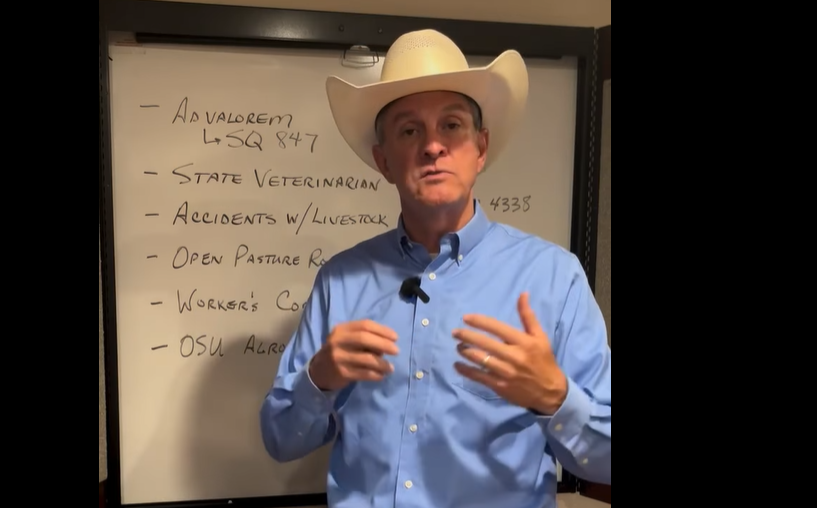
Ad valorem taxation was a major focal point leading into the session, and Kelsey highlighted the importance of State Question 847. This legislative referendum will appear on the November ballot as a proposed constitutional amendment.
- The measure lowers the maximum annual cap on property tax assessment increases for residential and agricultural real property from 3% to 1.75%.
- For all other property classifications, the maximum annual increase is adjusted from 5% to 4%.
- The legislation incorporates specific caps and freezes to protect older demographics and seniors.
Kelsey explained that this measure serves as a critical counterproposal to an alternative initiative seeking to eliminate property taxes on residential homes only.
“We’ve got this state question… that would eliminate property taxes on residential only—very, very bad state question for rural Oklahoma agriculture,” Kelsey previously warned. He explained that a residential-only exemption “will heavily shift the Ad Valorem, the property tax burden, onto land—agriculture land, commercial land, renters, industrial, stuff like that.”
Agricultural and Veterinary Legislation
Kelsey outlined several key pieces of legislation directly impacting agricultural operations that were passed and signed into law by the governor:
- State Veterinarian Qualifications: New legislation requires that the individual appointed as State Veterinarian must possess specific, practical experience with large animals. “State veterinarian requirement… would require that the state veterinarian have large animal experience,” Kelsey said. “We think that’s very, very appropriate and important.”
- Livestock Transport Accidents: Working in conjunction with the Livestock Marketing Association (LMA), legislation was enacted to establish clear parameters for emergency management personnel responding to vehicular accidents involving livestock. The law ensures the welfare and proper handling of cattle are prioritized during accident recovery before righting overturned transport vehicles.
- Open Pasture Roads: Updates were made to the Open Pasture Roads bill to reopen the enrollment period. Kelsey explained the intent was to provide essential liability protections for the landowner whose cattle may cross a county road running through unfenced land. He reminded producers that Oklahoma remains strictly a “fence-in” state, not an open-range jurisdiction.
- Workers’ Compensation Modifications: Senate Bill 1944 clarifies workers’ compensation requirements regarding independent contract services in agriculture. Kelsey noted that the law specifies agricultural operators are not required to provide workers’ compensation coverage for independent commercial truck drivers hired to transport livestock, clarifying the distinction between corporate employee relationships and independent contractor agreements.
Higher Education and Industry Events
Kelsey highlighted that the legislature approved critical funding for Oklahoma State University (OSU) Agronomy. This priority addresses aging agronomy facilities that have not been updated since the 1950s.
“That agronomy center… needs to be updated… in Oklahoma, we’re so blessed to be able to graze that wheat,” Kelsey said, noting the direct connection to the cattle industry. “What [researchers are] able to do is almost nothing short of miraculous… now we can start to see some facility upgrades that will… make that even more robust and more competitive.”
The OCA also reported successful regional engagement through five district drive-in events, as well as a specialized event for collegiate cattle producers from three state universities. Additionally, Kelsey noted that the annual Beef Day at the Capitol event successfully highlighted the industry.
“This is so much fun… we started this tradition a good handful of years ago, Beef Day at the Capitol—just an opportunity to highlight the beef industry,” Kelsey remarked. The event successfully served up nearly 500 ribeye steak sandwiches to lawmakers and Capitol staff, with support from Certified Hereford Beef.
Ground Water and the Brine Act
House Bill 4338, also known as the Brine Act, addresses the ownership of produced water generated during oil and gas exploration.
Kelsey explained that the legislation officially codifies that subterranean groundwater belongs to the surface owner. Consequently, if any economic value is derived from extracted produced water—such as the extraction of iodine, lithium, bromine, or the direct sale of the water itself—the financial benefits belong to the surface owner.
To expand on this legislation and broader water rights, Kelsey announced that a dedicated educational session on surface owner opportunities related to produced water will be held during the 74th Annual OCA Convention, scheduled for July 24th and 25th in Tulsa.