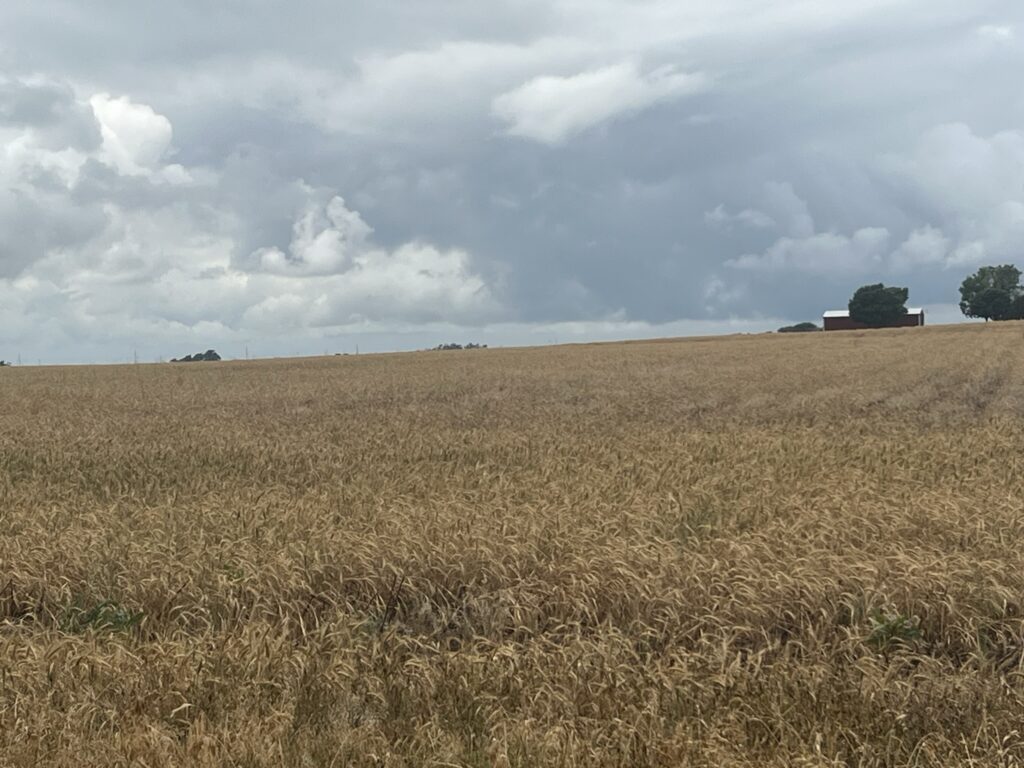
The agricultural sector continues to navigate a complex landscape of shifting weather patterns, policy developments, and global energy demands. To break down these challenges, University of Illinois Extension’s Todd Gleason spoke with Agricultural Economist Dan O’Brien from Kansas State University Extension to provide an in-depth look at the current outlook for the Kansas wheat crop and emerging trends in global agricultural energy.
Kansas Wheat Outlook: Mixed Conditions and Rising Abandonment
The current state of the Kansas wheat crop is highly variable across the region. When Gleason asked how the conditions looked, O’Brien noted that describing the situation usually requires a nuanced answer.
“The favorite answer of anybody answering about Kansas conditions is that it’s mixed and spotty,” O’Brien stated. “It’s just not consistent, but a lot of dry areas and lots of concern.”
Following prolonged dry periods, the wheat crop has sustained damage in several parts of the state. This persistent dryness has led to discussions surrounding historically high abandonment rates, with some estimates reaching 20% to 25%.
The severity of the situation depends heavily on the specific region. For example, O’Brien pointed out that in central Kansas, particularly around Hutchinson and Lion, fields have already been terminated.
“The wheat fields a month ago were yellow, which meant they had already been sprayed and killed off because they gave up on the wheat,” O’Brien said. “They’re going to plant no-till corn or sorghum into it probably.”
Consequently, the final harvested percentage of planted acres will likely fall well below historical norms. While Kansas rarely sees harvested acreage drop below 70%, O’Brien indicated that hitting that threshold this year would not be surprising, despite some pockets of resilient, high-yielding wheat remaining. The USDA currently projects a Kansas wheat yield of 37 bushels per acre, while the recent Kansas Wheat Quality Tour estimated it slightly higher at 38.7 bushels per acre.
Global Policies and the Push for E15
Turning to agricultural energies, Gleason brought up the legislative push for E15 in Washington D.C., noting that while it passed the United States House of Representatives, it faces a tough road in the Senate. Global geopolitical factors—including international conflicts and supply chain vulnerabilities—continue to exert pressure on domestic energy policies.
O’Brien explained that current energy market uncertainties are a primary driver behind the push for biofuels, making a Senate passage more plausible than under normal circumstances.
“If we didn’t have what’s going on in the oil market and the energy markets, we’d be probably less likely to see the potential for passing of E15 through the Senate and adoption overall,” O’Brien explained.
The current economic environment has significantly boosted the value of biofuels, with ethanol processing values tracking approximately $0.50 or more per bushel higher than in previous periods. Soybean processing values in Illinois, driven largely by the biofuels sector, were estimated at $17.09, up from $12.78 a year ago. This demand is incentivizing ethanol and renewable diesel plants across both the Eastern and Western Corn Belts to sustain and expand production capacity.
International Biofuel Trends and Market Impacts
When Gleason asked whether the rest of the planet is leaning toward biomass-based liquid fuels, as in the United States, O’Brien confirmed that countries such as Brazil and Australia are increasingly turning to domestic biofuel production to mitigate supply chain disruptions and geopolitical risks.
Brazil, a major player in the global corn market, has seen substantial growth in its domestic biofuel sector. Current policies and market demands have driven renewable sources to account for more than 40% of Brazil’s domestic fuel usage.
This shift could have long-term implications for global trade. As Brazil utilizes more of its corn allocation for domestic energy production, it raises questions about whether industrial biofuel demand will eventually limit their export capacity. Because the U.S., Brazil, and Argentina are the world’s primary corn exporters, any significant reduction in Brazilian export availability could directly impact U.S. corn market dynamics.
“If Brazil starts to push its domestic fuel usage of fuel production usage of corn to the place the United States does, then hey, you’re having some crowding out effect,” O’Brien noted.
While Brazil’s export numbers for the upcoming summer harvest remain strong—projected at approximately 1.8 billion bushels, up from 1.5 and 1.6 billion bushels in previous years—the long-term trajectory warrants close watch, especially as the country evaluates higher ethanol blends like E32 or E35.
O’Brien cited Jeff Cooper of the Renewable Fuels Association, noting that nations worldwide are actively seeking any viable source of liquid fuel they can secure to safeguard their energy independence amid ongoing geopolitical volatility.