
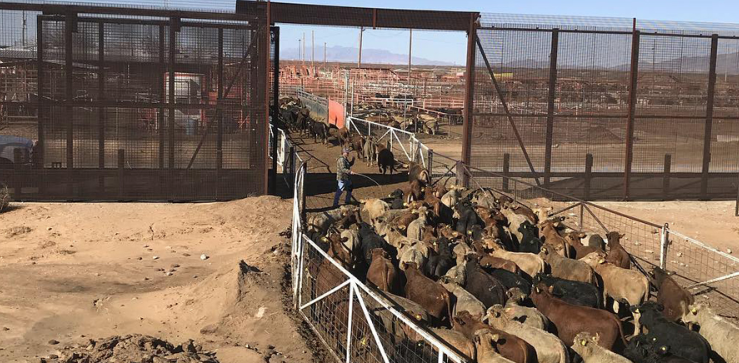
In today’s Beef Buzz, senior farm and ranch broadcaster Ron Hays features comments from a panel of leading cattle market analysts brought together at the spring meeting of the U.S. Meat Export Federation in Oklahoma City to discuss one of the cattle industry’s biggest questions: What new world screwworm concerns and the closure of the Mexican border to cattle imports mean for the U.S. beef supply chain. The panel featured Dr. Derrell Peel of Oklahoma State, Don Close, animal protein analyst at Terrain, and beef industry consultant Neville Speer.
Dr. Derrell Peel: “A bunch of the impact has already happened.”
Fresh off a trip to the border, Dr. Derrell Peel said producers should recognize that many effects of the Mexican cattle import shutdown are already unfolding. “There’s a bunch of issues here in terms of the impact that the border closure has on our industry,” Peel said. “In many ways, I would argue a bunch of the impact that it has has already happened.”
According to Peel, feedyards and producers on both sides of the border have already adjusted operations as cattle movement restrictions have persisted. “We’ve lost some feedlots, we’ve already seen a lot of people on both sides of the border have to make adjustments to how they’re going to utilize these cattle, and so on,” he said. “The longer it stays closed, I think the more implications there are for permanently changing things.”
After meeting with leaders from Mexico’s cattle sector, Peel emphasized that the industry south of the border is not standing still while the U.S. market waits. “The world doesn’t sit still just because the border’s closed,” Peel said. “Things continue, and the longer we make adjustments to deal with the situation, the more those things might become permanent in nature.”
Mexico Has the Infrastructure to Handle Cattle
One misconception Peel addressed directly is the belief that Mexico lacks the capacity to process or feed cattle without exporting them to the United States. “I think there’s a lot of feeling that Mexico has no ability to utilize these cattle, and that is absolutely wrong,” Peel said. “They’ve got significant processing capabilities and cattle feeding capabilities.” He explained that Mexican operations are already adapting to reduced exports. “The longer that they don’t export cattle to the U.S., they can utilize those cattle, and they are using those cattle,” he said.
Peel pushed back on fears that a massive backlog of feeder cattle is building just south of the border. “I don’t believe there’s any significant backlog of cattle beyond what there would have been,” he said. “There’s some calves that maybe they’ve held a couple of months, but they can’t hold them indefinitely. They’re moving.”
Even if the border reopened soon, Peel suggested the flow of cattle would likely return gradually. “If the border were to open anytime soon, it’ll take a while to get it ramped back up,” he said. “By this fall, we could see some flow of cattle.”
He added that while futures markets may react immediately to reopening news, market fundamentals could quickly temper expectations. “I think certainly the futures market will react if the border announcement comes today,” Peel said, “but I think the reality will show up pretty quickly that there’s not a lot of backlog.”
Drought Inflated Mexican Imports in Recent Years
Don Close agreed with Peel’s assessment and cautioned producers against expecting import volumes to immediately return to recent highs. “I agree with that completely,” Close said.
He pointed to severe drought in Mexico during recent years as a major factor behind elevated cattle movement into the U.S. “If you go back to ’22 specifically ’23 and ’24, Mexico was having a horrific drought,” Close said. “The marketplace collectively thinks that, okay, they open the border, and we’ll automatically be talking million, million two — that import number had been inflated because of the aggressive liquidation they were going through.” In other words, Close said expectations of an immediate return to more than a million head of imports may not reflect reality. “If we open up there, it’s not going to be that big,” he said.
Peel echoed that point, noting the 2025 total likely would have fallen below recent levels even without a shutdown. “It wouldn’t have been that big in 25,” Peel said. “It would have been lucky to get a million head in 25 after what happened in 24.”
Genetics, Geography, and Market Shifts
Close also explained that the cattle traditionally exported to the U.S. largely come from Mexico’s border states, while Mexican feedyards source cattle from much farther south. “The cattle that typically come to the U.S. come from the five border states,” close said. “The Mexican feed yards are in the north, but they buy cattle — they go all the way to Guatemala to source some feeder cattle.”
That system has shifted since the border closure, creating unexpected opportunities for Mexican feeders. “We closed the border, and it has enabled the Mexican feeders to buy superior genetics closer to the feed yard with about a 25 percent discount,” Close said. “It’s been a field day for those guys.”
Close also noted that if cattle inventories are building anywhere, the greater risk may be farther south in Mexico, not near the U.S. border. “If there’s a real risk of numbers building up, it’s cattle south of the TB line,” he said. “It’s not cattle that are inclined to come to the U.S.”
The Beef Buzz is a regular feature heard on radio stations around the region on the Radio Oklahoma Ag Network and is a regular audio feature found on this website as well. Click on the LISTEN BAR above for today’s show and check out our archives for older Beef Buzz shows covering the gamut of the beef cattle industry today.