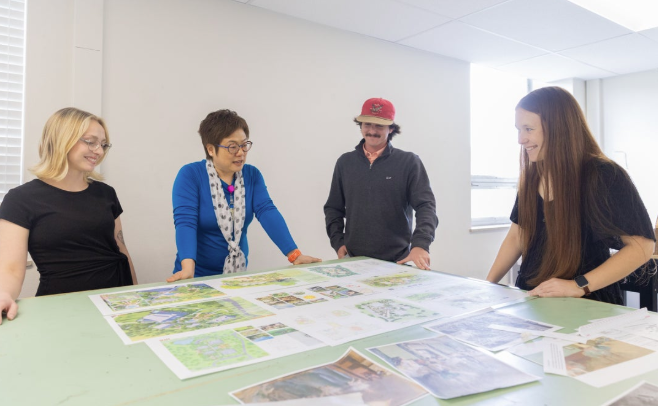
It was another late night for Carson Holmes on the third floor of Legacy Hall on Oklahoma State University’s campus.
Holmes, a sophomore landscape architecture student at OSU, was surrounded by crumpled-up piles of scratch paper. He’d spent the past three weeks tweaking his design, trying to nail down a final one he liked.
“I remember Carson in the studio,” said Madylan Hux, a sophomore landscape architecture student. “He was pulling his hair out.”
This wasn’t just another late-night crunch for a class assignment. This one was different. This past fall, OSU’s Horticulture and Landscape Architecture department partnered with Hope is Alive, an Oklahoma City-based organization dedicated to providing people with a holistic approach to managing their addictions.
The students in professor Qing Luo’s class weren’t just practicing and studying design theories. They were implementing them. Hope is Alive asked OSU students to help design a healing garden for its new rehabilitation center.
“Real-world experiences like this are highly impactful because they move learning beyond theory,” Luo said. “They place students directly into the realities of professional practice.”
It resulted in a real-world impact felt by many. As plans are finalized, portions of the work by OSU students will be incorporated into the finished design.
“We were creating a place where people could reflect and be able to process what they just went through,” Holmes said. “This was a key point of the project.”
Creating a space from scratch
The Healing Center — one of Hope is Alive’s facilities — is a multi-building campus located in Jones, Oklahoma, with plans to expand.
Part of the plan includes a healing garden.
“Their focus on recovery, healing and helping individuals rebuild their lives gave the project a strong sense of purpose,” Luo said. “It allowed students to see how thoughtful design can directly support human well-being and community impact.”
The class traveled to Jones to scout the location. It was an empty field. Holmes recalls two trees and a small runoff into a pond on the property. Outside of where administrators planned buildings to go, students had creative freedom.
“I was thinking of the family the whole time,” Holmes said. “How can I create this environment not only helping the family with what they’re going through, but also reminding them of the big impact they have on their family members’ lives?”
Hux focused on opportunities to provide spots for reflection, incorporating water elements and a nature walk around the property. Sophomore student Izzy Holding prioritized a central water theme, offering more public spaces closer to the center, and more secluded spots further away.
The students hoped not to “overdesign” the space, allowing for calmer tones. Despite different designs, the plan was to create a versatile space, adaptable to what individuals needed in the moment.
“It helps you work on it with more effort, in a way,” Holding said. “You know who you’re designing for and you know the impact it can make.”
Building a real-world experience
Luo often seeks technical, real-world applications to incorporate into her classwork.
For this project, she searched for a site smaller than five acres, allowing students to explore a physical site design while also understanding how emotions and human experience can be shaped through landscape.
With the help of Oklahoma County OSU Extension educator Andrew Fleet, Luo found exactly what she needed through Hope is Alive.
“I wanted a project requiring students to think beyond functional elements alone and consider healing, comfort, reflection and the emotional value of outdoor space,” Luo said.
The real-world learning experience also allowed students to implement one of Luo’s core professional focus areas: trauma-informed design. This concept intertwines physical environments with themes promoting safety, healing and well-being.
“My design process was focused on the user experience,” Hux said. “How can I best help them heal?”
Luo also stressed the importance of practical creativity. Strong ideas also need to be realistically implemented, safe and usable.
“This project allowed students to engage directly with a professional framework focused on reducing stress, promoting a sense of safety and supporting emotional healing through the built environment,” Luo said. “This helps students understand technical knowledge is not separate from design.”
Leaving an impression
Holmes recalls a time when Hope is Alive came to his high school to deliver a presentation about addiction. The talk stuck with him. Years later, he jumped at the opportunity to help the organization.
“I knew some of the people associated with Hope is Alive,” Holmes said. “It was rewarding to give back in a way.”
Once the designs were finalized, each student in the class presented their projects to the administrators. The results were astonishing. Hux recalls some in the room being moved to tears by the students’ work.
“Their intentionality, creativity and effort they put into their plans were evident, and it was a heartfelt experience listening to their ideas,” said Jesse Vobornik, director of operations for Hope is Alive.
Designs for the garden are still being finalized, but Hope is Alive plans to incorporate elements from several students’ projects in the final design.
“We’re proud to have the students come out and invest their time in these plans,” said Dakota Enterline, Hope is Alive’s director of assets. “They took this project seriously and captured the emotion of this space. Their work helped us get one step closer to bringing our vision for the healing garden to life.”
The students all learned something from the project. For some, learning how to work closely with clients was vital. Luo stressed the importance of combining practicality and creativity.
But they all agreed on one thing. They learned design could make an impact.
“It’s one thing to have an assignment; all of our other designs were a landscape, more for aesthetics,” Holding said. “It wasn’t any kind of deeper meaning. This project showed how impactful design can be.”