
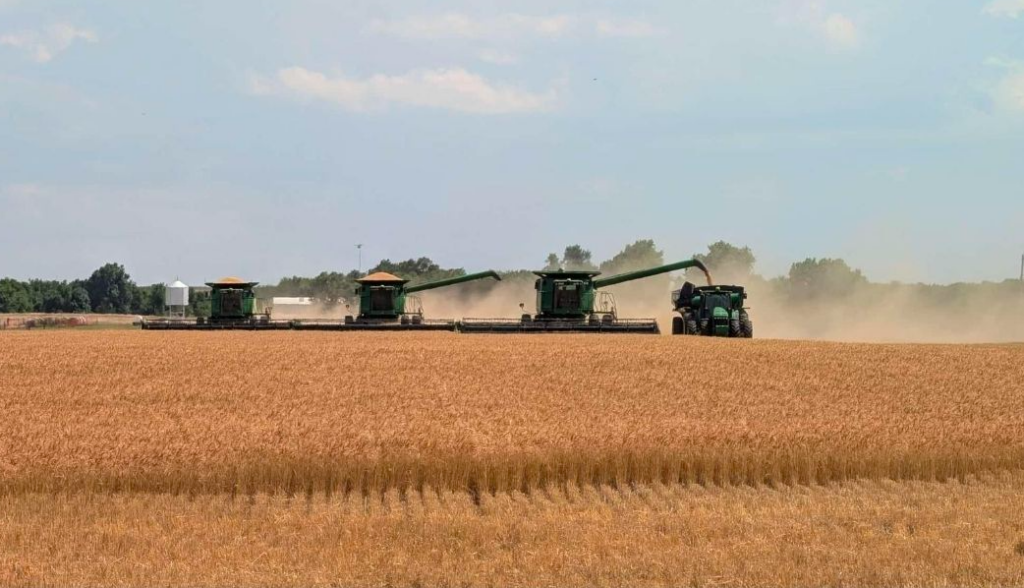
Weather continues to drive variability across the U.S. wheat crop. In the Southern Plains, recent rainfall has slowed
HRW harvest while the drought conditions that persisted throughout the growing season has limited yield potential.
SRW harvest is picking up in southern states under generally stable conditions, while conditions for the SW wheat crop
in the Pacific Northwest remain optimistic. HRS planting is nearly complete, with early conditions mixed but mostly
improving. Northern durum planting remains ahead of average, though emergence has been uneven and more moisture
is needed to support full yield potential.
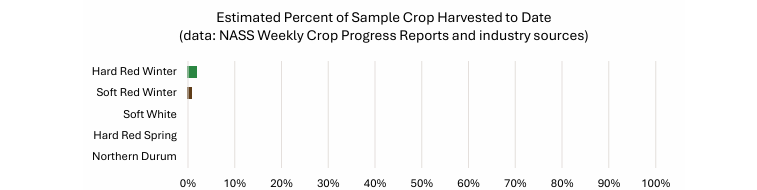
Crop progress: Widespread rains continued to slow harvest progress in Texas and Oklahoma. USDA estimates the
Texas harvest at 23% complete, while state representatives report Oklahoma at 25%. The Kansas crop is about 79%
colored, with test cutting underway. An estimated 47% of the crop is headed, and development remains 2 – 3 weeks
ahead of average due to environmental stress. Initial samples have arrived at the lab, with preliminary quality data
expected in the coming weeks.
Crop conditions: Recent rains in Texas are delaying harvest and raising quality concerns. Reported yields in Texas and
Oklahoma range widely, with most fields averaging 20 – 30 bu/acre (1.3 – 2.0 tons/ha). Soil moisture in Kansas remains
very short; recent rainfall arrived too late to improve yield potential but may help stabilize drought‑stressed fields.
Abandonment is expected to be significantly higher than normal across the southern HRW region, with some states
expecting abandonment near 35 – 40% compared to a typical 5 – 7%. In later‑planted northern areas, recent moisture
and milder temperatures have been beneficial.
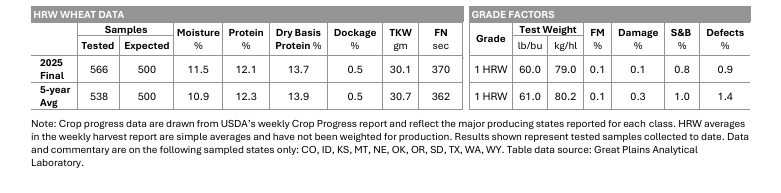
Wheat data: The laboratory has received 31 HRW samples to date. Very early averages show protein at 12.76% (12%
mb) and test weight at 60.6 lb/bu (79.7 kg/hl). These values are preliminary given the limited sample size.
Disease/pest pressure: Producers continue to monitor disease issues, including rust and wheat streak mosaic.
Weather: Rain fell across much of the growing region last week, with severe storms reported in parts of Colorado and
Nebraska. Isolated rainfall and moderate temperatures are forecast.
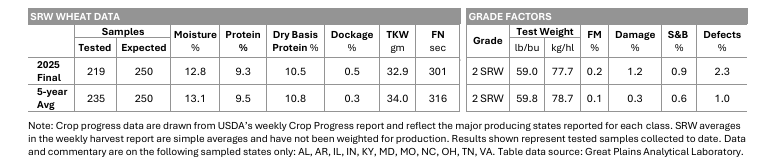
SOFT RED WINTER
Crop progress: SRW harvest is underway in southern states, with progress reported at 23% in Alabama, 10% in
Arkansas, 5% in Kentucky, 4% in North Carolina, 1% in Tennessee and 6% in Virginia. Nearly all SRW acreage is now
headed. Harvest is not expected to begin in Illinois for another 1 – 2 weeks and likely will not start in Ohio until late June
or early July.
Crop conditions: Much of the SRW region received substantial rainfall early last week, providing relief to areas of severe
drought. Overall SRW crop conditions remain stable, with 59% rated good to excellent. Conditions are strongest in
Midwest states, where the crop benefited from more favorable growing conditions earlier in the season. Recent
moisture helped replenish soil in the southern and Mid‑Atlantic regions but arrived too late to significantly boost yields,
as the crop was already advanced. The moisture is expected to help maintain existing yield potential. In Illinois, a recent
plot tour estimated average yields near 103 bu/acre (6.9 tons/ha).
Disease/pest pressure: With increased moisture, producers are closely monitoring for disease development.
Weather: Warmer and more humid conditions are forecast across the SRW region, with isolated chances for additional
rainfall.
HARD RED SPRING
Crop progress: Spring wheat planting is 95% complete in the four main HRS states, with emergence at 96% in South
Dakota, 78% in Minnesota, 65% in North Dakota and 70% in Montana.
Crop conditions: USDA rates spring wheat at 78% good to excellent in Minnesota, 58% in North Dakota, 44% in South
Dakota and 1% in Montana. Cooler temperatures and timely rainfall benefited crops in South Dakota, Minnesota and
North Dakota. Conditions in Minnesota remain strong, while North Dakota and Montana have improved with recent
rainfall and more moderate temperatures. Producers in Montana are hoping for additional moisture.
Disease/pest pressure: No disease or pest issues have been reported.
Weather: Most of the region received rainfall last week, with additional precipitation in the forecast. Conditions in North
Dakota have moderated after recent heat and wind. Montana still needs more rain to support crop development.