

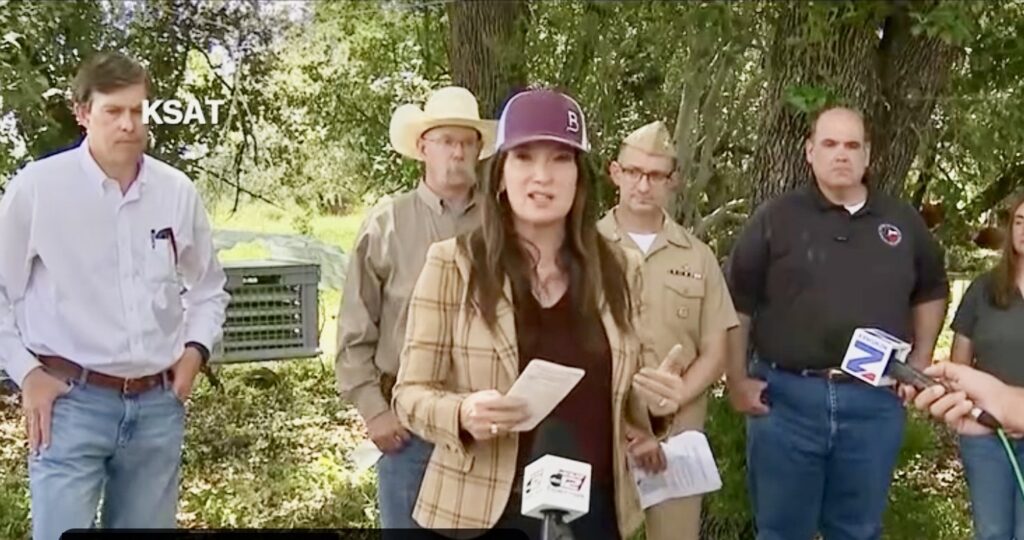
U.S. Agriculture Secretary Brooke Rollins said Thursday that an unprecedented federal and state response is underway following the detection of New World screwworm in South Texas, emphasizing that rapid action and coordination across agencies have positioned the country to contain the pest before it can inflict widespread damage on the livestock industry.
Speaking from the Chaparosa Ranch in Zavala County, where the first confirmed New World screwworm case in Texas was discovered, Rollins defended the administration’s response and said multiple federal agencies are now mobilizing resources to combat the threat. (You can listen to the Questions (and answers) taken by Secretary Rollins after her opening remarks with media present- click on the listen bar above.)
“Just a couple of hours ago, CDC also declared the emergency,” Rollins told reporters. “This reflects President Trump and our entire administration’s vigilance on this particular issue.”
Rollins said the Centers for Disease Control and Prevention’s emergency declaration adds another layer of federal support as agencies work together to prevent further spread of the parasite, which can infest livestock, wildlife, pets and other warm-blooded animals.
The secretary said the administration inherited a situation in early 2025 where little preparation had been made despite the screwworm’s steady northward movement through Central America and Mexico.
“When we walked in the door in January of last year and realized that really not much had been done to prepare for this moment, no funds had been secured, very little staff, no money invested and no plan deployed, we knew it was important to move out,” Rollins said.
She pointed to what she described as an “all-of-government” strategy involving USDA, CDC, EPA, the Department of Health and Human Services, the Department of Homeland Security and the Department of Defense. Rollins highlighted EPA approval of the Novo Fly technology and HHS support in deploying additional veterinarians to Texas.
A major component of the response is construction of a sterile fly production facility in Edinburg, Texas. Rollins said federal leaders have accelerated what normally would have been a five-year project into an estimated two-year timeline.
“Without hesitation, President Trump, Vice President Vance and Secretary Pete Hegseth said we will bump this to the very top of the list,” she said.
Rollins also pushed back against criticism that federal workforce reductions contributed to the current situation.
“DOGE cuts had zero to do with where we’re at today,” she said.
According to Rollins, USDA had only 10 full-time staff members focused on New World screwworm when the administration took office in January 2025. That number has since grown to more than 120 personnel.
“We’ve been able to scale up much larger than anybody else to get ready for this,” she said.
Federal officials continue investigating how the screwworm reached Zavala County. Rollins said weather patterns, including wind movement, are being examined, while officials are also considering the role of illegal livestock movement across the southern border.
“The illicit movement of cattle alongside the open border policies of the last administration is 100 percent the reason that we’re standing here today,” Rollins said.
Officials emphasized that sterile fly releases remain the primary tool for controlling the pest. Rollins said sterile flies were redirected and released in South Texas within hours of the initial detection, helping limit additional cases.
Rear Admiral Michael Schmoyer, USDA’s coordinator for the federal screwworm response, said extensive surveillance systems, predictive modeling and thousands of traps deployed across Mexico and the United States have been in place for months in anticipation of a possible detection.
“We actually have a playbook on how to do this,” Schmoyer said. “As these fly cases come up, we know how to address it.”
Despite the detection, Rollins stressed there is currently no threat to the food supply. However, she warned that uncontrolled spread could have severe consequences for livestock production and rural economies.
“We look back at the 1950s and 1960s and the destruction of our livestock industry and the decades it took to recover from that,” Rollins said.
She framed the response as both an agricultural and national security issue.
“The importance of farm security and ranch security to national security cannot be overstated,” Rollins said. “If we can’t protect these ranchers and ensure that we can protect our food supply and this way of life, then we will lose freedom in this country.”
USDA is also coordinating closely with neighboring states, particularly New Mexico, Arizona and California, while maintaining restrictions on livestock imports from Mexico.
Rollins said border ports have remained closed to livestock imports for approximately a year and will remain so until officials have a clearer understanding of the current outbreak situation.
In addition, USDA has deployed specially trained detector dogs at border crossings to inspect companion animals entering the United States from Mexico. Officials indicated additional screening measures may be forthcoming.
Department of Homeland Security officials attending the briefing said the agency is contributing personnel, technology and research support, including potential use of artificial intelligence and drone surveillance to monitor wildlife populations that could be susceptible to screwworm infestations.
“We’re just throwing everything out there,” said Dr. Sean Connelly of DHS. “Whatever resource we have that may contribute to the problem set, the Department of Homeland Security is there and getting after it.”
The New World screwworm response remains concentrated in South Texas, where federal and state officials hope aggressive surveillance, sterile fly releases and expanded infrastructure will prevent the pest from becoming established in the United States once again.







