
In today’s Beef Buzz, senior farm and ranch broadcaster Ron Hays speaks with Dr. Derrell Peel, livestock market economist at Oklahoma State University, about the June 2026 USDA Cattle on Feed report and what it says about tightening cattle supplies.
Peel said the June report showed fewer cattle entering feedlots, but even fewer cattle leaving them. “This latest cattle on feed report had placements in the month of May down 9.7% year over year,” Peel said. “Marketings in May were down 11.8% year over year, and that gives us an on-feed total for June 1 that’s up 2.1% compared to last year.”
Why On-Feed Numbers Are Increasing
That marks the second consecutive month that cattle on feed numbers have exceeded year-ago levels, but Peel says the increase can be misleading. “Cattle on feed numbers are going up not because we have more cattle,” Peel explained. “We’re placing less cattle, but we’re squeezing off marketings even more.”
Peel compared the situation to a water trough with inflow and outflow pipes. “Even though the in-pipe is slowing down, the out-pipe, if it slows down even more, you can keep the tank full,” he said. “That’s exactly what we’re doing here.”
Longer Feeding Times Push Carcass Weights Higher
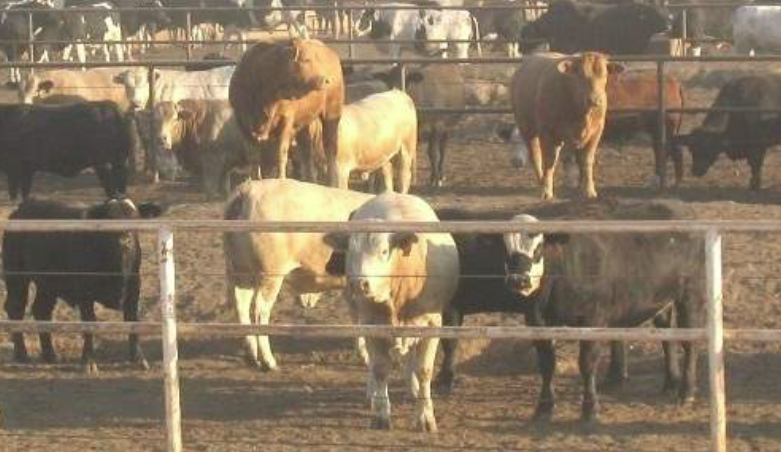
A major factor is the increasing number of days cattle are spending in feedlots, which continues pushing carcass weights higher. “When you feed these cattle longer, we continue to push these carcass weights,” Peel said. “Feedlots are basically placing pretty much anything they can find these days just because cattle numbers are so tight.”
According to Peel, the trend of heavier cattle has been building for several years. “It really started in 2024,” he said. “In 2024 and 2025, we added about 50 pounds to a steer carcass on average, and we’ve added another 30 pounds so far this year.”
Heavier Cattle Offset Some Production Losses
Those heavier carcasses are helping offset reduced slaughter numbers, though not completely. “Cattle slaughter is down roughly 6% so far this year, but beef production is down about 3.5%,” Peel said. “The carcass weights do make a difference. They’re moderating the decline in overall production, but they don’t completely offset it.”
Feedlots Focused on Capacity Utilization
Peel said feedlots are largely motivated by keeping pens full and maintaining operational efficiency. “We’re holding the inventory full by feeding these cattle longer,” he said. “The feedlot’s main motivation is just to have an inventory of cattle to feed.”
Still, Peel noted actual cattle throughput continues to decline. “The actual production coming out of the feedlot is still continuing to decline,” he said. “We’re actually producing less cattle—we’re just holding them in the feedlot longer and allowing the feedlot to capitalize on that capacity utilization.”
Cattle Numbers Continue Tightening
Peel emphasized that cattle-on-feed totals can hide the broader supply picture. “One of the lessons here is that cattle on feed sort of masks the fact that we are still tightening up overall cattle numbers in this country,” Peel said. “That’s what’s going to be important when it’s all said and done.”
Beef-on-Dairy Adds More Days on Feed
Ron also asked Peel about whether the growing number of beef-on-dairy cattle is contributing to longer feeding periods. “Well, yeah, those animals typically get placed in the feedlot fairly lightweight, so the days on feed is much bigger for those,” Peel said.
However, he noted that this is not a new dynamic. “That’s always been true for the Holstein cattle that we were feeding,” he said. “Those cattle went into the feedlot anywhere from 350 to maybe 550 pounds. If they go in at that very lightweight, they’re going to be on feed for a year.”
Peel said today’s beef-on-dairy crossbred calves follow a similar pattern. “They’re coming in at roughly the same weight, and they stay on feed an awfully long time,” he said.
The Beef Buzz is a regular feature heard on radio stations around the region on the Radio Oklahoma Ag Network and is a regular audio feature found on this website as well. Click on the LISTEN BAR above for today’s show and check out our archives for older Beef Buzz shows covering the gamut of the beef cattle industry today.