

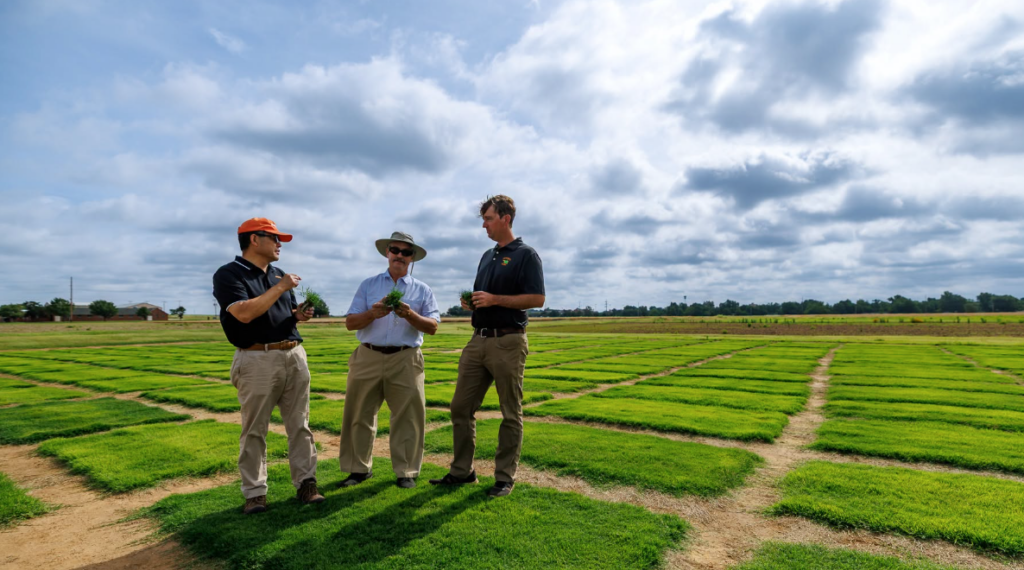
Oklahoma State University is once again making its mark on the world stage, and this time, it is under the feet of the world’s greatest athletes. Dr. Yanqi Wu, a Regents Professor of grass breeding and genetics at OSU, has spent decades developing high-performance turfgrass varieties that are now being featured in the FIFA World Cup.
“The turfgrass industry actually is pretty good size in the U.S.,” Dr. Wu said. “Probably around 40 to 50 million acres covered by a dozen turfgrass species.”
Among those varieties is Tahoma 31, an elite hybrid bermudagrass developed by Dr. Wu’s team that has gained international acclaim for its resilience and quality.
Decades in the Making
The journey of Tahoma 31 from a research plot in Stillwater to global soccer stadiums was a long-term scientific endeavor. Dr. Wu first arrived at OSU in 2001 to work on his PhD in bermudagrass before returning as a grass breeder. Supported by funding from the United States Golf Association (USGA) and the USDA, his program focused on developing high-performance varieties.
“Making a new bermudagrass variety needs more than 10 years,” Dr. Wu explained. “For example, Tahoma 31, I established the cross between two species—common bermudagrass and African bermudagrass—in 2006. And we released this variety in 2017. You can see we spent about 11 years.”
During those 11 years, the grass was rigorously evaluated across more than 20 locations in the United States. Dr. Wu’s team examined numerous traits, including color, density, uniformity, winter survivability, traffic tolerance, disease resistance, and drought tolerance.
Built for Elite Performance and Safety
Unlike artificial turf, which Dr. Wu noted can confuse consumers, his work focuses entirely on natural grass that has co-evolved with humans over millions of years. In a high-stakes environment like the World Cup, the physical characteristics of natural grass directly impact both player safety and the speed of the game.
“Tahoma 31, this grass is very dense,” Dr. Wu said. “And you can mow very low. In our test, it can tolerance one-eighth inch—that’s basically 3 millimeters tall—to 1 and a half inch.”
This density creates a highly uniform and smooth playing surface, allowing for excellent ball roll and rhythm. More importantly for player safety, the tightly knit structure helps prevent the surface from tearing up under intense athletic maneuvers.
“Because density is very high, it produces a surface with very few divots,” Dr. Wu said. “That’s very important for the players’ safety.”
The Next Frontier: Drought Resistance
While Tahoma 31 continues to represent OSU on the global stage, Dr. Wu’s program is already focused on the next major challenge facing agriculture and turf management: water conservation.
Over the last 15 years, the program has utilized USDA funding to breed varieties specifically for drought resistance, a critical need for regions like Oklahoma, Texas, and the Southwest that experience hot, dry summers. The program recently released a new drought-resistant variety called Endarra 81.
“A lot of water use for irrigation, that’s become a big concern in this nation,” Dr. Wu said. “We continue work on this, try to improve the drought resistance in bermudagrass. That will help millions of families when they grow this drought-resistant grass in their yard.”
For growers, sports complexes, or homeowners interested in utilizing these varieties, OSU patents and licenses the grasses to commercial entities, such as Sod Production Services, which coordinate with local licensed growers to make the turf commercially available.