OSU’s Todd Hubbs says Crop markets surged over the last week led by a strong rally in the wheat complex. Developments in the Black Sea drove wheat prices higher on disruptions to trade flows out of the region. Weather model predictions at present forecast significant rain events over the next week in Nebraska, NE Kansas, and NW Missouri with limited moisture over the remainder of the Corn Belt. Geopolitical events in the Middle East still hold the potential for market disruption. Expect crop market volatility to remain high into August.
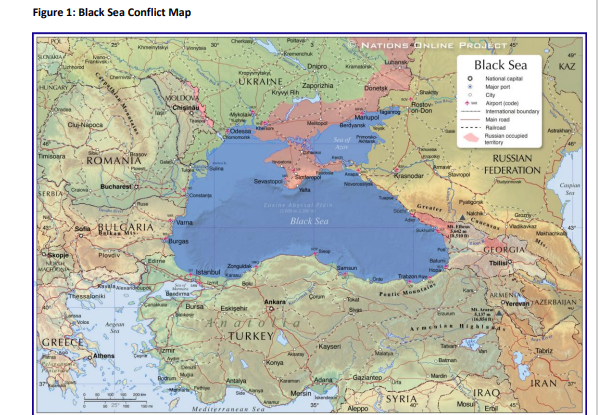
Wheat Market Outlook: Nearby hard red winter futures price drove over sixty cents higher last week. The escalation of the conflict between Russia and Ukraine via strikes in the Sea of Azov and on ports like Odessa in Ukraine raised the risk to Black Sea shipping. The geography of the conflict and routes is shown in Figure 1. Russia stopped shipping in the Sea of Azov and through the Kerch Strait. Shipping lanes are threatened for both players which raises transportation and insurance costs.
The conflict has brought back a risk premium in the wheat market because one of the world’s most important grain corridors is under jeopardy from the conflict. The escalation in hostilities continues into this week with no set resolution on the horizon. Prices have not come anywhere close to those seen under the initial period of the conflict. Large stocks carried in from last year along with good production prospects in wheat demand countries this year places the magnitude of the rally in question. While the potential for a supply disruption can increase buying in the short run, elevated prices will impact demand eventually. Timing the current market disruption will be exceedingly difficult. Rewarding rallies with sales may be a good strategy.
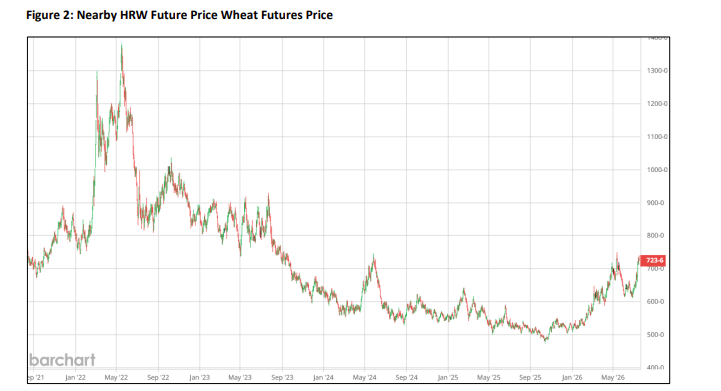
As shown in Figure 2, nearby HRW futures over the last five years gives an indication of the magnitude of the recent rally. September HRW prices closed yesterday at $7.24 per bushel, on par with the peaks seen after the bearish May reports from the USDA. HRW cash prices around Oklahoma vary in the $6.69 – $6.74 range after Monday’s close. Basis remains stable.
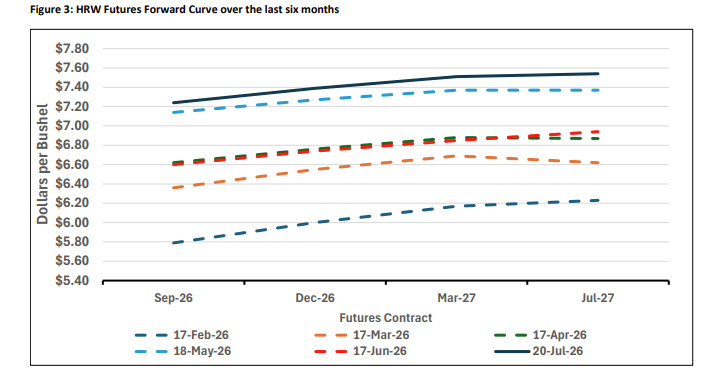
The HRW futures forward curve possesses a carry of 15 cents from September through December at present. The carry has not changed since the onset of the Iran War in March. Figure 3 presents the forward curve from the September 2026 contract through July 2027 over the last six months. The Sep.-Dec. carry sits at around 75 percent fully carry and is neutral to bearish despite the strong rally in price levels. December through March carry is at 12 cents and sits at a 70 – 75 percent full carry depending on the storage rate used in the calculation. The carry is sending a different signal than the price levels currently in the market. The development of Southern Hemisphere crops, the evolution of the conflict in the Black Sea, and the prospects for spring planted crops all hang over the HRW market.
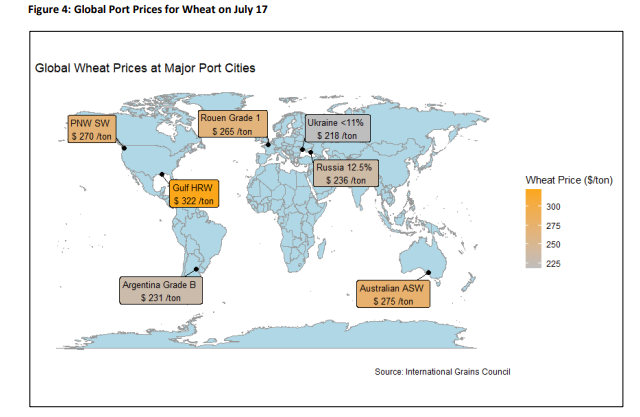
The rally pushed HRW Gulf prices well above world competitors. Global port prices shown in Figure 4 indicate Gulf prices at over $2 per bushel higher than Black Sea origins and eclipse Canadian port prices by approximately 65 cents. EU prices came in over $1.50 lower the U.S. Gulf HRW. The EU prices reflect the conflict and a recent heat wave. The prospect of U.S. prices moving higher relies on increased export demand and that remains a major question given our price competitiveness.
Milo Market Outlook: December corn futures moved lower to close at $4.73 yesterday. The December futures price sits almost 50 cents higher than the recent contract low. The September contract closed at $4.49 on Monday. Milo cash prices across Oklahoma locations range between $3.49 – $3.54 with higher prices reported in locations. Milo basis remains weak. Harvest basis sits at -90 to -100.
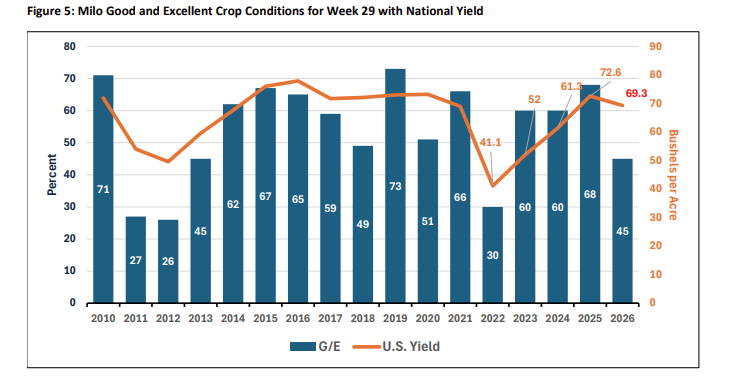
Milo crop conditions continue highlight issues that developed in July. Good and excellent conditions for Week 29 sit at 45 percent, well below conditions at this time last year, at 68 percent, when the U.S. milo crop totaled 72.6 bushels per acre. As shown in Figure 5, conditions in Week 29 provide an indication of potential directional magnitude on national milo yield. USDA’s current yield forecast of 69.3 bushels per acre appears a bit elevated given conditions.
Increased milo acreage at 6.3 million planted acres led to a production increase of 13 million bushels to 380 million acres for the new crop. The evolution of this year’s crop will determine potential usage. Currently, USDA forecast ending stocks at 37 million bushels on expectations of exports and ethanol usage remaining robust. An improvement for milo prices to close the gap on corn requires exports. The world’s largest, by far, milo importer is China which imported 75 – 88 percent of global milo imports over the last five years. Australia and Argentina are our major competitors on the global market. Australia production is forecast at 83 million bushels, down 16 from last year. As such, exports from Australia are forecast lower by those 16 million bushels at 79 million bushels. Argentina is forecast at 126 million bushels, up 31.5 million from last year. Exports out of Argentina are expected to be 67 million bushels, up 20 million bushels. At present, Argentine port prices sit on par with U.S. gulf prices for milo. Competition looks certain to impact export potential. China buying remains linked to political negotiations and trade talks.
July’s WASDE report left milo old crop ending stocks at 37 million bushels but with changes across usage categories. Milo exports were lowered by five million bushels to 220 million on a falling export pace. Food, seed, and industrial usage increased by 5 million bushels on continued strength in ethanol grind. Milo usage for ethanol needs to average 8.5 million bushels per month over the final four months of the marketing year to hit the new prediction. Average ethanol grind of milo from February through April was 10 million bushels per month. Further adjustments to the usage categories are possible but an expectation of ending stocks remaining at current levels for the old crop marketing year remain in place.
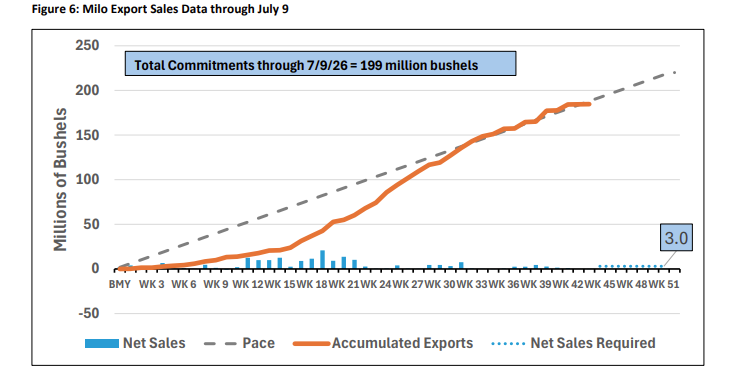
Export sales data place total commitments of milo at 199 million bushels through July 9, as shown in Figure 6. Outstanding sales sit at 14 million bushels of commitments. Sales dropped off in late June and into early July. Weekly net sales averaged 0.6 million bushels per week over the period. Exports are fading from the recently forecast 220 million bushels for the 2025-26 marketing year with 3 million bushels per sales a week needed to hit the forecast. The Chinese and unknown destinations remain the destinations with the most pending sales at 14 million bushels in total.