
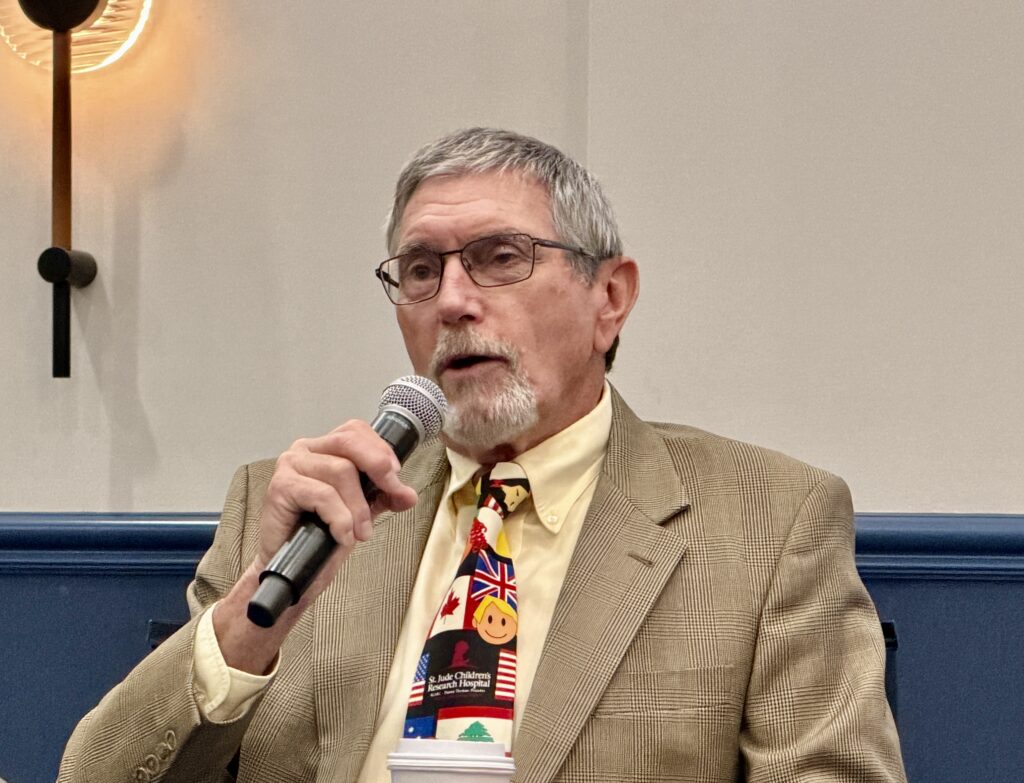
Oklahoma State Veterinarian Dr. Rod Hall says the decline in active New World Screwworm (NWS) cases in Texas is an encouraging sign that containment efforts by the U.S. Department of Agriculture and the Texas Animal Health Commission are working.
Hall noted that while 42 New World Screwworm cases have been confirmed in Texas, only 10 remain active. He talked after his presentation at the 2026 Oklahoma Cattlemen’s Convention in Tulsa with Ron Hays, Senior Farm and Ranch Broadcaster of the Oklahoma Farm Report,
“So, an inactive case becomes inactive after the wound has healed and there’s no more possibility of the New World Screwworm larvae being in that wound or being reinfested from new eggs,” Hall explained. “That could happen either because the wound completely healed, or in a couple of cases the animals had other health issues and were euthanized.”
Hall said the relatively low number of active cases is significant.
“The fact that we’ve only got 10 active cases right now is a good thing because it tells us the earlier cases have healed and we’re not seeing new cases crop up at the frequency that we were earlier,” he said. “It indicates to me that Texas is making a little bit of progress, or at least doing a good job of containing that thing through the Texas Animal Health Commission and the USDA partnership.”
Despite concerns surrounding the parasite, Hall emphasized that New World Screwworm has caused very few direct fatalities.
“If there have been any animals that actually died from New World Screwworm, it’s been very, very few,” Hall said.
He pointed to one of the first confirmed cases—a three-day-old calf with a severe infestation in its navel—as evidence that early detection can make all the difference.
“I actually saw a video of that and it was really nasty,” Hall recalled. “But they were able to get that thing treated, and three weeks later it was running around doing great. It just highlights the fact that if we’re watching our animals closely and we catch them early, this is pretty easy to treat.”
According to Hall, veterinarians in Texas are primarily using injectable avermectin products such as Dectomax, along with topical permethrin sprays.
“They’re putting the topical products on the outside to keep the flies away from laying any more eggs,” Hall said. “The injectable or systemic drugs like Dectomax get into the bloodstream, and as those maggots deeper in the wound are consuming blood and living tissue, they get enough of the chemical to kill the maggots.”
After participating in regular conference calls with USDA APHIS, the Texas Animal Health Commission, and fellow state veterinarians, Hall said he is increasingly optimistic about the response.
“I think it’s very encouraging what we’re seeing down there,” he said. “Once they found it, it has not spread any further north.”
Limited Sterile Flies Are Being Used Strategically
Hall acknowledged that cases have expanded somewhat farther west in Texas but said that development was expected because officials have a limited supply of sterile flies available for release.
“They have a finite number of sterile flies they can use, and we know there’s not enough,” Hall explained. “They’re having to be very intentional about where they use those flies. They just don’t have enough to saturate the whole border, so they’re adjusting their strategy almost day by day.”
One of the most encouraging developments, Hall said, has been the apparent success in containing the northernmost confirmed case in Tom Green County near San Angelo.
“That was such a concern that they actually used more sterile flies in that area than they had in some areas closer to the border,” Hall said. “We’re now a good month, maybe five weeks, since that case was found and there have been no more cases in that area. That’s very encouraging to me.”
Meanwhile, Oklahoma continues preparing in case New World Screwworm reaches the state. Hall said the Oklahoma New World Screwworm Working Group now includes approximately 100 participants representing agricultural organizations, Extension, lawmakers and other stakeholders.
“For the most part, we’re just trying to keep everyone updated on what’s happening in Texas and also what we’re doing in Oklahoma to prepare,” Hall said.
While not every stakeholder agrees on every aspect of a potential response, Hall believes confidence is growing as producers watch Texas’ efforts.
“I’d be lying if I said everybody agrees on what the response is going to look like,” Hall said. “But I think more and more, as we see that the response we plan to use is essentially what they’re using in Texas, people are seeing that it is working. That makes me feel better about our response, and I think we’ll get good buy-in if we do get it here.”
Check out the latest from the USDA at their website- Screwworm.Gov.