

Authors: K. Aleks Schaefer and Rylee Smith write in Southern Ag Today: Last week, the USDA announced it would resume Mexican cattle imports under a phased reopening beginning in August. This is a somewhat controversial, but scientifically sound choice. When the United States suspended imports of live cattle from Mexico, the objective was straightforward: keep New World Screwworm (NWS) out of the country for as long as possible. The policy accepted significant economic costs in exchange for delaying one of the livestock industry’s most damaging pests.
That question looks very different today. With NWS now confirmed inside the United States (USDA APHIS, 2026), policymakers are no longer deciding whether the border closures prevent introduction; they are deciding whether the restrictions provide enough benefit to justify their economic costs. Our previous research estimated the economic cost of the border closures and how much delay in pest establishment would be required for those costs to be worthwhile (Sumner et al., 2026). Those findings provide a framework for evaluating today’s policy debate.
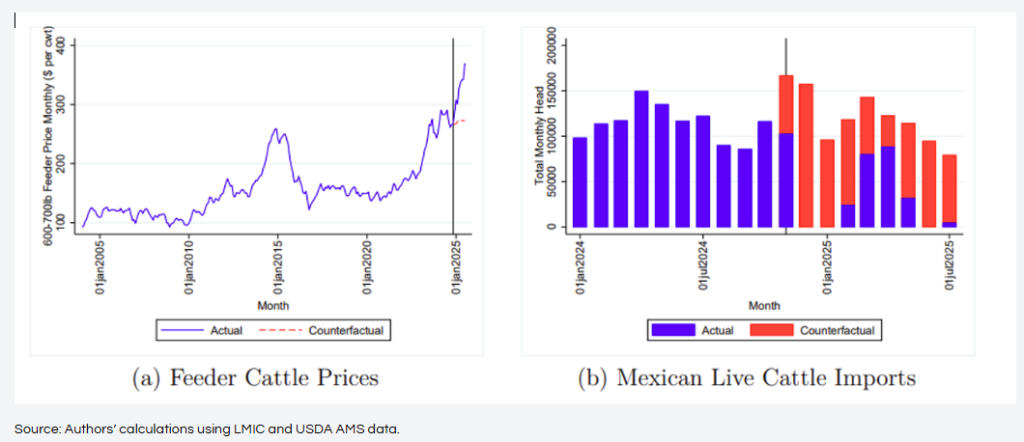
Border Closures Significantly Tightened Feeder Cattle Supplies: Mexico has long served as one of the largest suppliers of feeder cattle to U.S. feedlots, with roughly 1.2 million head imported annually before the restrictions (Sumner et al., 2026). When the border closed, those cattle disappeared from the market. At the largest point of disruption, monthly imports were more than 150,000 head below what historical market relationships would have predicted (Sumner et al., 2026).
Feeder Cattle Prices Climbed Well Above Expected Levels: With fewer feeder cattle entering the United States, domestic supplies tightened quickly. Our analysis shows that the border closures pushed feeder cattle prices much higher than expected. Prices initially followed normal market trends but increased rapidly, reaching nearly $100 per hundredweight above what would have been expected by July 2025 (Sumner et al., 2026).
Border closures put substantial upward pressure on feeder cattle prices. Changes in Mexican cattle imports had lasting effects on feeder cattle prices, demonstrating how closely U.S. and Mexican cattle markets are connected (Sumner et al., 2026).
Figure 1. Impacts of the import ban on U.S. Feeder Cattle Markets
With confirmed cases of New World Screwworm now detected within the United States (USDA APHIS, 2026), policymakers face a different decision. The question is no longer whether the border can keep the pest out entirely, but whether continued restrictions on Mexican cattle imports meaningfully slow its spread, reduce the likelihood of reinfestation from neighboring regions, or provide enough additional time for response efforts to outweigh the ongoing costs on the cattle industry.
Over nine months, the border closures reduced feeder cattle imports, tightened supplies, and increased feeder cattle prices (Sumner et al., 2026). Those impacts continue to accumulate with restrictions in place.
Policymakers must weigh the market disruptions against the biosecurity benefits that the restrictions provide. If the remaining benefits are limited, the economic case for prolonged border closures becomes weaker. If, however, the restrictions significantly reduce additional introductions, protect infestation-free regions, or improve the effectiveness of eradication efforts, continued restrictions may still generate benefits.
Biosecurity policies are rarely static. As conditions change, so should the economic questions used to evaluate them. The challenge is no longer asking “Did the border closure buy enough time?” It is asking “How much additional protection does the closure provide today and is that protection worth its continuing economic cost?”
Schaefer, K. Aleks, and Rylee Smith. “Reopening the Border to Mexican Cattle Imports is the Right Decision.” Southern Ag Today







