

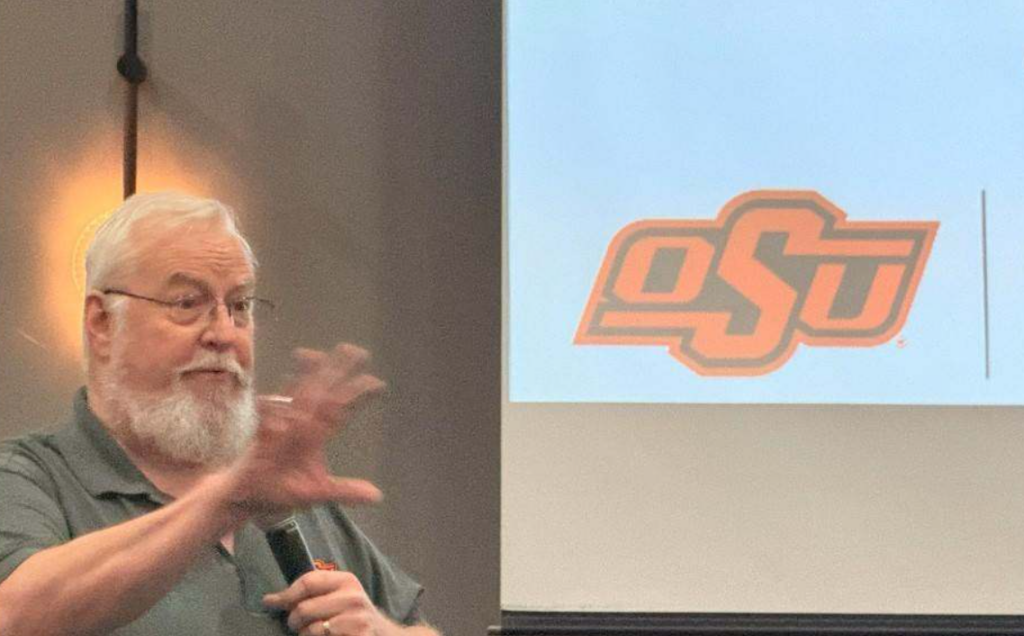
As July comes to a close, cattle markets have experienced a sharp correction that has caught the attention of producers across the country. In today’s Beef Buzz, Senior Farm and Ranch Broadcaster Ron Hays speaks with Oklahoma State University livestock market economist Dr. Derrell Peel, who says despite the recent volatility, the long-term outlook for the cattle industry remains unchanged.
July Pullback Follows a Long Bull Market
Peel says the recent decline has been driven primarily by the futures market rather than a change in supply and demand fundamentals. “We’ve had a big correction here in the month of July, and it’s really led by the futures market,” Peel said.
He explained that corrections are a normal part of any prolonged bull market. “We’ve been in a long bull market for three years now, and so it’s normal in the course of a bull market to periodically see a correction. Traders want to square up positions, take a little money off the table, reset some positions.”
Seasonal trading patterns and computerized trading also played a role. “It’s summertime now. I think part of this is summer doldrums,” Peel said. “Once we start a correction, there’s a technical element to it. Basically, the computers take over and kind of run the market for a short period of time.”
Even so, Peel believes the market has likely found its footing. “I think we’ve about bottomed. Nothing’s really changed in the market, and the fundamentals haven’t changed. My outlook hasn’t changed. This is just another correction.”
Historically Tight Cattle Supplies Continue
While futures prices have been volatile, Peel says the nation’s cattle inventory continues to point toward higher prices over time. “We’re historically tight,” Peel said. “The first estimate of the 2026 calf crop… is down again, so that means that going forward, feeder supplies continue to get smaller.”
Although producers are beginning to retain more replacement heifers, Peel says herd expansion remains a slow process. “We’re holding a few more heifers to suggest maybe we’re starting that process, but we’re going to have to hold more at some point to really see significant herd growth, and that means we’re going to squeeze supplies even more.”
He expects declining beef production to continue well into next year. “Slaughter will continue to decline. Beef production will continue to decline for the rest of 2026, and at this point, 2027 is pretty well in the bag because we don’t have enough heifers in the pipeline to really do anything in 2027.”
Hays compared rebuilding the nation’s cattle herd to steering an enormous ship. “It really does. This is a big battleship, and we’re using rowboat oars here, and so it’s just a very, very slow process to try to turn this thing.”
Tight Supplies Continue to Impact Beef Trade
Peel says shrinking beef production has also reshaped U.S. beef trade. “The trade situation has evolved over the last three years exactly like you would expect relative to a market response,” he said. “As beef production goes down, prices are at record levels… so you would expect that would moderate beef exports, and it has.”
He noted that the loss of access to China has further reduced exports. “We’re still not in the Chinese market at all at this point, and so that took a major export market down significantly.”
At the same time, imports have increased to help satisfy domestic demand for lean beef used in hamburger production. As beef production falls in the U.S., the relative decline in processing beef… is down the most proportionately, and that’s the stuff we need for our ground beef market, so imports are up because of that.”
Even though more imported beef is entering the U.S., Peel says it’s filling a necessary supply gap. “We have to. Even in normal years we import beef to supplement those non-fed beef supplies in the U.S., but we’re certainly doing it to a bigger extent right now.”
The Beef Buzz is a regular feature heard on radio stations around the region on the Radio Oklahoma Ag Network and is a regular audio feature found on this website as well. Click on the LISTEN BAR above for today’s show and check out our archives for older Beef Buzz shows covering the gamut of the beef cattle industry today.







