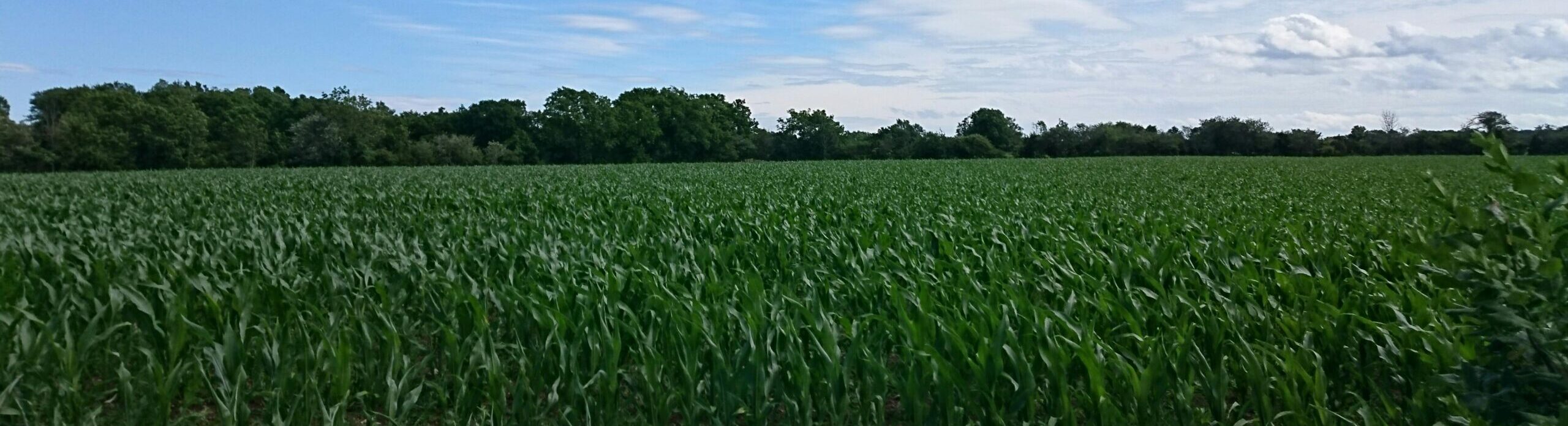
Lee Seunghyun writes in Southern Ag today: The first forecast of corn yields by the USDA is expected to be released with the Crop Production report on August 12, 2026. However, most southern corn has passed through silking, the crop’s most critical yield-determining period. One can then look at the USDA Crop Progress and Condition Layers current condition ratings to gain a meaningful signal of likely yield outcomes. According to crop condition data for the week ending July 26, most southern corn entered the second half of July in fair-to-good condition—3.56 on a scale from very poor (1) to excellent (5). The average masks a sharp divide between the mid-South and the Carolinas. While weather can still affect kernel weight, much of the crop’s yield potential, and damage from June and early-July heat and moisture stress, has already been determined.
As shown in Figure 1, conditions were near good from Arkansas through Mississippi and into northern Alabama and Tennessee. Alabama was good (4.18), while Tennessee and Arkansas were near good (3.98 and 3.96, respectively). The strongest county ratings clustered in northern Alabama and the Tennessee Valley. Conditions weakened farther east. South Carolina was below fair (2.88), and North Carolina had the region’s lowest rating, between poor and fair (2.81). The lowest-rated counties were concentrated in eastern North Carolina’s Coastal Plain, where much of the state’s corn acreage is located.
Figure 2 shows the corn condition by state throughout the growing season. Both Carolinas were near the middle of the regional range in late spring before deteriorating during June and early July amid repeated heat and limited, uneven rainfall. Because the decline overlapped silking, the Carolinas are increasingly likely to experience below-trend yields and reduced production, especially in eastern North Carolina. In contrast, stronger mid-South conditions point to comparatively favorable yields.
These lower expected yields may matter more for local markets than for national corn prices because Southern production is small relative to the Corn Belt. The Carolinas, like many other southern states, have livestock and poultry sectors and often rely on corn shipped from other regions. A smaller local harvest could increase demand for imported grain, strengthen local basis, and raise delivered feed costs. Mid-South producers, by contrast, head toward harvest with a near-good crop and no comparable supply concerns.


Lee, Seunghyun. “Southern Corn Conditions and Yield Expectations.“ Southern Ag Today