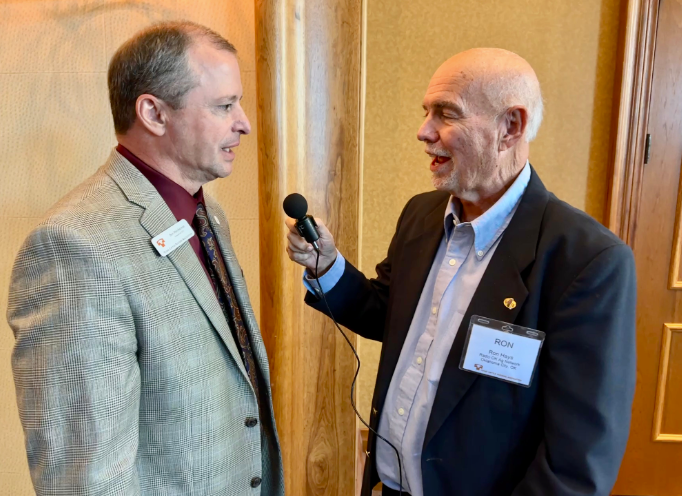
In today’s Beef Buzz, senior farm and ranch broadcaster Ron Hays speaks with Ben Weinheimer, president and CEO of the Texas Cattle Feeders Association, about the association’s upcoming annual convention in Oklahoma City and the issues facing cattle feeders across the Southern Plains.
TCFA Convention Returns to Oklahoma City
The Texas Cattle Feeders Association annual convention will be held October 18-20 in Oklahoma City, bringing cattle feeders together for industry updates, business discussions and motivational speakers. “Oklahoma City is always in our convention rotation,” Weinheimer said. “It’s a great opportunity for us to come over there and highlight the feedyards and Oklahomans that are members of TCFA and our coordination, collaboration, and partnership with the Oklahoma Cattlemen’s Association.”
Weinheimer said the convention will begin Sunday afternoon with a welcome reception, followed by a beef pack reception. “We’ll be in Oklahoma City October 18th through the 20th. We’re looking forward to a great program,” he said.
AI, Industry Updates and Motivational Speakers
Monday’s convention program will feature updates from TCFA Chairman Laphe LaRoe and the National Cattlemen’s Beef Association, along with business and industry discussions.
One featured speaker will be Tom Edwards of Ernst & Young, who will discuss artificial intelligence and its potential applications in agriculture. “He’s really an expert in this artificial intelligence space,” Weinheimer said. “We’re looking forward to him bringing forward his perspective and some of the other industries where he and his team at Ernst and Young have applied AI and how we can potentially utilize some of that in our own applications within the cattle feeding industry.”
The convention will also feature several motivational speakers, including retired U.S. Army Staff Sergeant Travis Mills and Dave Sanderson, who was the last individual to exit U.S. Airways Flight 1549 after it landed in the Hudson River in 2009.
Weinheimer said Mills’ story is particularly inspiring. “This is an individual who’s lost most of his limbs, but yet if you get a chance to look at some of his YouTube videos before you get to the convention and then hear him in person, it’s really amazing to kind of have that inspiration from somebody who’s gone through some of the worst in life, and yet has figured out how to make the best of it,” he said.
Dave Sanderson will also share lessons from surviving the Hudson River plane landing. “He has a great story to tell about being part of that experience, and then how that’s changed his life, views, the learnings from that that other people could embrace,” Weinheimer said.
Darrell Peel to Discuss Livestock Economics
The Monday afternoon program will also include an economic outlook from Oklahoma State University livestock economist Dr. Darrell Peel. “And who better to really kind of provide a comprehensive update on all things related to the livestock industry and the economic outlook, not just for cattle feeders, but the cattle industry as a whole,” Weinheimer said.
Southern Plains Feedlots Remain Optimistic
Weinheimer said the cattle feeding business across Texas, Oklahoma and New Mexico remains relatively optimistic, although feedyards continue to deal with the effects of the Mexican border closure to feeder cattle. “So, the state of the business is still fairly optimistic,” Weinheimer said. “We continue to suffer from the lingering effects of the closure of the Mexican border to feeder cattle.”
TCFA members have worked to expand the geographic area where they source feeder cattle, while beef-on-dairy crosses have helped replace some of the cattle that previously came from Mexico. “A big piece of that, of course, has been replacing some of those missing Mexican feeder cattle with beef on dairy crosses,” Weinheimer said. “We see a considerable number of those calves continuing to come into our region.”
He expects those cattle to remain an important part of the Southern Plains feeding industry. “They’ll really be a mainstay, I think, going forward here as far as the makeup of the cattle on feed that we have in the three-state region of Texas, Oklahoma, and New Mexico,” he said.
Mexican Feeder Cattle Remain a Major Supply Chain Issue
Weinheimer said reopening the Mexican border remains an important issue for cattle feeders and the broader beef industry.
He noted that protocols being used to address the New World screwworm situation are similar to procedures developed to reopen the border previously, including inspections, treatment, movement documentation and animal identification. “We’re utilizing some of the very same protocols that were developed to reopen the Mexican border in regards to inspections and treatment and movement documentation and animal identification,” Weinheimer said.
He believes the experience gained from those protocols could help support discussions about reopening the ports. “There’s been a lot of trust and confidence gained in those protocols through the process here domestically, and so from a technical basis, it makes a lot of sense now to revisit that and see if we can get to a situation where we can reopen those Mexican border ports,” Weinheimer said.
He emphasized that the issue extends beyond the feedlot industry. “That’s really a larger supply chain issue because the absence of those 1.3, 1.4 million head of Mexican feeder cattle that extends all the way to the meat case,” he said.
Mexican Cattle Impact Southern Plains Beef Production
According to Weinheimer, the reduction in Mexican feeder cattle has had a measurable impact on beef production in the Southern Plains. “Our Southern Plains region, in essence, has reduced our annual beef production by a little less than 1 billion pounds,” he said.
Weinheimer said cattle from Mexico can ultimately make their way into the TCFA region regardless of which border crossing they use. “There’s considerable movement, regardless of which port those cattle cross from,” he said. “When all the nine ports are open and operational, it’s not unusual for us to receive cattle into the TCFA region.”
Weinheimer’s comments come as Agriculture Secretary Brooke Rollins has announced a phased-in reopening of the market for cattle coming from Mexico, beginning August 24.
The Beef Buzz is a regular feature heard on radio stations around the region on the Radio Oklahoma Ag Network and is a regular audio feature found on this website as well. Click on the LISTEN BAR above for today’s show and check out our archives for older Beef Buzz shows covering the gamut of the beef cattle industry today.