

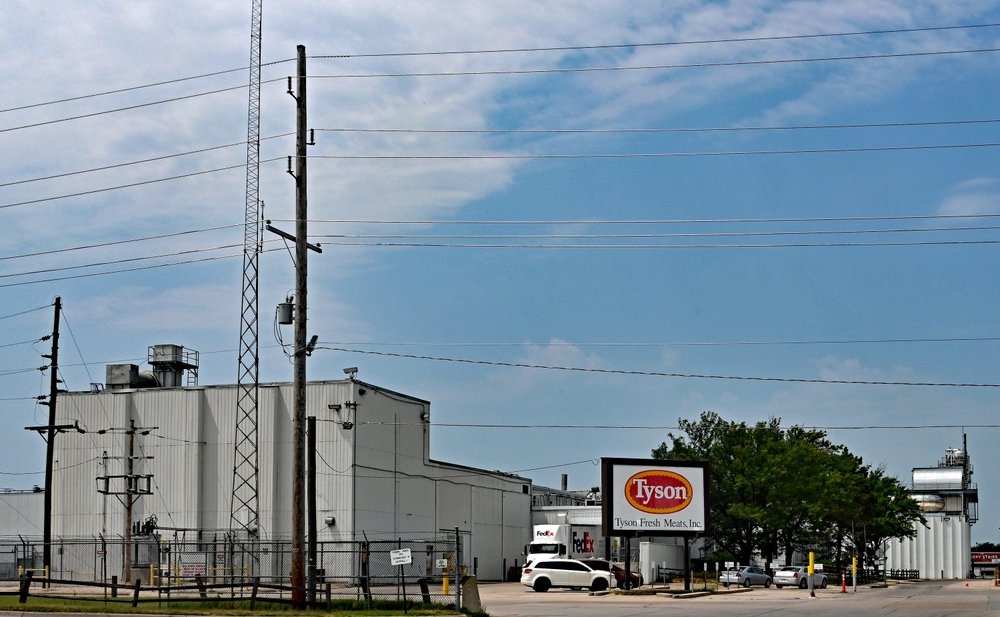
Tyson Foods has announced the immediate closure of its beef processing plant in Joslin, Illinois, and its case-ready facility in Eagle Mountain, Utah, marking another major contraction in U.S. beef packing capacity as the livestock sector grapples with historic cattle shortages.
The abrupt announcement comes just months after Tyson permanently shuttered a large beef processing plant in Lexington, Nebraska. In addition to the Illinois and Utah closures, the meatpacker confirmed it is actively pursuing the sale of its beef processing plant in Pasco, Washington.
The Joslin facility, which has operated in Rock Island County for 43 years, had a daily harvest capacity of approximately 3,000 head of cattle and employed roughly 2,500 workers. According to reporting from Farm Progress and Talk Business & Politics, harvest operations halted immediately on August 13, with meat processing wrapping up August 14. Tyson stated it will pay impacted workers for 60 days and assist them in finding opportunities at other facilities.
Strategic Shift to Central Facilities
To manage the ongoing supply constraints, Tyson announced it is restructuring its beef footprint around three central plants: Dakota City, Nebraska; Holcomb, Kansas; and Amarillo, Texas.
When the Lexington plant closure was announced in late 2025, Tyson scaled back its Amarillo facility to a single shift. The company now plans to restore Amarillo to a two-shift schedule as cattle availability allows.
“Collectively, these changes will allow the company to maintain a similar level of cattle harvesting across a more efficient and modern network,” Tyson said in a statement.
Financial analysts at Stephens Inc. estimate the closures and consolidations will yield Tyson between $100 million and $150 million in annual cost savings, following anticipated segment operating losses of up to $600 million to $650 million in fiscal year 2026 due to compressed packer margins.
Industry Reacts to Immediate Midwest Exit
The abrupt nature of the Joslin closure sent shockwaves through Midwest feedlots. Unlike typical plant shutdowns that offer several months of notice, the zero-warning departure leaves Midwestern cattle feeders scrambling. Producers in Illinois and eastern Iowa now face hauling live cattle between 160 and 400 miles to reach alternative processing facilities.
Illinois Beef Association Executive Vice President Josh St. Peters expressed deep disappointment and disbelief over the sudden exit.
“For decades, the Rock Island County plant has served as a critical market for family farmers and has been an important economic driver for rural Illinois,” St. Peters said. “This announcement underscores the importance of maintaining a strong and competitive beef sector.”
Illinois state Rep. Ryan Spain emphasized the severe local fallout: “I am stunned and saddened by the news that Tyson Foods is closing after 43 years in Joslin. This is devastating to our region, to the families that depend on the income they receive from this factory, and to the communities who will bear the downstream impacts of this closure.”
National Cattlemen’s Beef Association (NCBA) Chief Executive Officer Colin Woodall noted the plant’s longstanding role in the Midwest beef supply chain and urged Tyson to work closely with local cattle producers to identify alternative market outlets. Woodall also welcomed Tyson’s decision to seek a buyer for the 2,000-head-per-day Pasco, Washington, facility rather than closing it outright.
Structural Shifts Across the Cattle Complex
Combined with JBS USA’s June 2026 closure of its 2,000-head-per-day facility in Souderton, Pennsylvania, recent packer shutdowns have eliminated approximately 10,000 daily shackle spaces across the national beef processing landscape.
DTN Livestock Analyst ShayLe Stewart noted that the announcement clarifies why livestock futures traded softly leading into the news, warning that cash cattle and feeder cattle prices could face near-term downward pressure.
“Tyson’s announcement of their plant closures in Joslin, Illinois, and Eagle Mountain, Utah, along with their intent to sell the plant in Pasco, Washington, proves one very clear thing: The cattle complex is changing and this is by no means the same marketplace cattlemen had a year ago, five years ago or even back in 2015,” Stewart said.
Stewart explained that older facilities built decades ago struggle to compete with modern, highly efficient plants entering the market, such as the Sustainable Beef facility in North Platte, Nebraska, and the Producer Owned Beef project in Amarillo, Texas.
“Given the historically low cow herd in which the U.S. sits with, it’s no secret that ensuring a profit in the packing sector has been a difficult endeavor over the last two years and could remain challenging until domestic supplies increase,” Stewart added. “From a grassroots perspective, this is eerie news to stomach as keeping enough shackle space open for however large the U.S. cow herd builds back to remains a pressing issue for cattlemen who are considering growing their herds.”
75-Year Inventory Lows Squeeze Packer Margins
The driving force behind the processing cuts remains the smallest U.S. cattle herd in decades. According to the USDA Jan. 1 Cattle Inventory report, 2026 marked the seventh consecutive year of contraction for the national beef cow herd, dropping to 27.6 million head—the lowest level since 1951. While the July 1 inventory showed slight stabilization, with overall cattle and calves at 94.2 million head and beef replacement heifers up 3% to 3.8 million head, supplies remain exceptionally tight.
Elliott Dennis, livestock and meat economist for the University of Nebraska-Lincoln Center for Agricultural Profitability, pointed out that the current packing dynamic is the inverse of the high-margin environment seen in 2015, 2016, and during the COVID-19 pandemic.
“Now with fewer cattle numbers, their profits have decreased,” Dennis noted. He added that while cattle feeders have offset some head-count deficits by feeding animals to heavier weights and improving yield efficiencies, higher cattle costs have continued to erode packer margins. Dennis also cited the temporary closure of the Mexican border due to the New World screwworm outbreak as another constraint on feeder cattle supplies.
As the industry navigates reduced harvest capacity and shifting supply lines, market participants across every tier of the beef chain are bracing for ongoing volatility.
“Regardless of where you operate in the supply chain, whether you’re a cow-calf operator in the grasslands of Montana, a stocker in Kansas, or a fellow packer, this large news announcement grabs your attention and demands consequential thought,” Stewart concluded. “The business is chock-full of risk and is subject to nauseating headlines that can gravely derail the market’s trajectory and stability.”







