

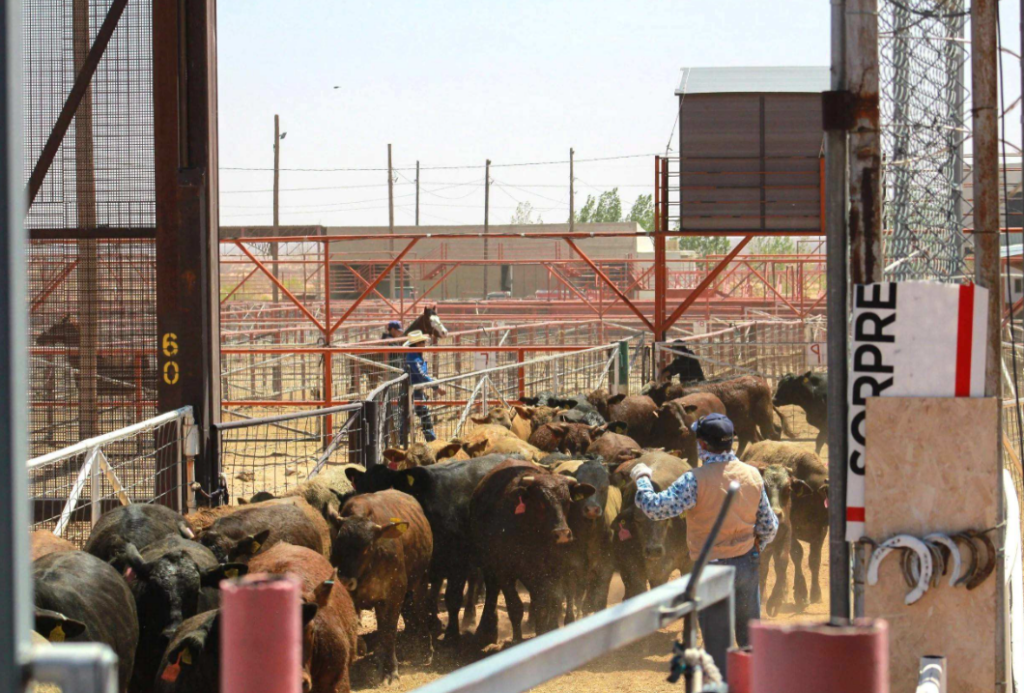
In today’s Beef Buzz, senior farm and ranch broadcaster Ron Hays speaks with Tyler Cozzens of the Livestock Market Information Center about USDA’s plans to begin a phased reopening of the U.S.-Mexico cattle border as New World screwworm cases continue to decline.
New World Screwworm Cases Decline
New World screwworm cases along the southern border appear to be becoming fewer and farther between. USDA’s Screwworm.Gov website shows 30 cases were reported in June when the first cases were found in the US, followed by 14 in July and just one during the first half of August. Livestock producers are hopeful that measures like sterile flies being released are making a difference.
With that trend, USDA is preparing to reopen Mexican cattle imports on a phased basis, beginning with the westernmost border crossing at Douglas, Arizona.
Three Ports Could Reopen
Cozzens says USDA is also taking steps toward reopening the Columbus and Santa Teresa ports in New Mexico. “USDA is planning to open the westernmost border crossing with Mexico, and that is the port of Douglas, Arizona,” Cozzens says.
He notes that every animal entering the U.S. through the ports will receive a full USDA inspection to make sure the cattle show no signs of New World screwworm. USDA has also said the reopening timeline will remain flexible and could be adjusted depending on Mexico’s progress in meeting action-plan milestones. The openings could also be paused if USDA identifies increased risk in Sonora or Chihuahua.
Historical Cattle Flows
Looking at 2023 and 2024, before the border was closed because of New World screwworm concerns, Cozzens says the three ports represented a significant flow of cattle into the United States. At Douglas, Arizona, approximately 180,000 to 200,000 head came through annually. Columbus, New Mexico, saw roughly 135,000 to 140,000 head, while Santa Teresa was by far the largest of the three.
“Now Santa Teresa is hands down the largest port where we saw most cattle come through a couple of years ago,” Cozzens says. “We were seeing potentially 532, about half a million head of cattle come through that one port, Santa Teresa, New Mexico.”
A Potential 16,000 Head Per Week
Cozzens says those historical numbers provide a reference point for what cattle imports could eventually look like once the ports fully reopen. On average, Douglas handled about 3,000 to 4,000 head per week, Columbus saw roughly 2,500 to 3,000 head, and Santa Teresa averaged about 10,000 head per week.
“If we focus just on Douglas and Columbus and Santa Teresa, we could potentially be seeing about 16,000 head on a weekly basis on a normal year,” Cozzens says.
However, he cautions that imports are unlikely to immediately return to those levels. “Now, will we see that sort of ramp up that quickly? Probably not,” Cozzens says. “We’ll probably see more of a phased in approach here.”
Producers Will Need Time to Adjust
Cozzens says one of the biggest factors to watch will be how quickly Mexican producers can redirect cattle from domestic markets toward U.S. export channels while meeting the new health protocols. “A key with this will be how quickly the Mexican producers can pivot and divert cattle supplies from their domestic supply chains and position those cattle to then be shipped into the U.S.,” Cozzens says.
He adds that weekly import numbers will be an important indicator of how quickly cattle supplies begin moving north. “Watching kind of those weekly flow of cattle imports from Mexico will kind of be that gauge that we need to look for to see the potential cattle numbers that we might see placed into feedlots,” Cozzens says.
Where Will the Cattle Go?
As Mexican cattle begin returning to the U.S., Cozzens says Texas and Arizona will likely receive the majority of the animals initially, although some could eventually move farther north. “Likely these cattle will end up being placed in feedlots located in Texas or potentially Arizona, or possibly even Oklahoma or Kansas,” Cozzens says. “But in the near term, Texas and Arizona will likely be the states that will see a majority of the cattle imported.”
USDA is set to begin allowing Mexican cattle back into the United States on August 24, with the phased reopening starting at Douglas, Arizona.
The Beef Buzz is a regular feature heard on radio stations around the region on the Radio Oklahoma Ag Network and is a regular audio feature found on this website as well. Click on the LISTEN BAR above for today’s show and check out our archives for older Beef Buzz shows covering the gamut of the beef cattle industry today.







