

As Mark Johnson discussed in his article on August 3, early weaning substantially reduces the nutrient requirements of the cow and forage demand during drought or periods of limited pasture. Once the decision to early wean has been made, however, the focus needs to shift to the calf. These calves are younger, lighter and have different nutritional and management needs than the 500- to 600-pound calves we normally wean in the fall.
Calves can be successfully weaned at 45 to 60 days of age. For most spring-calving herds considering early weaning during late summer, calves will be 3 to 5 months old and may weigh 300 to 400 pounds. At this age, calves are fully capable of consuming and utilizing a high-quality diet. The challenge is making the transition from milk and forage to a prepared diet as smooth as possible.
Young calves are efficient
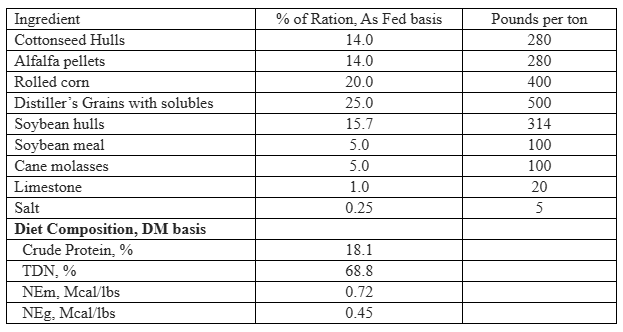
One advantage of managing an early-weaned calf is its excellent feed efficiency. Lightweight calves grown in dry lot on the diet below can be expected to need only 4 to 5 pounds of feed per pound of gain when properly managed. Depending on frame size and growth potential, growing diets can be formulated for gains of 2 to 2.5 pounds per day without adding excessive fat cover.
A 300- to 400-pound calf can consume up to 3% of its body weight in dry matter daily once it is fully adapted to the diet. Because feed intake is relatively low while requirements for muscle and skeletal growth are high, these diets need to be nutrient dense. Calves weighing less than 400 pounds require diets containing 18% crude protein on a dry matter basis, compared to 15% crude protein for heavier conventionally weaned calves. We should also provide plenty of high quality clean and palatable hay free-choice.
The objective is not to feed these calves like finishing cattle. They need a highly palatable growing diet containing adequate protein, energy, minerals and effective fiber.
An example diet for lightweight early-weaned calves is shown below. This is only an example; producers should work with their county Extension educator, nutritionist or feed supplier to develop a ration using palatable feeds that are locally available and economical.
The first few days are critical
Getting calves to eat and drink quickly is more important than trying to maximize gain or least cost feeding immediately after weaning. Feed should be fresh, palatable and easy for calves to find. Good-quality hay helps attract calves to the bunk, and clean, readily accessible water is essential. Avoid dusty, stale, or fermented feeds such as silage during early weaning.
Reduce stress at weaning
Early weaning is already a major change for a calf. Whenever possible, avoid combining weaning with other stressful events, such as transportation long distances, castration, and dehorning.
Fenceline weaning can be particularly useful because calves maintain visual and limited physical contact with their dams while learning their new routine. Keeping early-weaned calves at the ranch also avoids adding transportation, commingling and a completely unfamiliar environment at the same time they are adjusting to weaning. Calves should also be familiar with people, feed bunks and water sources before separation from their dams whenever practical.
Think about marketing and management before weaning
Before pulling calves off the cows, producers should know what they are going to do with them. Early weaning does not automatically mean calves need to be sold immediately.
Calves can be retained and grown to a more traditional marketing weight by grazing on high-quality forage when it becomes available or growing in dry lot on a properly formulated ration. With efficient feed conversion, retaining early-weaned calves may be an attractive alternative when selling very lightweight calves. Early weaning can be an extremely useful management tool, particularly when forage is limited. It is key to recognize that removing the calf from the cow is only the first step.
Dr. Mark Johnson discussed the benefits of early weaning and considerations for cattle operations on SunUpTV from August 8, 2026 https://www.youtube.com/watch?v=YhnLjZzv5JM
Source:
David Lalman. The use of early weaning in practical cattle management. Fact Sheet AFS-3278 https://extension.okstate.edu/fact-sheets/the-use-of-early-weaning-in-practical-cattle-management







