Livestock Risk Protection (LRP) has found its place as a price risk management tool for the Oklahoma cattle business. For the data discussed, 2026 refers to policies initiated from 7/1/2025 to 6/30/26. The previous year’s data works on the same calendar for their respective years.
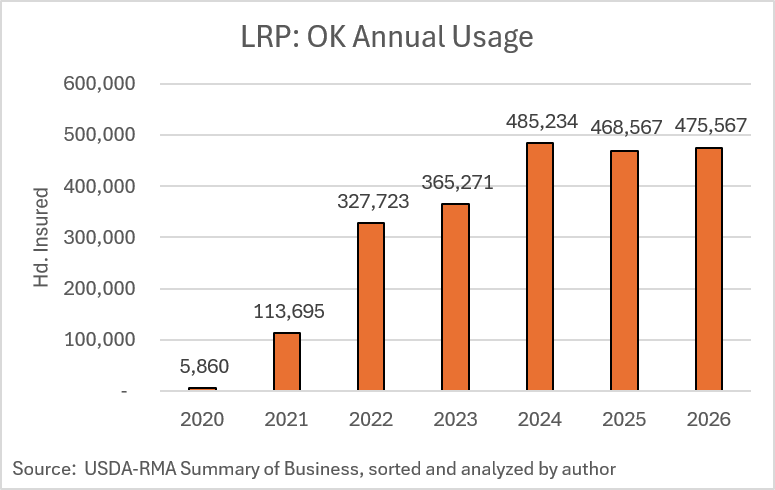
There were 475,567 head of cattle in Oklahoma were price protected with LRP policies initiated in 2026. LRP usage in Oklahoma has leveled off at just under half a million head annually over the past three years. While LRP has existed since the early 2000s, the adoption was minimal. However, usage has grown rapidly since 2020 when only 5,860 head were covered. This is likely a reflection of two issues. In 2020 a series of changes were made to increase the usability and affordability of LRP. This, combined with the stronger cattle prices in recent years, has created an environment for LRP to gain footing with producers.
The most popular application of LRP has been in Weight 2 Steers and Heifers (600-1,000 lbs.). This category made up almost 85% of cattle covered in OK. The Unborn Steers & Heifers and Weight 1 (up to 600lbs.) categories follow distantly with 6.13% and 5.47% respectively. This highlights two growth areas where LRP could benefit producers more. The Unborn Steer & Heifer option is viable to reduce the price risk when buying or developing bred females in our higher price level environment. The Weight 1 option fits well in the cow-calf sector where producers are selling at weaning.
Two last notes regarding coverage level and length of coverage.
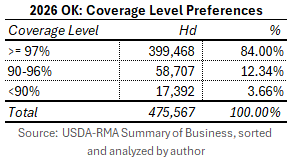
Oklahoma producers that are implementing LRP generally select high levels of coverage. In 2026, 84% of insured cattle were covered at a level at or above 97% of the Expected End Value. Only 3.66% of cattle were insured at a level under 90%. Additionally, shorter term policies are more common than longer term selections.
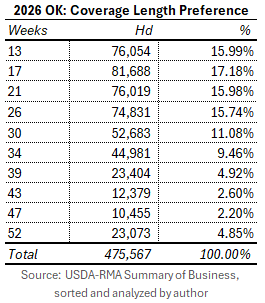
One of LRP’s biggest strengths is that it is adaptable to almost every beef cattle business in Oklahoma. Implementing LRP can eliminate a portion of the downside price risk that is lurking in the background and let us get the most out of our current markets.
Data is from the USDA-RMA Summary of Business which can be found at https://www.rma.usda.gov/tools-reports/summary-of-business.