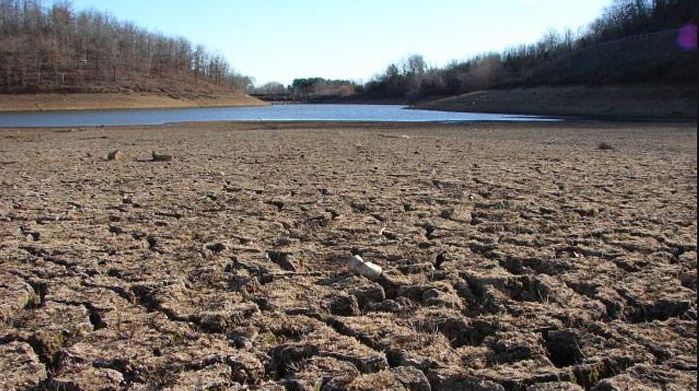
Summer has been a challenge in Oklahoma and numerous other locations. The Stillwater Mesonet site has posted a total of 27 days of temperature in excess of 100 degrees in July and August. The current forecast shows the first seven days of September will continue above 100 degrees. Precipitation in July and August totaled 5.52 inches with 79 percent occurring in three events on July 4 and August 17 and 22.
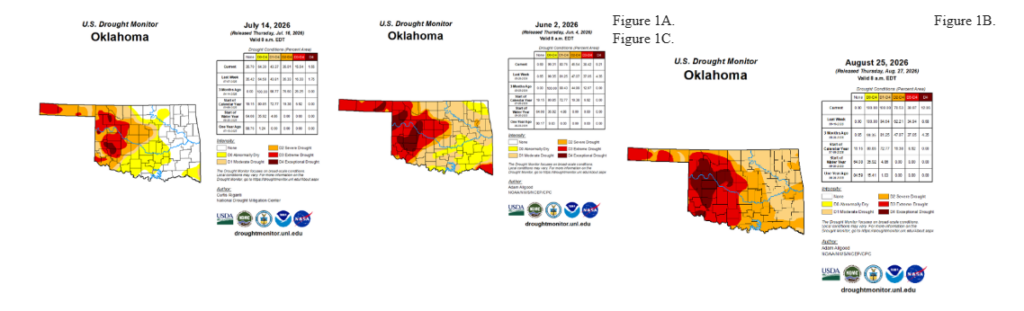
Oklahoma drought conditions were poor early in the year, with the worst point in early June (Figure 1A), followed by the eastern half of the state seeing significant improvement until mid-July (Figure 1B), then the entire state saw worsening conditions that continue (Figure 1C). Current drought conditions are at the most severe level since February of 2023.
Pasture and range conditions in Oklahoma followed a similar pattern with the percentage poor to very poor decreasing from 33 percent in early May to 28 percent in mid-June before increasing to a current level of 58 percent of pastures and ranges rated poor to very poor. Typically, moving into September, there is much interest in planting some early wheat for potential grazing. The current dry conditions and warm soil temperatures make wheat planting unlikely thus far.
Adverse weather conditions combined with a barrage of news and uncertainty are keeping cattle markets down for the time being. Fed and feeder cattle prices will likely recover significantly if politicians will shut up and stop proposing actions that will not help cattle producers or beef consumers, in either the short run or the long run. Ever tighter cattle supplies and continued strong beef demand will reassert market fundamentals at some point. The August Cattle on Feed report showed historically low feedlot placements and marketings which will decrease further going forward. In Oklahoma, auction volumes decreased 31.7 percent from mid-July through the end of August, partly because of hot weather and weak cattle prices, and partly because the cattle are simply not there. Despite limited signs of heifer retention, poor production conditions and tremendous uncertainty due to a whirlwind of political rhetoric and industry dynamics suggest that no herd rebuilding is likely for the foreseeable future. Probably the best we can hope for is data that confirms that the liquidation has stopped. And that is by no means certain.