Increasing the ownership period of calves will help you capture more of their true value. This can either be for the good or the bad, depending on the quality of your cattle.
Kansas State University and Merck Animal Health put together an analysis of 15,287 Superior Livestock Auction lots sold in 2021 and 2022 containing more than 2.5 million calves. The average lot contained 168 head, averaged 559 pounds, and brought $181/cwt. Steers brought an average of averaged $19.26/cwt above the base, heifers and bulls were discounted. Brahman-influenced calves were discounted $7.43/cwt nationally but only $1.56/cwt in the Southern Plains, illustrating that environmental adaptation may be valued differently depending on where cattle are marketed.
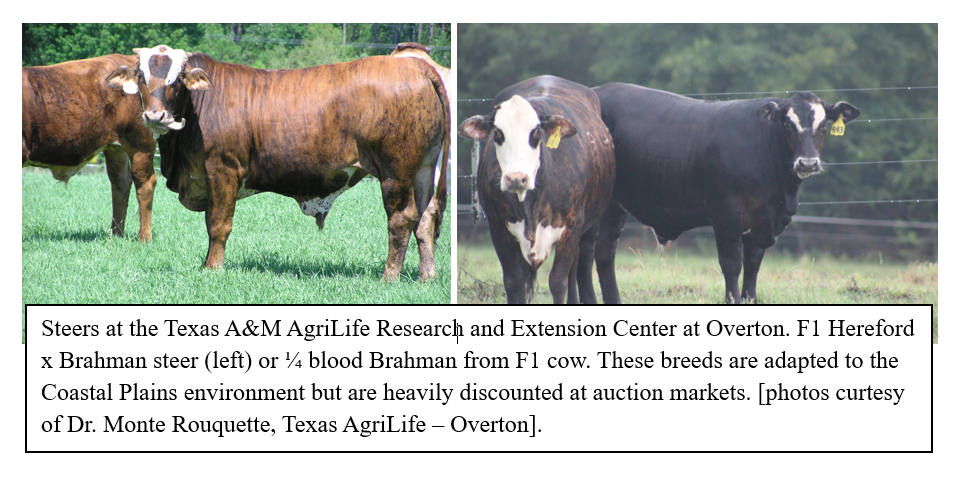
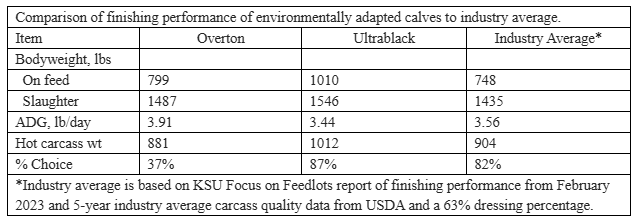
Brahman breeding is essential to match cows to the environment, they are known for heat and insect tolerance and provide hybrid vigor to crossbreeding programs. An example of selecting cattle for adaptation to the environment but getting discounted at the auction market is the herds at the Texas AgriLife Research and Extension Center at Overton. Over the last 11 years, these calves averaged weaning weight of 681 from 1274-pound average cow with a weaning weight ratio of 0.53. Yet, auction market evaluations show discounts for striped or spotted hides or markings up to $26.42/cwt. The black hided Simental x Hereford x Brahman calves still receive the “Brahman discount”. For these steers out of Overton, stocker gains on winter pasture were 3.5 pounds per day, while summer gains on bermudagrass were 2 pounds per day. Finishing performance was equally impressive on these cattle. Steers from Overton came into the feedlot averaging 799 pounds and were harvested at 1487 in 175 days with gains averaging over 3.9 pounds per day. These steers only averaged 37% Choice quality grade (Table 1) so marketing in the live market rather than on a carcass grid is advisable.
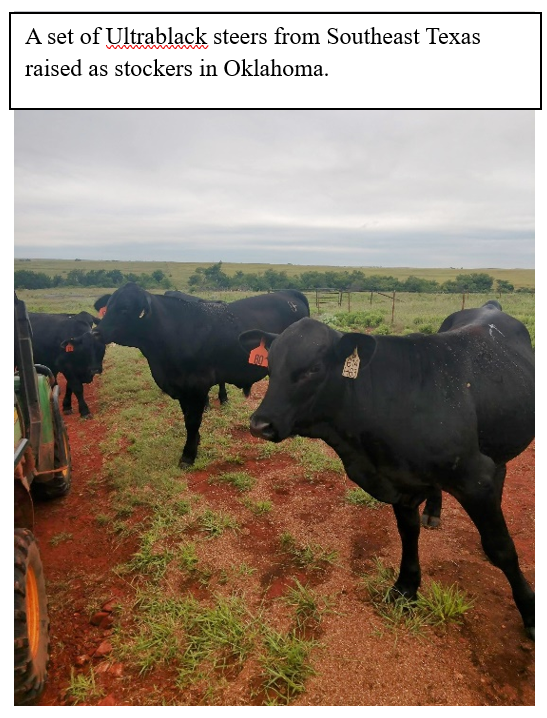
Another example we can use is the set of Ultrablack steers in the picture below. These steers were purchased out of Southeast Texas and transported to Oklahoma for research in both Eastern and western Oklahoma. The discounts were not as high for these black hided steers, but the Brahman discount is still in place.
The Ultrablack steers gained an average of 2.25 pounds per day while grazing summer pasture in Oklahoma. These steers were finished in a commercial feedyard in the fall and winter of 2021-2022. They entered the feedyard at 1010 pounds and weighed 1546 pounds after 167 days with gains averaging 3.4 pounds per day. These steers were over 87% Choice.
From the Table below, we can see that the tropically adapted cattle performed better than the industry average in some factors but not all. The Ultrablack steers gained exceptionally well on pasture but because they got so big on grass had slightly lower performance than industry average during finishing. They did produce a high percentage of Choice and better carcasses. The steers from the Overton herd gained well on grass and performed exceptionally well in the feedlot, but did not have many high quality carcasses. Understanding when and where to market cattle is important. The cattle from Overton should be sold live basis after finishing, the high carcass quality from the Ultrablack steers give premiums when marketed on a carcass grid.
To market your calves effectively, you need to know their potential. This may be better – or worse – than what buyers recognize at the sale barn. Retaining ownership beyond weaning gives you the opportunity to capture the value of superior performance, but it also means bearing the cost when cattle fall short. The goal is to match your marketing strategy to what your calves can deliver.