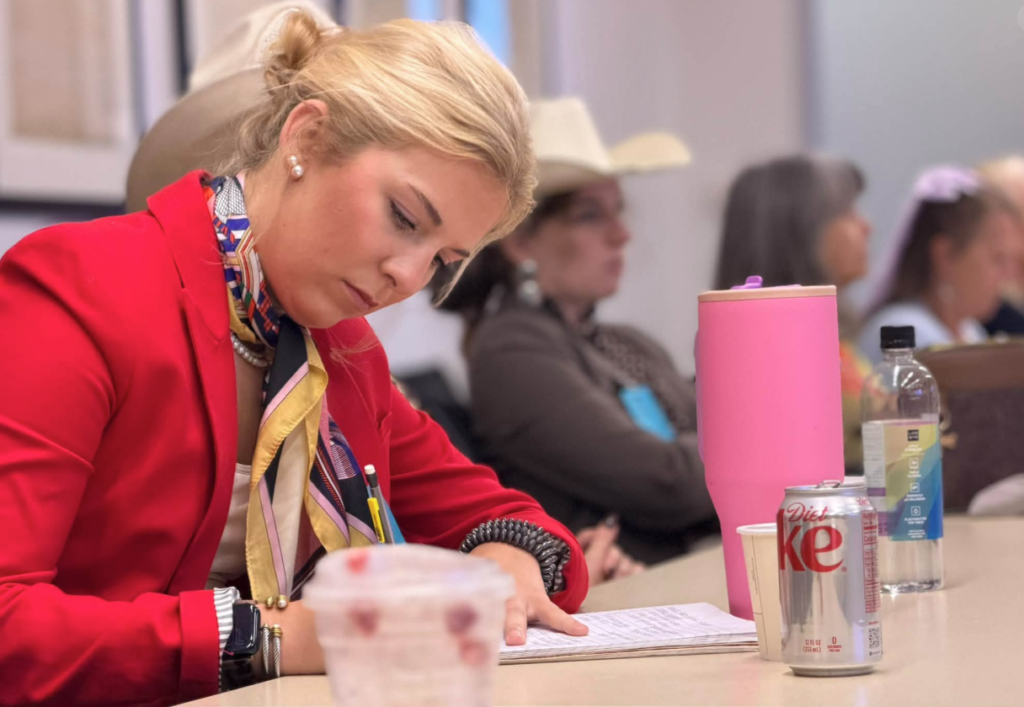
ANCW Beef Ambassador Haley Bryand is using her background in the beef cattle industry to educate consumers, advocate for producers and help shape the future of agriculture. A senior at Texas A&M University, Bryand grew up on her family’s cow-calf operation in East Texas and is spending the next year representing the beef industry through the American National CattleWomen’s Beef Ambassador program.
Bryand spoke with Associate Farm Reporter Carli Davenport about her agricultural roots, her experience advocating for cattle producers in Washington, D.C., and her goals for connecting consumers with the beef industry.
Growing Up in the Beef Cattle Industry
Bryand is from Overton, Texas, where she developed her passion for agriculture through her family’s cattle operation. “I’m from a very small town in East Texas called Overton, Texas. That’s where my passion for the beef cattle industry started,” Bryand said. “My parents and I, we have a cow-calf operation there. We raise registered Simbrah heifers as well as some of the commercial side as well.”
Growing up around cattle has helped shape Bryand’s interests and her plans for the future. She is currently in her senior year at Texas A&M University, where she is studying animal science with a minor in legal foundations through political science. “I really just want to be able to make an impact on the people around me and be able to be immersed in agriculture,” Bryand said. She explained that those goals helped lead her to pursue her studies in both animal science and political science.
Her academic background also complements her work as a beef ambassador, giving her opportunities to engage with both the production side of agriculture and the policies that affect the industry.
Three Main Goals for the Beef Ambassador Program
Bryand’s term as a national beef ambassador began in September and will continue for a full year. During that time, she and the other ambassadors will focus on advocacy, education and legislative engagement. “The Beef Ambassador program has already been such a rewarding experience for me,” Bryand said.
She explained that one of the program’s primary goals is to advocate for the beef industry while educating people in their local communities, at school and across the country. “Ultimately, that’s one of our huge goals.” Bryand said.
The ambassadors are also working to make an impact through legislation, including meeting with policymakers to discuss issues affecting cattle producers. “Consumer education is essential,” Bryand said. She added that the program wants to ensure the next generation of students and beef advocates understand the issues facing the industry.
Bringing Cattle Producers’ Perspectives to Washington, D.C.
One of Bryand’s early experiences as an ambassador was traveling to Washington, D.C., alongside members of the American National CattleWomen. During the trip, the group met with congressional offices, House representatives and senators to discuss issues affecting cattle producers in their respective regions and throughout the United States. “What we did is really take the time to meet with our local offices, House representatives, senators, and just take the time to share with them the specific beef cattle issues facing our areas and the United States as a whole,” Bryand said.
The group also met with agencies, including the U.S. Department of Agriculture and the U.S. Fish and Wildlife Service, to discuss issues relevant to the beef cattle industry. “We’re constantly facing so many issues, and so really making sure they’re aware of those is important,” Bryand said. “And just bringing in that producer perspective.”
The meetings gave Bryand an opportunity to connect the experiences of farmers and ranchers at home with the policymakers making decisions in the nation’s capital. She said one of the most interesting parts of the trip was realizing that some representatives were not fully aware of the challenges facing producers in her region. “I was most surprised by how some of our representatives didn’t fully know what was going on in our areas,” Bryand said.
That realization opened the door for her to share more about her own family’s operation and the challenges facing other producers in her community. “It really opened up an opportunity for me to talk about my personal operation and also those around me, and just kind of some of the specific issues, and also thank them for the work that they’ve done for us so far,” Bryand said.
She said being able to share that information and help policymakers better understand agriculture was a particularly meaningful part of the experience.
Bryand Says Agriculture Has a Place for Everyone
While Bryand has spent much of her life around cattle, she recognizes that many consumers may not have the same connection to agriculture. She believes helping people understand the industry starts with highlighting the community and traditions that support cattle production. “For me, agriculture and specifically the beef cattle industry all starts with my roots and just the traditions that come with raising our beef cattle and just being involved with my family operation,” Bryand said.
When asked what message she would share with someone unfamiliar with agriculture, Bryand pointed to the strength of the cattle industry’s community. “If I was going to share one message, it would be community, and that is the thing that I think really holds our producers together in our industry,” she said.
Bryand encouraged consumers to learn more about cattle production and find ways to participate in agriculture, even if they do not work directly on a farm or ranch. “I would encourage everyone to get involved and learn more because I think that there’s something that everybody can do to impact the industry,” Bryand said.
She also emphasized the importance of continuing to learn about the industry and using reliable resources to find ways to contribute. “Continue to learn more, we offer resources, and so whatever you might be interested in, whatever you hope to do, the beef cattle industry and ultimately agriculture as a whole has a place for everyone,” Bryand said.
She added that agriculture is connected to everyday life, making consumer understanding important whether someone has a direct connection to farming and ranching or not.
Regional Meetings and National Events Ahead
Bryand and the other ambassadors have several opportunities to continue their outreach throughout the remainder of their terms. Bryand said her regional meeting is scheduled for October and will include participants from Texas, Oklahoma and Arkansas. The other ambassadors will also attend regional meetings in their respective areas.
The group is expected to reunite in February for the National Cattlemen’s Beef Association business meeting in Nashville, Tennessee.
Bryand said the meeting will provide an opportunity to connect with other collegiate agriculture groups, including other cattlewomen groups. “That’ll be a really unique opportunity for us to connect with other collegiates and ultimately other producers in the industry as well.”
Through those events, Bryand hopes to continue building relationships, educating consumers and representing the cattle producers who make the beef industry possible.