
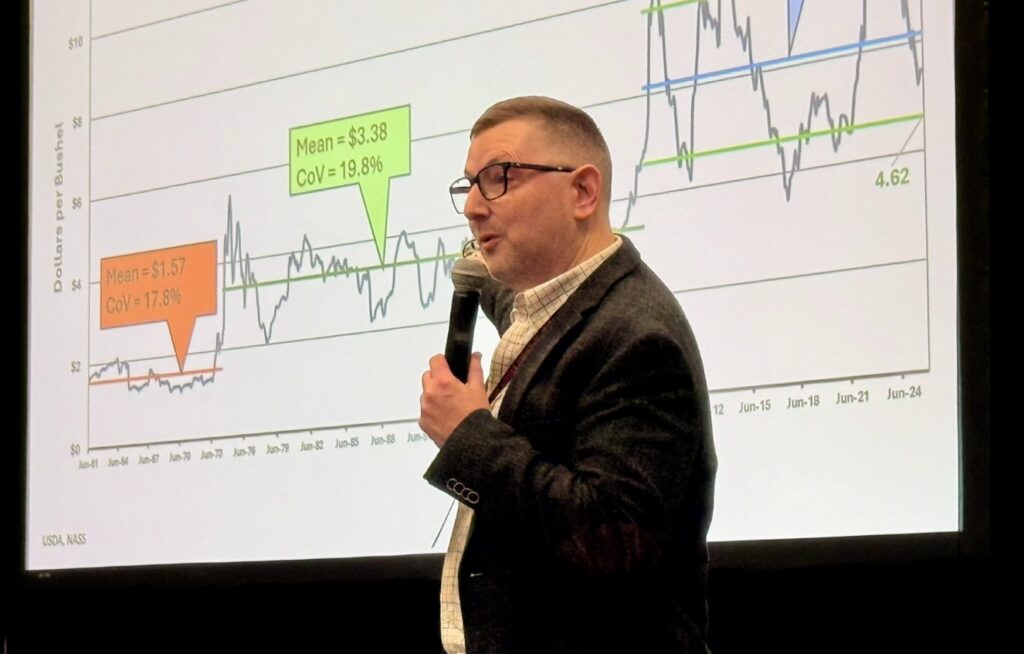
In this week’s crop marketing update, Radio Oklahoma Ag Network Farm Director KC Sheperd sat down with Oklahoma State University crop marketing specialist Dr. Todd Hubbs to break down the heavy downward pressure across the commodity board, markets, the state of Oklahoma’s winter wheat crop, and the demand drivers to monitor heading into the winter.
“They’re bad. We’re getting some real downward pressure,” Hubbs said when asked about the week’s commodity trade. “A lot of money’s leaving our commodity markets, particularly in wheat. We’ve seen the July ’27 price drive down below $6.60.”
Wheat: Black Sea Flow and Southern Plains Soil Moisture
Hubbs pointed out that despite smaller Hard Red Winter (HRW) wheat production domestically and a reduced crop across the European Union, global pricing continues to feel heavy seasonal and speculative fund pressure.
“We keep getting noise out of the Black Sea that Russia is moving wheat and grain,” Hubbs explained. “It was just a constriction, not a contraction—the stuff was all still there and waiting to move, and it seems like it is. We’ve seen purchases of Russian wheat out of the Baltic to numerous locations, particularly North Africa, parts of Southern Africa, and the Middle East. Shipping costs are so high it’s hard for us to compete in those markets right now where the price is.”
On the domestic side, fall planting and replanting across Oklahoma are heavily dictated by upcoming moisture prospects.
“We’re expecting a bunch of rain coming through the weekend, hopefully it shows up,” Hubbs noted. “With the climate forecasts, we’re supposed to get a decent amount of rain and it may be a little bit warmer here in the Southern Plains, so maybe we can get some good stands established and have a good crop going when we get into next spring.”
For producers weighing sales triggers, Hubbs advised patience rather than chasing market lows:
- Cash Sales: Hubbs recommends a “wait-and-see” approach rather than selling at the bottom, noting that futures are approaching levels that should begin flattening out.
- Basis Levels: Local basis has remained steady around the minus 50-cent range across Oklahoma, constrained primarily by elevated transportation costs and sluggish port movement.
- Crop Insurance Anchor: Producers with coverage are reminded that the projected price safety net is locked in at $8.11, providing crucial marketing support.
Row Crops: Stable Basis and South American Weather Watch
Turning to corn and soybeans as harvest wraps up, Hubbs anticipates relatively range-bound basis levels in the near term.
“I think you’re just going to see some stabilization in basis because I think demand is going to be good at these levels,” Hubbs said. “We’re not moving the [corn] exports like a lot of people think, but we are moving soybeans at a pretty healthy clip.”
Key row-crop dynamics Hubbs is monitoring include:
- Ethanol & Milo Spread: Corn prices across Oklahoma are hovering between $4.50 and $4.55. While strong ethanol margins support grind demand, China has bought very little grain sorghum, maintaining a wide spread between corn and milo in the Southern Plains.
- Soybean Crush: Domestic crush margins remain robust, buoyed by biofuel demand for soybean oil, even as export demand for soybean meal starts off moderately light in the young marketing year.
- South American El Niño Risk: On the global balance sheet, Hubbs is closely tracking rainfall in northern Brazil. An active El Niño pattern typically creates drier-than-normal conditions for Brazil’s primary soybean and second-crop safrinha corn production windows. Any production cutbacks out of South America next year could provide critical support to domestic balance sheets.
When asked how many months it might take before he can discuss grain markets without a heavy sigh, Hubbs concluded with a laugh: “It could be a while.”