

In his Latest newsletter, OSU crop marketing specialist Todd Hubbs says Grain and oilseed prices reacted to USDA’s reports last week and settled into narrow ranges for the remainder of the week except for wheat prices. Geopolitical events remain key market drivers with crop outcomes in South America coming to the fore over the next quarter.
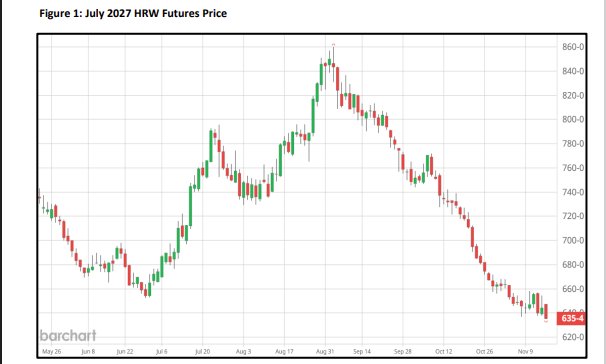
Wheat Market Outlook: December HRW future prices moved another nine cents lower on Monday to close at $6.19 per bushel. Cash price stayed at a -55 to -70 basis across the state on prompt delivery. As shown in Figure 1, the July 2027 price closed at $6.35 per bushel, down eight cents on the day. Since September 1, July futures have lost over two dollars on weak export pace, optimism over Black Sea negotiations, good crop potential in the Southern Hemisphere, and positive expectations for the U.S. winter wheat crop. The prospect of the July contract nearing a bottom rest on the previously mentioned topics.
Next year’s winter wheat crop has caught up on planting pace for this point in the year. USDA placed winter wheat planting at 92 percent for the week ending November 15, 2 percent below the five-year pace. At 84 percent planted, Oklahoma trails the average by 8 percent. Notwithstanding slower planting early this fall, July HRW prices continue to indicate that the market expects a good crop this marketing year.
Speculation on winter wheat acreage points toward higher acreage than last year given the prospective crop insurance price and conditions during the planting window across the Southern Plains. My models place Oklahoma acreage near 4.15 million acres, up from last year’s 4.05 million acres. Winter wheat acreage near 33 million acres for the U.S. seems feasible, up from 31.2 million acres last year. The range around these forecasts is quite large and the initial estimate will come from the USDA’s Winter Wheat Seedings report due out on January 12.
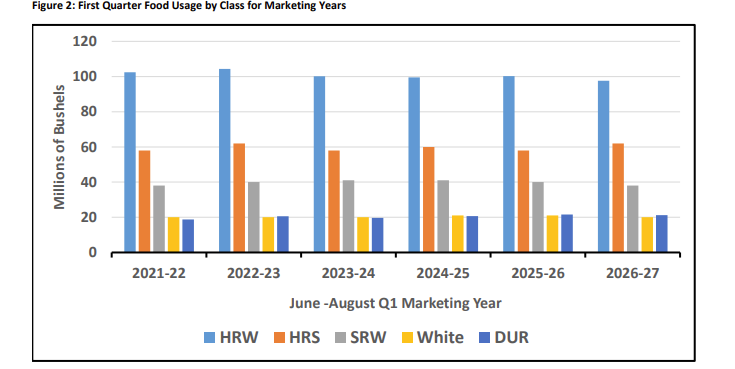
On the demand side, USDA lowered food usage by three million bushels in the last WASDE report. As shown in Figure 2, the first quarter of the marketing year came in lower from last year for hard red winter wheat and food usage was lowered one million bushels in the forecast for the HRW 2026-27 marketing year. Food usage remains flat for wheat in the U.S. with small deviations from year to year. Exports remain a key driver for wheat prices.
HRW exports sales remain behind pace to hit USDAs recently lowered 165 million bushels projection. While export sales ticked up over the last three weeks to average 3 million bushels per week, net sales need to total 2.5 million bushels per week for the remainder of the marketing year. Total commitments sit at 93 million bushels with outstanding sales making up 27 million bushels of the total through November 5. U.S. Gulf HRW export price has fallen to $7.74 cents per bushel at the end of last week, down from $8.64 on October 16. Gulf HRW prices reflect the competitive nature of world prices and increased exports are necessary to halt the price decline seen over the last three months. Southern Hemisphere crops were increased in the latest WASDE for Argentina and Australia. Argentinian wheat looks to be a competitive force over the near term and maintain downward pressure on export prices.
Soybean Market Outlook: January soybean future price closed on Monday at $12.29 per bushel, dropping a little over two cents from the open. Futures prices jumped almost forty cents after the USDA report releases last week. Nearby futures settled in a narrow band between $12.20 – $12.35 after the reports. Price moves over the near-term turn toward South American crop potential as we enter December. An uptick in volatility is a distinct possibility. Cash prices in Oklahoma varied between $11.65 – $11.85. The harvest crop insurance price, based on the November futures contract through October, is $12.63 per bushel, up from the $11.09 projected price for 2026.
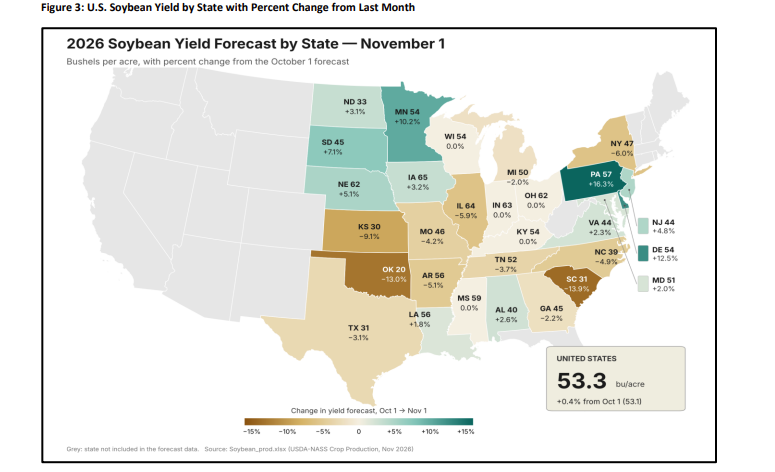
Soybean harvest is complete across the country. U.S. percent harvested sits at 96 percent through November 15 with a scattering of states still lagging the five-year average. USDA’s Crop Production report estimated U.S. soybean yield at 53.3 bushels per acre, up 0.2 bushels from October. As shown in Figure 3, the Northern Plains saw yield increases across the board with lower yield forecasts for Illinois and the Southern Plains. Lower yield in Kansas, Oklahoma, and Texas is not surprising given the conditions this crop year. A final yield estimate will be produced in January’s Crop Production report. Expectation should not focus on the major change in soybean production in January.
The strong price moves higher related to increased export potential for the 2026-27 marketing year. USDA raised soybean exports by 25 million bushels to 1.72 billion bushels. Export sales data place marketing year exports at 67 percent of the current forecast, ten percent above the five-year average and helped to support the move higher on exports. Chinese total commitments sit at 611 million bushels. Commitments total 66 percent of the 25 million metric tons agreed to between Trump and Xi in a previous meeting. My expectations remain fixed with China not surpassing the agreed upon total by a significant margin unless an issue develops with the South American crops. Brazil remains on track for a 6.8-billion-bushel crop and U.S. soybean exports fading in the second half of the marketing year.
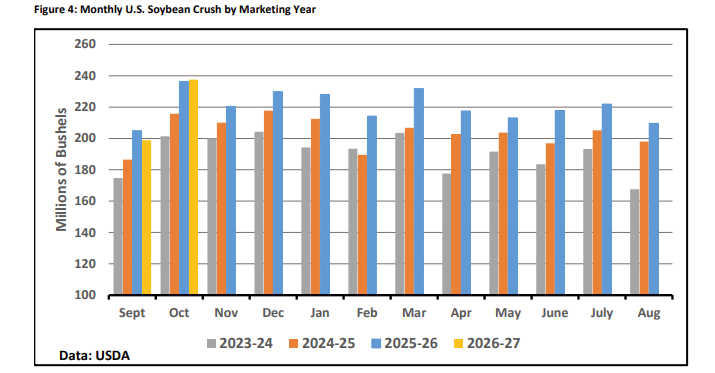
Crush forecast stayed at 2.78 billion bushels. The crush projection is reachable given crush capacity and strong margins. As seen in Figure 4, NOPA crush came in Monday morning and registered a record level of 234.2 million bushels for any month on the historical record. At that level of crush, NASS crush looks set to be 237.5 million bushels for the month of October. To hit USDA’s projection, monthly crush needs to average 234 million bushels a month or approximately 7.7 million bushels per day for the remainder of the marketing year.
Soybean meal demand in export markets needs to pick up, but an expectation of strong meal demand remains in place. Soybean oil demand for biofuels is expected to remain strong given the requirements necessary to meet the 2027 renewable volume obligations. A significant amount of uncertainty is present due to political machinations surrounding the Renewable Fuels Standard. A detailed discussion of potential RFS demand and the uncertainty around it can be found in the link to this article: Rewriting the RFS Playbook: The Coming Battle over the 2027 Biomass-Based Diesel RVOs.