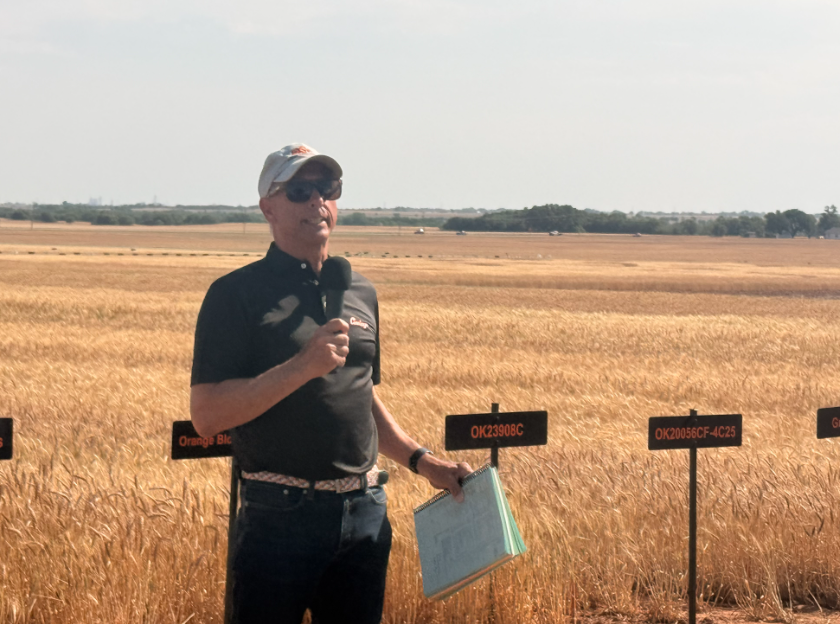
At the recent Lahoma Wheat Field Day, discussions around Oklahoma wheat varieties and disease resistance highlighted both the challenges and opportunities facing producers after one of the toughest growing seasons in recent memory. Speaking with Farm Director KC Sheperd, Oklahoma State University wheat breeder Dr. Brett Carver reflected on the difficult year, promising new varieties, disease pressures, and the future of wheat breeding in Oklahoma.
“Every year is a good learning year,” Carver said. “They’re all different, so we talk a lot about how we tested this line for six years before releasing it. Well, this is the reason why. We just need to make sure we get as many of these types of environments as we can.”
Wyatt Variety Shows Promise Despite Tough Conditions
While drought and disease pressure limited many wheat fields this season, Carver said a few bright spots stood out — including OSU’s newly released wheat variety, Wyatt. “I’m still pretty enthusiastic about Wyatt,” Carver said. “That’s the 20708 that was released by the OSU Ag Research in February.”
Carver said researchers are hoping to have roughly 2,000 bushels available for future distribution, depending on the success of irrigated grow-outs in the Oklahoma Panhandle. “If that goes well, then we’ll have a lot to distribute, and I hope we can distribute across the state,” he said.
Even under harsh drought conditions, Carver believes the variety has strong potential if growers receive timely moisture during key developmental stages. “If we can get that quarter-inch, half-inch in March, when it’s really critical — and of course, half-inch here and there — we don’t need inches,” Carver explained. “Just that little amount at very critical times. I think our producers are going to see a jump up, a tick up in yielding ability, and also keep the crop upright, good standability.”
Regional Partnerships Strengthen Wheat Breeding Efforts
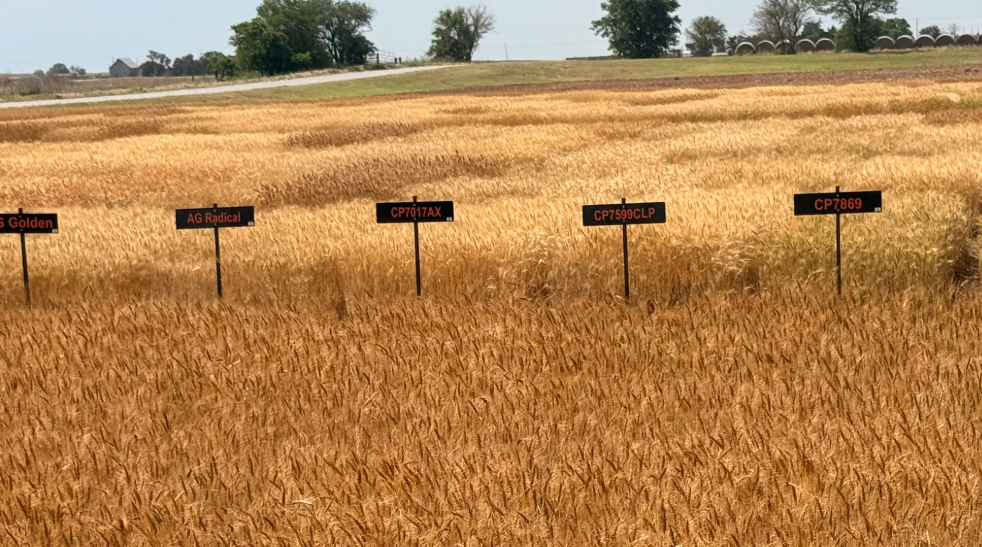
Carver also emphasized the importance of collaboration with neighboring universities and breeding programs, including efforts with Kansas State, Colorado, and Texas researchers. “Extremely important,” Carver said of those partnerships. “I’d like to think that we can operate in a vacuum… just run our own little program here and be just fine. No.”
He explained that sharing germplasm, technology, and breeding resources allows programs across the region to improve wheat development more efficiently. “If we can piggyback off the success of other breeding programs — breeding programs that produce germplasm that is relevant to Oklahoma wheat production —now we have an opportunity to raise our gain,” he said.
“We’re not going to double our yield gains, but we’re going to do something better than 1x,” Carver continued. “We might be able to access certain traits that we just cannot access here.”
Carver added that the collaboration benefits the entire Southern Plains region. “We put that together. That is a breeding program, I think, for the region.”
Wheat Streak Resistance Remains a Major Focus
One of the biggest ongoing priorities for the OSU wheat breeding program remains resistance to wheat streak mosaic and related viruses. “We tried adamantly to not just go after one known gene that might help us in wheat streak,” Carver explained. “I wanted to put a package together.”
That process has been lengthy and difficult, particularly because some resistance traits originated from wild wheat relatives. “That really did take some time, because now you’ve got to assemble the package for the disease, and then you’ve got to assemble the package for the entire background — the agronomics and the quality,” he said.
Carver admitted the process has sometimes been frustrating. “I had to admit that was a little bit frustrating, especially working with genes for wheat streak resistance that came from a wild relative that always amps up the difficulty level,” he said.
Still, he believes the program has turned a corner. “I think we’ve turned a point now,” Carver said. “I think we now have something we can commercialize.”
Disease Pressure Surprised Producers During Drought
Another major topic during the field day was the unusual disease pressure seen during severe drought conditions.
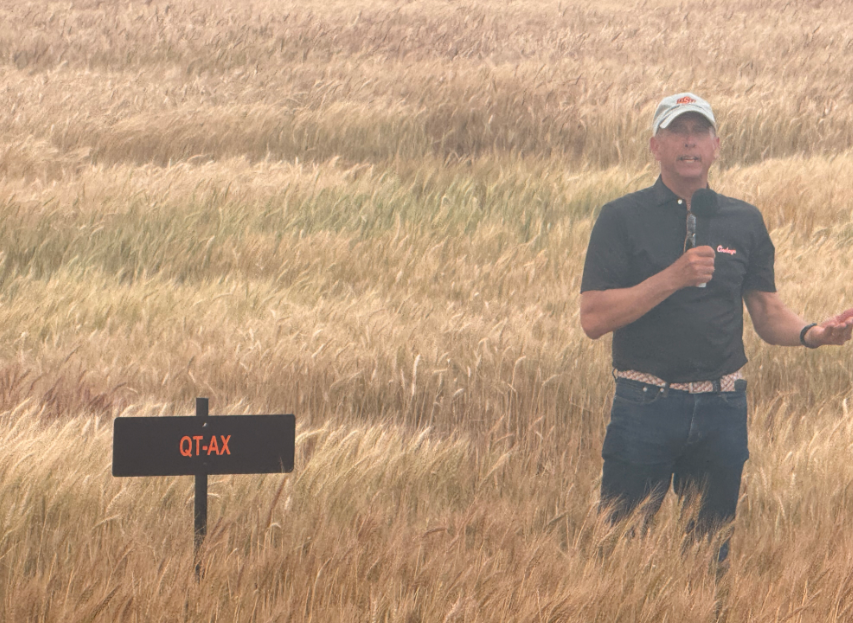
Carver said viral diseases remain especially problematic because they are less dependent on rainfall than many fungal diseases. “The viruses usually play that game with us,” Carver said. “They’re notorious for it.”
He pointed specifically to barley yellow dwarf and wheat streak mosaic as significant issues this season. “I think our crop was significantly impacted by BYD,” he said. “If we didn’t use a seed treatment or if we didn’t use BYD resistance in our varieties, I think there was a penalty there.”
He also discussed leaf rust, calling it “the common cold of wheat” because of how adaptable it is across environments.
Purple Wheat Could Help Connect Consumers to Agriculture
Carver also shared excitement about research involving purple wheat varieties. “I think we’re going to reach directly with the consumer,” Carver said. “I love working with farmers, and we’ll continue to do that, but if you can connect to the consumer, I think now we have an opportunity to not just push wheat onto our plates, but we can pull it.”
Carver believes consumer interest in specialty wheat products could create new opportunities for the industry. “The consumer will do the pulling, and now we give them something to pull on,” he said. “Anthocyanins, colored wheat, is something to pull on.” He added, “I think that’s a great opportunity for our industry as a whole.”
New Funding Brings Major Opportunities for OSU Wheat Research
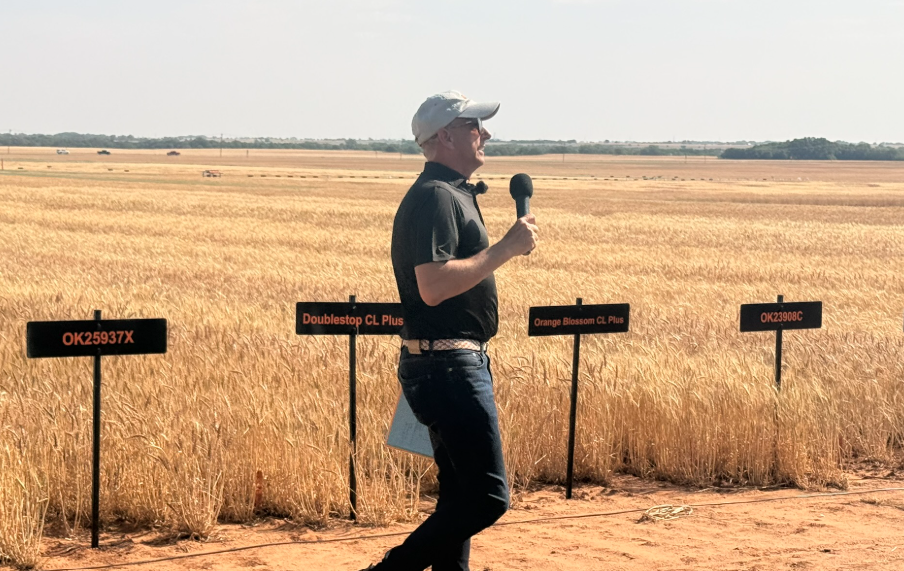
Carver also discussed the impact of a recently announced $40 million investment supporting future research efforts. “First goal is to say thanks,” Carver said. “Very appreciative of this. This is monumental.”
Carver said one of the first priorities will be upgrading aging greenhouse facilities that have become a bottleneck for research progress. “I feel like we are being held back,” he said. “Our greenhouses look like they’re 60 years old, and they’re performing like they are that old.”
Oklahoma Farm Report also recorded Dr. Carver’s complete presentation in the Wheat Fields at Lahoma, where me mentioned specific varieties and traits. You can listen by clicking below:
The threat of wheat streak mosaic virus is not a temporary hurdle for producers, but rather a long-term challenge requiring sophisticated management. In recent field evaluations, researchers emphasized that addressing the disease complex—which often involves both wheat streak mosaic virus and Triticum mosaic virus—is highly complicated, and producers must look beyond simple labels of “resistance” to make informed variety selections.
The Role of Mite Pressure and Environment
Mite pressure plays a critical role in how well a variety performs under disease stress. The timing of curl mite arrival and the duration of their infestation heavily influence final outcomes. For instance, in areas with severe mite infestations, a variety like Showdown—which possesses native tolerance inherited from Jagger—can show drastically different results based on planting dates. When planted late under intense mite pressure, it can be severely hammered, whereas early planting can allow it to handle the pressure successfully, resulting in yield differences of 30 to 40 bushels per acre.
Producers must differentiate among viruses present in their fields and understand the specific genetics of the varieties they choose, particularly when a line relies on a single resistance gene.
Evaluating New Variety Candidates
Several experimental and newly graduating lines demonstrate unique trade-offs between yield, kernel size, and disease packages:
Wyatt: A large-kernel, high-yielding variety that represents a cross of Eastern European and United States genetics (Smith’s Gold). While it offers substantial yield rewards, it possesses weaker disease resistance under severe conditions and requires careful management.
Line -91: A cross of Smith’s Gold by Green Hammer that is currently a few years behind Wyatt in development. It is being evaluated as a potential fit for the southwestern part of the state, offering a strong overall disease package that echoes the historic combination of Showdown and Green Hammer.
Paradox: A high-functionality dough variety that commands a premium price but must be grown separate from commodity wheat.
24OX: A deliberate cross of a Paradox sibling by Showdown, bred to tame some of the extreme dough strength of Paradox while making it more multi-functional for bread baking and higher yielding.
Advancements in Coaxium and Herbicide-Tolerant Lines
The adoption of Coaxium technology continues to progress with the evaluation of several experimental lines aimed at delivering clean fields and improved agronomics:
031, 044, and 055X: These lines are being compared to evaluate yield performance, with the 055X line notably recovering well from a 2X rate of a herbicide stressor during testing.
088X: This line combines the grazeability traits of the 031X line with enhanced baking quality, addressing the wide variation in quality seen across early experimental Coaxium material. It also carries the Uncharted trait for barley yellow dwarf resistance.
116X: A late-planted, acid-soil-tolerant line that combines Baker’s and Uncharted genetics alongside the Coaxium trait.
937X: Unlike the double-haploid lines, this is a conventionally inbred line. Conventionally inbred lines benefit from multiple rounds of herbicide applications across generations, effectively weeding out the more susceptible plants over a three-year period. The 937X stands out as one of the most herbicide-tolerant lines in the breeding program.
Clearfield Choices and Green Hammer Derivatives
In the Clearfield system, Orange Blossom has shown an earlier maturity pattern compared to Double Stop. Double Stop is photoperiod-sensitive (day-length-sensitive), meaning it heads out precisely when it wants to, regardless of temperature, making it consistently later than most varieties. While Double Stop offers reliable protection against stripe rust, Orange Blossom provides outstanding resistance, a trait researchers are actively studying to improve breeding efficiency.
Additionally, three general-purpose lines derived from Green Hammer (62, 109, and 46) are undergoing continued evaluation to find the right balance of yield and disease defense.
The Genetics of Wheat Streak Resistance: WSM1 vs. WSM2
The breeding program utilizes distinct genetic sources to combat the wheat streak mosaic complex, each with clear strengths and limitations:
WSM1 (Breakthrough): Inherited from a wild relative (intermediate wheatgrass), this gene provides robust protection. Developed through a three-way collaboration among K-State, Colorado State, and local selection, Breakthrough carries this gene and has proven well-adapted to the high plains.
WSM2 (Snowmass, Joe): Derived from common wheat, the WSM2 gene performs adequately under low mite pressure as long as only wheat streak mosaic virus is present. However, if Triticum mosaic virus hits the field, WSM2 fails to provide effective defense.
021: This line attempts to bolster WSM2 by pairing it with a curl mite resistance gene. While it provides direct protection against the mite and outpaces standalone WSM2 lines, testing under systematic mite infestations demonstrates it does not achieve the advanced defense level provided by WSM1 alone. It remains under consideration for release in the panhandle and down-state regions.
840 and 338: These lines combine WSM1 with the CMC4 gene, achieving the advanced level of protection researchers have targeted. While the 838 line carries some Overley influence that introduces a slight risk of shattering, the 840 line remains a favorite for its balanced agronomic profile. Both are being tested side-by-side to determine their long-term fitness for down-state and panhandle producers.
Efforts also continue around WSM3, another gene sourced from intermediate wheatgrass. Because it carries significant unwanted genetic “baggage” from its wild relative, geneticists are continually whittling down the chromosome segment to isolate the WSM3 gene cleanly, ensuring that future varieties can utilize it without compromising essential agronomic traits.